
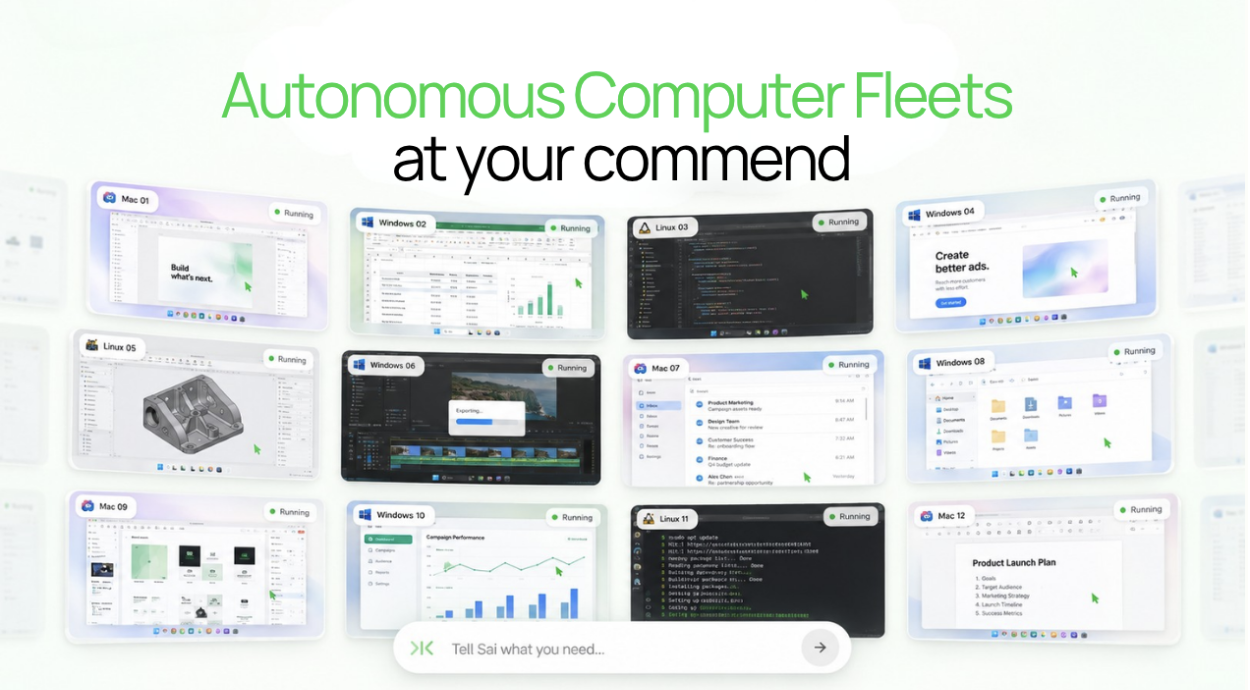
什么是“机器人秘书”?一种能够操控多个自主运行计算机的计算机代理程序。
November 11, 2026
Short answer: An AI sandbox is an isolated environment where an AI model or agent can run code, open files or browse without touching the systems around it. Developers use sandbox AI to run code that a model wrote, to test agents safely, and to give each user a clean, disposable workspace. When the work has to persist, keep logins, or be shared between several agents, a sandbox is usually the wrong shape and a cloud computer for AI agents fits better.
Definition. Sandbox AI means running an AI system inside a sandbox: a restricted environment with its own file system, processes and network rules, separated from the host and from other users. Anything the model does inside, including running untrusted code, stays inside, and the sandbox can be reset or deleted when the task ends.
The three meanings of "AI sandbox"
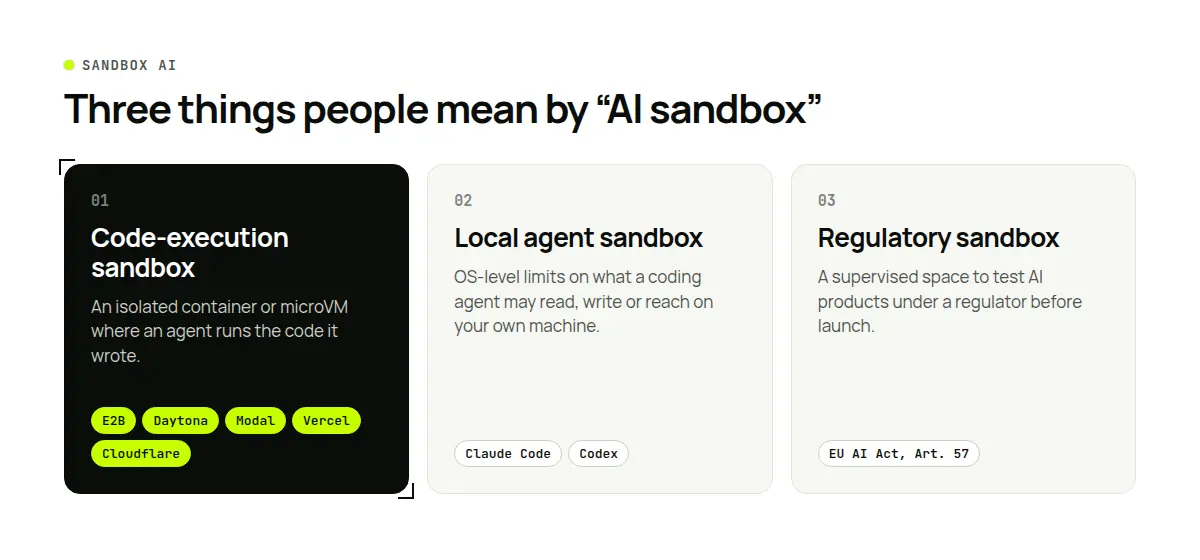
The phrase is used in three different ways. Knowing which one you mean saves a lot of confusion.
| Meaning | What it is | Who uses it | Examples |
|---|---|---|---|
| Code-execution sandbox | An isolated container or microVM where an agent runs code it wrote | Developers building agents and AI apps | E2B, Daytona, Modal Sandboxes, Vercel Sandbox, Cloudflare Sandbox |
| Local agent sandbox | Operating-system limits on what a coding agent may read, write or reach on your own machine | Developers using coding agents | Claude Code sandboxing, Codex sandbox modes |
| Regulatory or learning sandbox | A supervised space to test AI products under a regulator, or to try AI tools safely inside an organisation | Regulators, companies, schools | EU AI Act AI regulatory sandboxes |
The rest of this article is mainly about the first two: the technical sandboxes agents run in.
Why AI agents need sandboxes
A model that only answers questions needs no sandbox. An agent that acts does. Agents run code they generated, install packages, download files and follow links, and any of those can go wrong.
- Untrusted code. Code from a model can delete files, loop forever or leak data. A sandbox contains the damage.
- Prompt injection. A web page or document can carry instructions that hijack the agent; OWASP ranks prompt injection as the top risk for LLM applications. Network and file limits reduce what a hijacked agent can reach.
- Isolation between users. In a product with many users, each session needs its own clean space so one user's data never reaches another's.
- Reproducibility. Starting each run from the same template makes evaluations and tests comparable.
- Clean teardown. When the task ends, the sandbox is deleted and nothing lingers.
How AI sandboxes isolate code
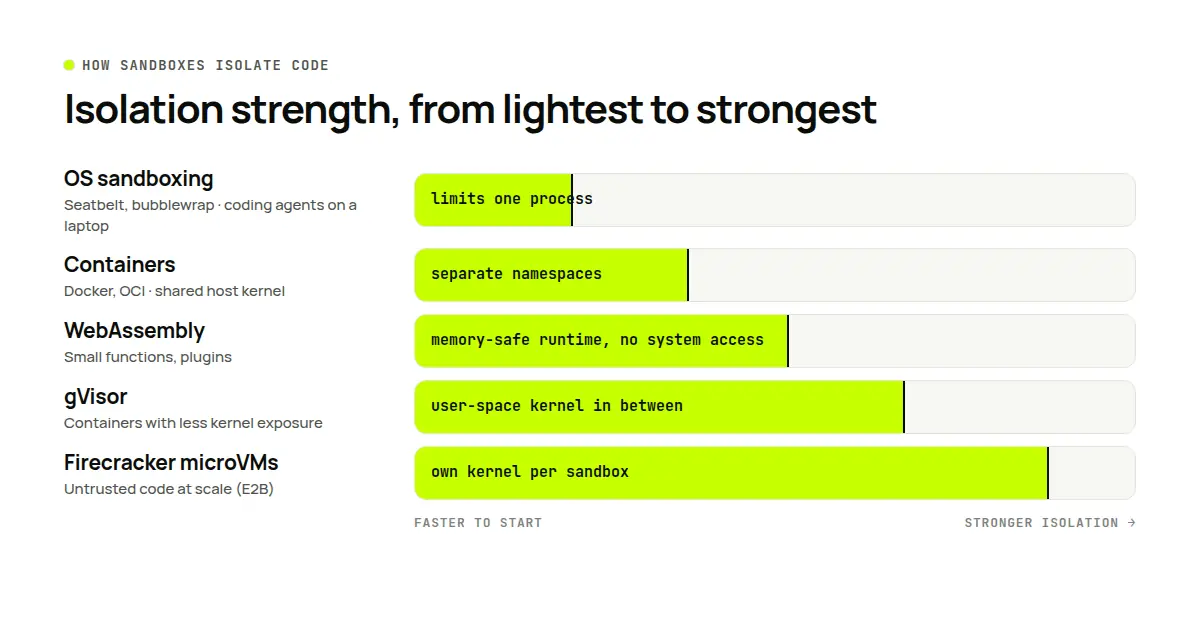
Sandboxes use different isolation layers. Stronger isolation usually costs a little more start-up time.
| Technology | How it isolates | Typical use |
|---|---|---|
| Containers (Docker, OCI) | Shared host kernel, separate namespaces | Fast, lightweight; trusted or semi-trusted code |
| gVisor | A user-space kernel between the container and the host | Containers with a smaller kernel attack surface |
| Firecracker microVMs | A minimal virtual machine per sandbox with its own kernel | Untrusted code at scale |
| WebAssembly | Code runs in a memory-safe runtime with no system access by default | Small functions, plugins |
| OS sandboxing (Seatbelt, bubblewrap) | The operating system limits one process's files and network | Coding agents on your own laptop |
Read more in the Docker container security docs, the gVisor overview, the Firecracker project (used by E2B) and WebAssembly's security model.
Popular AI sandbox platforms
- E2B. Open-source sandboxes on Firecracker microVMs, driven from Python and JavaScript SDKs. A Desktop template adds a Linux desktop for computer use. Runs last up to 24 hours on Pro.
- Daytona. Sandboxes for agents, evaluations and training, with SDKs, persistence by default, GPUs, and Windows on higher tiers.
- Modal Sandboxes. Containers created from code on Modal's serverless platform, with GPUs available.
- Vercel Sandbox and Cloudflare Sandbox. Short-lived sandboxes tied to each platform's developer tools, aimed at running AI-generated code inside web apps.
- Coding agents' own sandboxes.Claude Code can sandbox its bash commands with OS-level file and network limits. Codex has sandbox and approval modes from read-only to full access.
For a deeper comparison of hosted options, see E2B alternatives for AI agents and Orgo vs E2B vs Daytona vs Simular Box.
Sandbox, virtual machine or cloud computer?
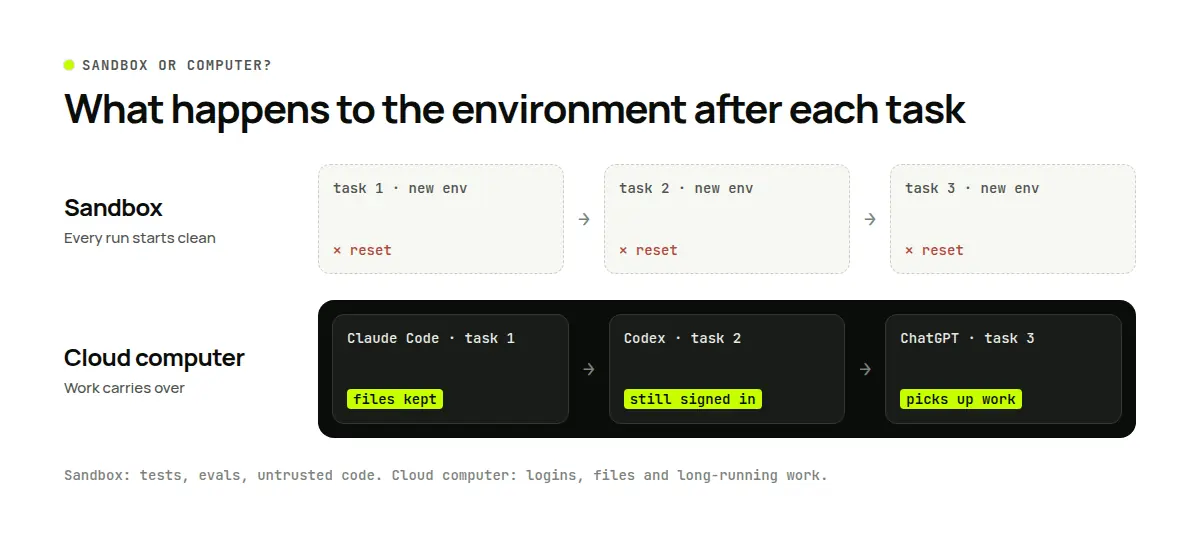
These words overlap, and vendors use them loosely. The useful question is what happens to the environment after the task.
| Sandbox | Virtual machine | Cloud computer for agents | |
|---|---|---|---|
| Built to | Run a task, then be thrown away | Run an operating system for anything | Be an agent's own computer that stays |
| Lifetime | Seconds to hours | As long as you run it | Persists between tasks |
| Desktop and browser | Usually none; some add one | Whatever you install | Desktop, browser, files and terminal ready |
| Logins and app state | Lost on reset | Kept if you manage them | Kept, so the agent stays signed in |
| Controlled by | Your code, through an SDK | You, as an administrator | Agents, through MCP or an API |
| Best for | Running untrusted code, evals, per-user isolation | General infrastructure | Ongoing work: research, data entry, web apps, long tasks |
A sandbox is the right answer when every run should start clean. It is the wrong answer when the agent's value depends on what it kept from last time: a signed-in account, a half-finished spreadsheet, a project folder another agent will continue. For a list of services in the third column, see Orgo cloud computer alternatives.
Where Simular Box fits: a cloud computer, not a sandbox
Simular Box (box by Simular) is a cloud computer for your AI agents: a Linux desktop with Chrome, files and a terminal that stays put between tasks. It is not a sandbox, and it is not built to be thrown away.
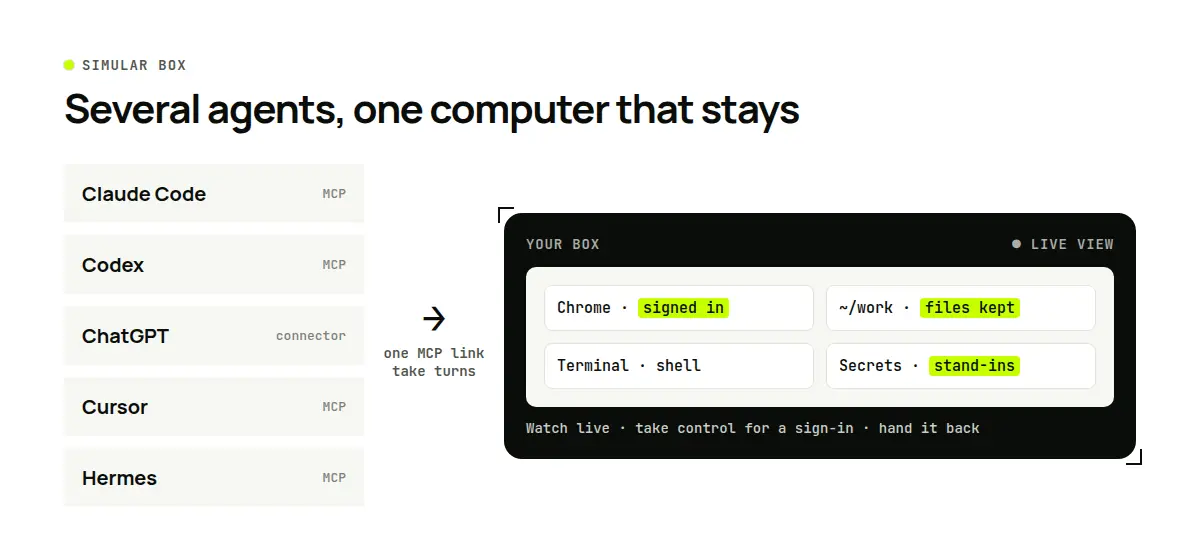
It covers the cases sandboxes leave open:
- Work that persists. Files, apps and browser sessions are still there next time, so a task can run over days.
- Logins stay on the box. You sign in once in the box's Chrome, through live view if needed. Passwords stay there and are never sent to the AI you connect.
- Keys without exposure. API keys added as secrets can be used by commands on the box while the AI only sees a stand-in.
- Several agents, one computer. Claude Code, Codex, ChatGPT, Cursor and Hermes connect to the same box through one MCP link and take turns on it, so one can pick up where another stopped.
- You can watch and step in. Live view shows what the agent is doing. You can take control for a sign-in or a payment and hand it back. Simular Box's own agent never enters payment details.
- Your laptop stays free. Long or noisy agent work runs on the box, not on your machine.
A sandbox and Simular Box can sit side by side: run untrusted code in a disposable sandbox, and give your agent a box for the ongoing work. To see how computer-use agents drive a desktop like this, read our guide to computer use agents. Get Simular Box: start with $5 of free credit, then pay as you go from $0.10/hour or pick a plan from $19/month.
Limitations and risks of AI sandboxes
- Isolation is not safety. A sandbox limits damage inside it, but an agent with network access can still post, send or delete things on the internet. You still need permissions and confirmations for consequential actions.
- Time limits. Hosted sandboxes often stop after a set time, which cuts off long tasks.
- No memory between runs. Resetting is a feature for tests and a problem for ongoing work.
- Cold starts and cost at scale. Thousands of sandboxes per day add up, and stronger isolation adds start-up time.
- Desktop work is extra. Most code sandboxes have no screen. Agents that must use desktop apps need a desktop template or a full computer.
- Simular Box is not a substitute for a sandbox when you need thousands of short-lived, isolated runs from code. E2B, Daytona or Modal fit that better.
AI regulatory sandboxes, briefly
In policy, an AI regulatory sandbox is a supervised setting where companies test AI systems with a regulator before full launch. Article 57 of the EU AI Act requires each member state to set up at least one AI regulatory sandbox by 2 August 2026. The UK, Singapore and others run similar programmes. If you searched "sandbox AI" for compliance, that is the meaning you want.
FAQ
What is sandbox AI? Sandbox AI means running an AI model or agent inside an isolated environment, so the code it runs and the files it touches cannot affect the host system or other users.
What is an AI sandbox used for? Running code a model wrote, testing and evaluating agents, giving each user of an AI app a clean workspace, and limiting what a coding agent can reach on a laptop.
Is an AI sandbox the same as a virtual machine? Not always. Some sandboxes are microVMs, others are containers or OS-level limits. What makes it a sandbox is isolation and disposability, not the technology.
Is a sandbox enough to make an AI agent safe? No. It contains damage on the machine, but an agent with internet access can still act on websites and accounts. Pair a sandbox with permissions, confirmations and human review.
Which AI sandbox is best? For code execution at scale, E2B, Daytona and Modal are common choices. For a coding agent on your laptop, use its built-in sandboxing. For ongoing work that needs logins and files to stay, use a cloud computer such as Simular Box.
Do AI agents need a sandbox or a full computer? A sandbox when each run should start clean. A full cloud computer when the agent must stay signed in, keep files, use desktop apps or share work with other agents.
Is Simular Box an AI sandbox? No. Simular Box is a cloud computer for your AI agents. It keeps files, apps and logins between tasks and lets several agents share one computer, which is the opposite of a disposable sandbox.
What is an AI regulatory sandbox? A supervised programme where a regulator lets companies test AI systems under guidance before launch. The EU AI Act requires member states to run one.
