
Oops! Something went wrong while submitting the form.
The best E2B alternative depends on what E2B is not doing for you. If the limit you keep hitting is that a sandbox is only a machine and you still have to build and babysit the agent that uses it, the alternative is a computer-use agent with its own computer, such as Sai by Simular, which you call with a task instead of a shell command. If you want E2B's model with Windows desktops and a Series A behind it, Daytona is the closest competitor. If you need GPUs, Modal. If you want the cheapest per-second Linux microVM inside a platform you already use, Vercel Sandbox. If memory-preserving standby with near-instant resume is the point, Blaxel (now part of Baseten). And if you want to own the whole stack, OpenSandbox, Firecracker and E2B's own new Embed package let you self-host.
This guide compares ten E2B alternatives on isolation technology, scope (headless sandbox, GUI desktop, or full computer-use agent), whether memory survives a pause, session limits, the hourly cost of a 2 vCPU / 4 GiB machine, free tiers, concurrency, self-hosting and GPU support. Every figure was read from the vendor's own pricing or documentation page on 11 October 2026; where a vendor does not publish a number we say so rather than guess.
E2B runs isolated Linux sandboxes for AI agents on a proprietary Firecracker-based microVM runtime with dedicated kernels and a custom snapshot layer. Its positioning in 2026 is "every agent gets a machine": a sandbox boots from a snapshot, runs code and tools, can be paused with its memory intact (about four seconds per GiB to pause, about a second to resume, kept indefinitely), forked into up to twenty copies, and torn down. SDKs cover Python and JavaScript, an MCP gateway inside each sandbox exposes more than 200 tools from the Docker MCP catalogue, and the optional E2B Desktop adds a Linux Xfce GUI with mouse and keyboard control for computer-use experiments.
Pricing is per second: $0.0504 per vCPU-hour and $0.0162 per GiB-hour, so the default 2 vCPU sandbox at 4 GiB costs about $0.166 an hour (the billing docs put the default memory at 512 MiB, which is cheaper and smaller than most agents want). The Hobby plan is free with a one-time $100 credit, 20 concurrent sandboxes and a one-hour continuous-session cap; Pro is $150 a month for 100 concurrent sandboxes and 24-hour sessions, with 500 more slots for each extra $500 a month; Enterprise starts around $3,000 a month and unlocks multi-day sessions and bring-your-own-cloud on AWS, GCP or Azure. In September 2026 E2B shipped Embed, an Apache-2.0 single-machine package of the open-source runtime for self-hosting, and in October, Secrets, for injecting credentials into requests without exposing them to the agent. Its last funding was a $21 million Series A in July 2025.
Where it stops: sandboxes are CPU-only, their CPU and RAM are fixed at template build time, the session caps reset state unless you pause, BYOC is enterprise-only, and the GUI option is Linux only. Most importantly, E2B gives you a machine and leaves the agent to you. For coding agents that is exactly right. For agents whose work is operating software, it is the beginning of a much larger build.
The reasons people give in comparison articles and on E2B's own issue tracker cluster into eight. Continuous-session caps of one hour on Hobby and 24 hours on Pro end long-running agents unless you engineer around pause and resume. Sandboxes cannot be resized while running. There are no GPUs. Pausing a large sandbox is slow (four seconds per GiB) and reconnecting to a paused one has produced 404 and 409 errors in the past. Concurrency is sold in 500-slot blocks. Self-hosting the full platform is a Terraform-and-Nomad project, and the new Embed package is single-node. Idle sandboxes cost money unless paused. And, the reason this article exists, a sandbox is not an agent: if the job is a Windows desktop application or a portal with no API, E2B Desktop's Linux Xfce box and a model-level computer-use tool are a long way from a finished solution.
Ten platforms, compared on: isolation (Firecracker, other microVM, gVisor, container); scope (headless sandbox, GUI desktop, full computer-use agent); whether the agent is included; memory-preserving pause; maximum session length; the derived hourly price of a 2 vCPU / 4 GiB machine where per-resource rates are published; free tier; concurrency on the entry plan; self-host and bring-your-own-cloud options; GPU support. Prices and limits come from vendor pricing and documentation pages on 11 October 2026 and GitHub star counts from the same day. Simular publishes this guide and lists Sai first because it is the only option that includes the agent; the remaining nine are ordered by how directly they replace E2B's sandbox, then by price. Nothing here is sponsored.
Isolation: A cloud virtual machine Simular hosts. Scope: Full computer: Windows or Linux desktop with applications, browser, files and terminal, or your own Mac or Windows machine. Pricing: Explore free (pooled Windows cloud computer, credits refreshed daily); Pay as you go $50 per month for 50,000 credits with up to five cloud computers at once; Sai Unlimited $500 per month with an always-on computer; Enterprise custom. Open source: No; the Agent S research framework is Apache-2.0.
Sai is the one entry here that is not infrastructure. E2B hands you an empty machine and an SDK; Sai hands you a machine with a computer-use agent already running on it. You send a task in plain language over POST /v1/agents/message, poll GET /v1/agents/events for progress and the result, and answer approval events when Sai wants to run a command or needs a decision. Logins, passwords and phone verifications are routed to a human as an approval link rather than typed by the agent. The same surface is an MCP server, @simular-ai/sai-mcp, so Claude Code, Codex or Cursor can delegate GUI steps in one line.
That changes what "sandbox" means. Instead of a Linux container where your agent runs code, you get a Windows or Linux desktop where Sai operates software: the vendor portal, the desktop ERP client it exports to, the spreadsheet, the terminal. Cloud computers hibernate when idle and wake on the next message; the $500 plan keeps one always on; and the computer and the model are both inside the credits, so cost shows up as one usage.costUsd figure per task rather than vCPU-seconds plus model tokens. Simular reports Sai at a 77.3% partial score at $14.34 per task on OSWorld 2.1 with trajectories published; vendor-reported, but no sandbox vendor publishes a completion rate at all, because they do not ship an agent.
Sai is not an E2B replacement for coding agents that need a shell, a filesystem and nothing else; it does not expose exec, screenshot or click primitives, and you cannot run your own agent loop on its computer. It replaces E2B when what you were really trying to build on E2B was an agent that operates applications.
Teams that adopted E2B to build a computer-use agent and would rather have one, and coding agents that need a reliable tool for GUI work.
Isolation: Containers by default (sub-90 ms start), Linux VMs, Windows VMs and GPU runtimes with a dedicated kernel per sandbox. Scope: Headless sandbox plus Computer Use desktops (Linux via noVNC, Windows). Pricing: $0.0504 per vCPU-hour, $0.0162 per GiB-hour, storage $0.000108 per GiB-hour after 5 GiB, Windows $0.0858 per vCPU-hour, H100 from $2.27 per hour pre-emptible; $200 in free compute; per-second billing; pooled limits by top-up tier (10 vCPU on email verification, 100 vCPU after a $25 top-up, up to 500 vCPU). Open source: The repository (AGPL-3.0, about 72,000 stars) is no longer maintained; core development moved to a private codebase in June 2026.
Daytona is E2B's most direct competitor and, on paper, the broader product: identical Linux compute rates, plus Windows VMs, GPU sandboxes up to eight cards, five SDK languages (Python, TypeScript, Ruby, Go, Java), two regions, and a Computer Use API with mouse, keyboard, screenshot, recording and VNC on both Linux and Windows. It raised a $24 million Series A in February 2026 and spent the year shipping Windows sandboxes, OSWorld-style "real computers for computer use" and integrations with Devin and Cursor.
Two things to know. Memory-preserving pause exists only for VM sandboxes; the default containers lose memory on stop, which is a regression from E2B's default behaviour if you rely on pause. And the open-source story ended in June 2026, when Daytona announced it was going closed source for security reasons, so if "open" was on your list this is no longer the answer.
Teams that want an E2B-shaped sandbox API with Windows and GPU options and do not need open source.
Isolation: gVisor by default; a VM runtime built on Cloud Hypervisor reached general availability on 1 October 2026. Scope: Headless sandbox with Docker support on the VM runtime. Pricing: Starter $0 plus compute with $30 of monthly credits and 100 concurrent containers; Team $250 per month with $100 credits and 5,000 containers. Sandbox CPU is $0.00003942 per physical core-second (about $0.142 per core-hour, where a core is two vCPU) and memory $0.00000667 per GiB-second (about $0.024 per GiB-hour); GPUs from T4 to B200, H100 at $3.95 per hour. Open source: The client is; the platform is not.
Modal is where you go when the agent's work is compute rather than clicks. Sandboxes share the platform with Modal's serverless functions, so GPUs, high concurrency and sub-second cold starts come for free, and the new VM runtime adds a real kernel for Docker, FUSE and nested workloads. Lifetimes run from a five-minute default to 24 hours.
Persistence is the gap: filesystem snapshots are solid, but memory snapshots are alpha, expire after seven days, terminate the sandbox when taken and are off for GPU sandboxes. Sandbox rates are also higher than Modal's function rates, and roughly 40% above E2B's for the same 2 vCPU / 4 GiB box.
Agents that run inference, data pipelines or anything needing a GPU inside the sandbox.
Isolation: Firecracker microVM with a dedicated kernel; default image Ubuntu 26.04. Scope: Headless sandbox. Pricing: Hobby includes 5 active CPU-hours, 420 GB-hours of memory, 5,000 creations and 10 concurrent sandboxes a month with a 45-minute session cap; Pro and Enterprise pay $0.128 per active CPU-hour and $0.0212 per GB-hour of provisioned memory, with 24-hour sessions and 10,000 concurrent sandboxes. Open source: No.
Vercel's sandboxes went GA in January 2026 and gained GA filesystem persistence in May. They are the same Firecracker-class isolation as E2B, bill only for active CPU (I/O wait is free), run in 19 regions, support Docker and VPNs via sudo, and ship JavaScript, Python and CLI clients. For a Next.js or AI SDK application that needs a sandbox for generated code, there is nothing to integrate.
The 45-minute Hobby cap is tighter than E2B's hour, there are no memory snapshots, the docs say sandboxes are "not designed to run continuously", and the active-CPU pricing makes a busy 2 vCPU / 4 GiB box roughly twice E2B's price while an idle one is far cheaper.
Teams already on Vercel who need disposable, well-isolated sandboxes for agent-generated code.
Isolation: microVM (hypervisor not named). Scope: Headless sandbox plus hosted MCP servers, batch jobs and an agent file drive. Pricing: Active compute billed at $0.0000115 per GB of RAM per second (about $0.041 per GB-hour, CPU scales with memory, so 4 GB is about $0.166 an hour); standby costs only snapshot storage at $0.20 per GB-month; up to $200 in free credits; concurrency tiers from 10 sandboxes free to 50 after a $20 top-up and 200 after $50; sandbox TTL seven days on the free tier and 30 days on Tier 1. Open source: No.
Blaxel's design is "perpetual sandboxes": a sandbox drops to standby seconds after its last connection, keeps its memory, and resumes in under 25 milliseconds when the agent returns, which is the opposite trade-off from E2B's four-seconds-per-GiB pause. It also hosts MCP servers next to the sandbox, carries SOC 2, HIPAA, ISO 27001 and GDPR badges, and offers Python, TypeScript and Go SDKs. In September 2026 Blaxel was acquired by Baseten, which should be read as both validation and a roadmap question.
Interactive agents that pause and resume constantly and cannot afford E2B's pause latency.
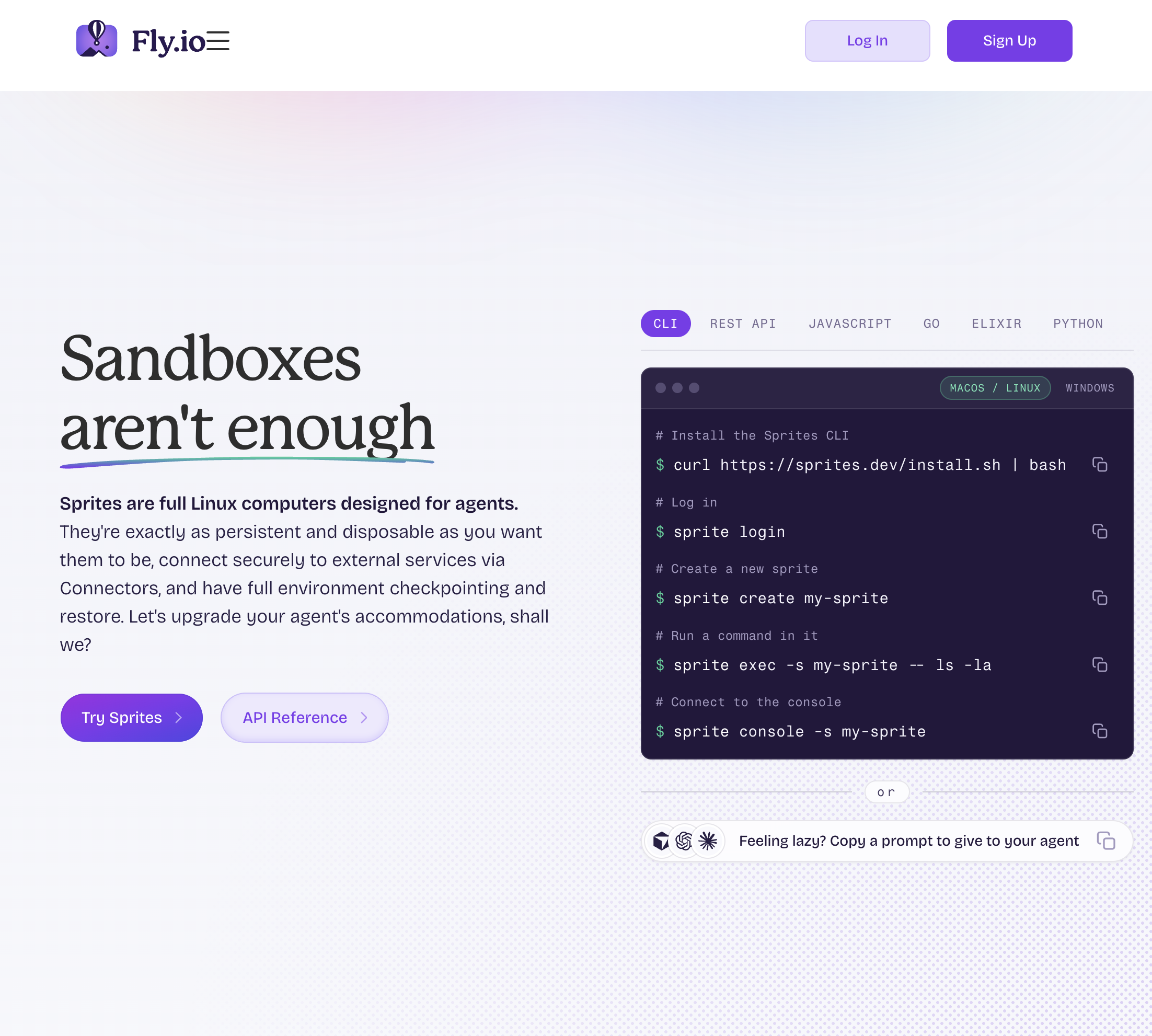
Isolation: Fly Machines, KVM microVMs. Scope: A persistent, full-root Linux computer, headless. Pricing: $0.0385 per CPU-hour and $0.021875 per GB-hour while running, $0 while idle; hot storage about $0.50 per GB-month; a $30 trial credit; pay-as-you-go capped at three concurrent Sprites, or the $20 a month "Level 10" plan with ten concurrent and bundled hours. Each Sprite is a fixed 8 vCPU / 4 GB. Open source: No.
Sprites are not sandboxes but computers: 100 GB of persistent disk, a long list of pre-installed runtimes and coding agents, and a lifecycle that goes running to warm (memory frozen, wake in hundreds of milliseconds) to cold (memory dropped, wake in seconds) with no compute billed while asleep. SDKs cover JavaScript, Go, Python and Elixir, and there is a remote MCP server. Checkpoints are disk-only, so they rewind files rather than resuming a process, and the fixed size means an 8 vCPU box costs about $0.40 an hour when busy.
Coding agents that need a machine of their own that costs nothing between sessions.
Isolation: gVisor containers in the cloud; Docker, QEMU or Apple Virtualization locally. Scope: GUI desktops (Linux in the cloud; Windows, macOS and Android self-hosted), bring your own agent. Pricing: Cua Fleet at $0.044625 per vCPU-hour plus $0.0223125 per GiB-hour (about $0.178 for 2 vCPU / 4 GiB); local sandboxes free. Open source: Yes, MIT core with FSL components, about 29,400 stars; SDKs in Python, TypeScript, Swift and Kotlin.
If what you used E2B Desktop for was computer-use research, Cua is the fuller open-source stack: desktop images for every major OS, a driver that works as an MCP server for coding agents, a benchmark suite, and the ability to develop locally and scale to Cua's cloud or your own AWS, GCP or Modal account. Cloud sandboxes are gVisor containers rather than VMs, there is no suspend, and sandboxes lapse 15 minutes after your process stops renewing them. As with E2B, the agent is yours to build.
Teams building their own computer-use agent who want open desktop infrastructure.
Isolation: Virtual machines (hypervisor not named); a few seconds to first command. Scope: Headless devboxes with blueprints, snapshots, an object store, event streams and an MCP hub. Pricing: Basic $0 plus usage with a $50 credit and 100 GB of free storage; Pro $250 per month; $0.108 per CPU-hour and $0.0252 per GB-hour; trial limited to three running devboxes. Open source: No.
Runloop is narrower than E2B on purpose: everything is built around the coding-agent loop, from reproducible blueprints to a case study running 10,000 concurrent devboxes, an OpenAI Agents SDK provider and an MCP hub. Suspend preserves disk only, the default lifetime is an hour, and the per-hour price is nearly double E2B's.
Teams scaling software-engineering agents who want the environment layer handled.
Isolation: Cloudflare Containers, each a microVM with its own kernel. Scope: Headless sandbox, in beta. Pricing: Available on the $5 a month Workers Paid plan, with an included monthly allowance (25 GiB-hours of memory, 375 vCPU-minutes) and then $0.000020 per vCPU-second (about $0.072 per vCPU-hour) and $0.0000025 per GiB-second (about $0.009 per GiB-hour); maximum instance 4 vCPU / 12 GiB. Open source: The SDK (Apache-2.0, about 1,100 stars); the platform is not.
For a Worker-based agent, @cloudflare/sandbox gives you code execution, preview URLs, git clone and file snapshots next to your edge code. It is JavaScript-only, explicitly beta, has no GPU, and the instance ceiling is small; it is the right answer when your agent is on Cloudflare and the wrong one otherwise.
Cloudflare-native agents with modest sandbox needs.
Isolation: Firecracker, Docker or Kubernetes, on your hardware. Scope: Sandbox plus browser and desktop environments. Pricing: Your infrastructure. Open source: OpenSandbox (Alibaba) is Apache-2.0 with about 15,800 stars; Firecracker itself is Apache-2.0 with about 36,400 stars; microsandbox (local-first microVMs, Apache-2.0, about 8,700 stars) and E2B's own Embed package are the other credible routes.
Self-hosting used to mean reimplementing E2B. In 2026 it means picking a project. OpenSandbox runs agents in Docker, Kubernetes or Firecracker sandboxes with pause and resume, browser and desktop environments, SDKs in Python, Java, TypeScript, C# and Go, and MCP. E2B Embed packages E2B's open-source runtime and dashboard for a single machine under Apache-2.0 with no licence key. microsandbox boots microVMs in under 100 ms on local hardware. You own the uptime, the patching and the scaling, and you pay nothing per vCPU-second.
Platform teams with compliance requirements or enough volume that managed per-second pricing no longer makes sense.
You need an agent, not a machine: Sai. You want E2B's API with Windows and GPUs: Daytona. GPU-heavy agent work: Modal. Already on Vercel: Vercel Sandbox. Constant pause and resume: Blaxel. A persistent box that is free when idle: Sprites. Open-source GUI desktops: Cua. Coding agents at scale: Runloop. Already on Cloudflare: Sandbox SDK. Own the stack: OpenSandbox, Firecracker or E2B Embed.
A simple test: if your agent's output is code, stay in the sandbox category. If its output is a completed task in someone else's software, you are shopping for a computer-use agent, and most of this list is infrastructure you would still have to build on.