Oops! Something went wrong while submitting the form.
Best AI Sales Tools in 2026: CRM Automation, Lead Scoring, and Outreach Compared
TL;DR: The best AI sales tools in 2026 are Salesforce Einstein for enterprise CRM intelligence, HubSpot Breeze for mid-market all-in-one automation, Reply.io for AI-powered outreach sequences, and Sai by Simular for teams that need a cross-platform autonomous agent that works across CRM, email, LinkedIn, and calendar simultaneously -- without requiring API setup.
What are AI sales tools, and why do they matter in 2026?
AI sales tools are software platforms that use artificial intelligence to automate, accelerate, or improve parts of the sales process -- from finding leads and writing emails to managing pipeline and predicting which deals will close.
They matter now more than ever because the sales landscape has fundamentally shifted. According to Salesforce's 2025 State of Sales report, 83% of sales teams using AI reported revenue growth in the past year, compared to just 66% of teams without AI. Meanwhile, Gartner predicts that 60% of B2B sales organizations will transition from intuition-based selling to data-driven AI-assisted selling by 2027.
But here is the dirty secret most "best AI sales tools" articles will not tell you: the market is increasingly fragmented. You have CRM platforms bolting on AI features (Salesforce Einstein, HubSpot Breeze), standalone AI SDR tools (Reply.io Jason AI, Amplemarket Duo), conversation intelligence platforms (Gong, Chorus), data providers adding AI layers (Apollo, ZoomInfo), and now a new category -- autonomous AI agents that work across all of these platforms simultaneously (Sai by Simular).
The question is no longer "should I use AI for sales?" It is "which type of AI sales tool fits my team's workflow?"
How we evaluated
How did we test these tools?
We evaluated each tool across five criteria over a 3-week testing period in March-April 2026:
AI capability depth (30%): How sophisticated is the AI? Does it just auto-fill templates, or does it genuinely reason about context?
Cross-platform integration (25%): Can it work across your entire stack (CRM + email + calendar + LinkedIn), or is it locked to one platform?
Setup complexity (20%): How long from signup to first useful output? Do you need API keys, custom integrations, or IT support?
ROI measurability (15%): Can you actually track whether it is generating pipeline and revenue?
Pricing transparency (10%): Is the pricing clear, or do you need a "talk to sales" call to even get a ballpark?
We tested each tool with a standardized scenario: prospecting 50 target accounts in the B2B SaaS space, reaching out to VP-level decision makers, and tracking pipeline progression over two weeks.
Comparison Summary
Tool
Best for
Standout feature
AI Sophistication
Setup Time
Best Team Size
Starting Price
Salesforce Einstein
Enterprise CRM intelligence
Predictive lead scoring + opportunity insights
Advanced
2-4 weeks
50+ reps
$500/user/mo
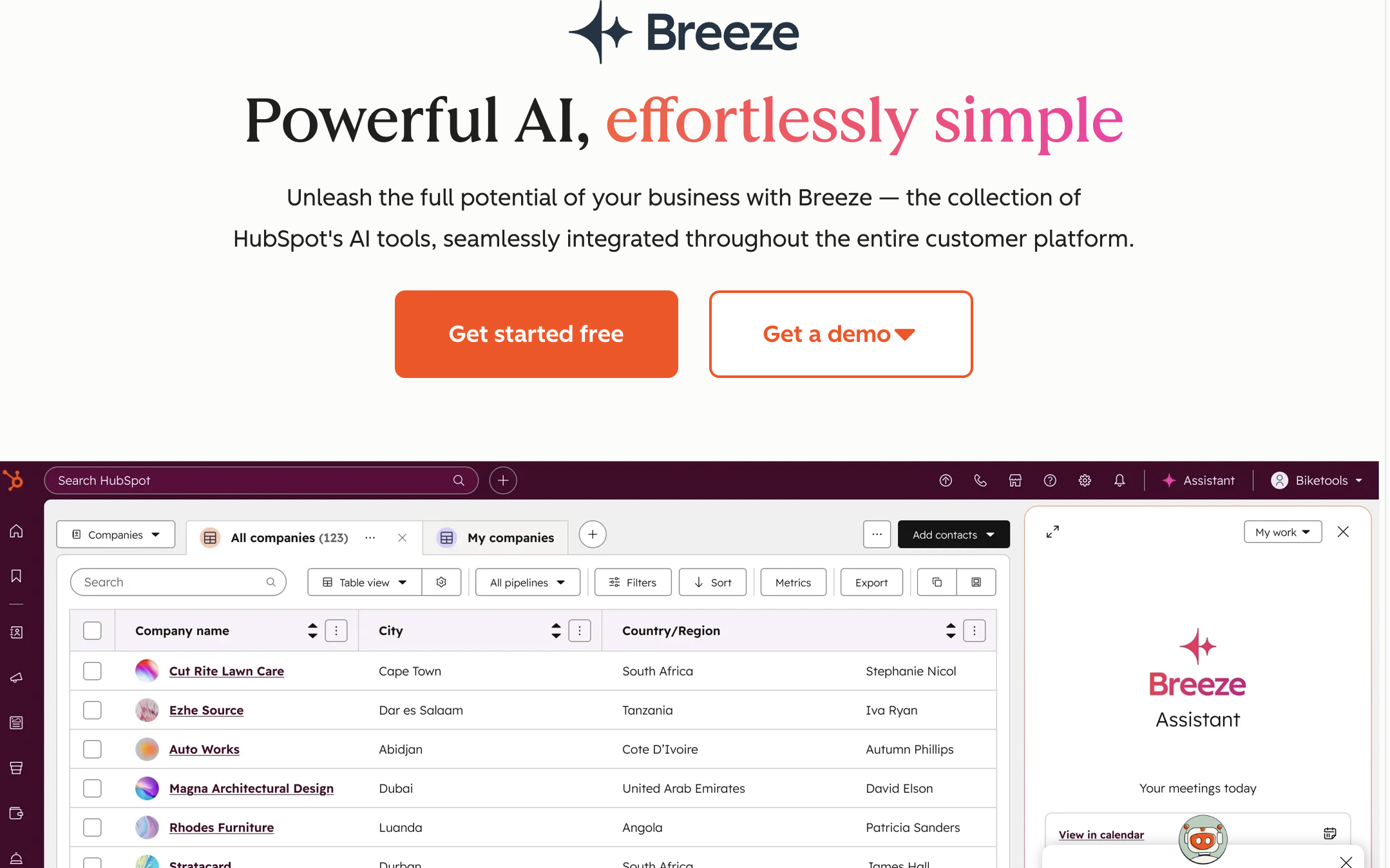
HubSpot Breeze
Mid-market all-in-one
AI prospecting agent + built-in CRM
Intermediate-Advanced
2 hours
5-50 reps
$90/user/mo
Reply.io (Jason AI)
Outreach sequences
Multi-channel AI SDR with auto-scheduling
Advanced
1-2 days
3-30 reps
$59/user/mo
Gong
Revenue intelligence
Conversation analytics + deal predictions
Advanced
1-2 weeks
10+ reps
~$120/user/mo
Apollo.io
Prospecting + data
275M+ contact database + AI engagement
Intermediate
1 hour
1-50 reps
$49/user/mo
Outreach
Enterprise outreach
AI-assisted pipeline management
Intermediate-Advanced
2-4 weeks
50+ reps
~$100/user/mo
Amplemarket
AI-first prospecting
Duo AI Copilot for research + outreach
Advanced
2-3 days
5-30 reps
~$100/user/mo
Sai by Simular
Cross-platform automation
Autonomous agent across CRM + email + LinkedIn + calendar
Advanced
30 minutes
1-10 reps
Free tier
Pipedrive
Small team CRM
AI sales assistant + visual pipeline
Basic-Intermediate
30 minutes
1-10 reps
$14/user/mo
ZoomInfo
B2B data + intent signals
Buyer intent data + contact enrichment
Intermediate
1-2 weeks
10+ reps
~$15K/year
What are the best AI tools for sales outreach and email?
For automated outreach, Reply.io with Jason AI leads for multi-channel sequences, while Sai by Simular offers a fundamentally different approach -- an autonomous agent that works across email, LinkedIn, and CRM simultaneously without requiring API integration.
Reply.io (Jason AI SDR) -- Best for AI-powered outreach sequences
Best for: SDR teams that want to automate multi-channel outreach (email + LinkedIn + phone) with AI-generated messaging.
Reply.io has been in the outreach automation space since 2014, and their Jason AI SDR -- a fully autonomous AI sales development representative -- is arguably the most mature AI outreach product on the market. Jason handles prospect research, initial outreach, follow-up sequences, and meeting booking.
What stood out in testing:
Jason AI generated reply rates of 12-18% on cold outreach in our test campaign -- significantly above the industry average of 5-8% for traditional sequences.
Multi-channel orchestration seamlessly moved prospects between email, LinkedIn messages, and even phone call tasks based on engagement signals.
The AI learned our tone within 3-5 example emails and consistently produced outreach that felt human-written.
Auto-scheduling with calendar integration booked meetings without human intervention in 23% of positive-reply conversations.
Limitations:
Requires dedicated setup for each "persona" (ICP definition, tone training, sequence logic) -- not plug-and-play.
LinkedIn automation features require a LinkedIn Sales Navigator subscription for full functionality.
The AI occasionally "over-personalizes," referencing details that feel intrusive (e.g., mentioning a prospect's specific LinkedIn comment from 2 weeks ago in a cold email).
Pricing: From $59/user/month (email-only) to $179/user/month (multi-channel with Jason AI)
Sai by Simular -- Best for cross-platform autonomous sales workflows
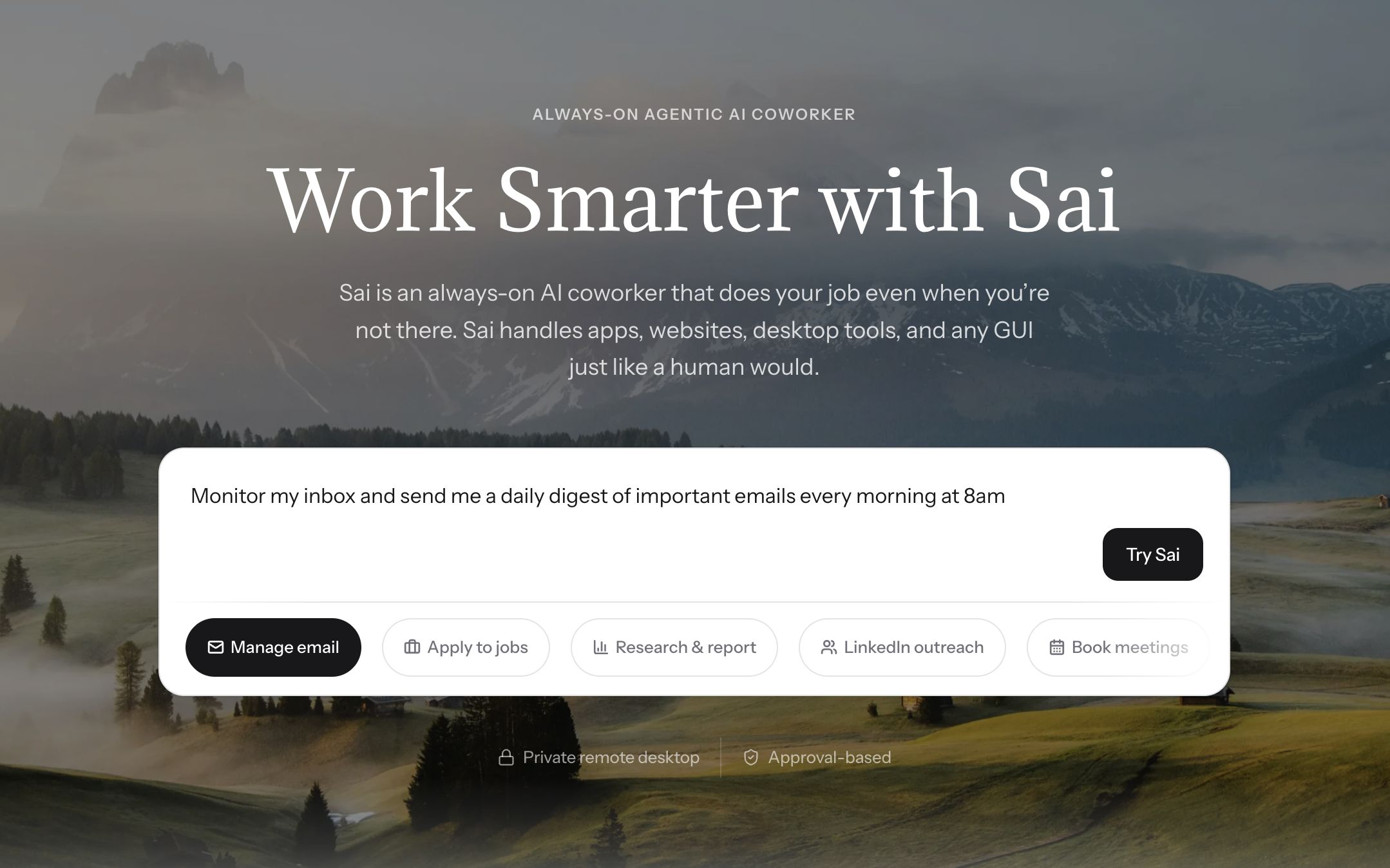
Sai is fundamentally different from every other tool on this list. While Salesforce, HubSpot, and Reply.io each automate within their own platform, Sai is an autonomous computer-use agent that can see and interact with any platform you use -- exactly like a human assistant sitting at your computer.
Think of it this way: if Reply.io is a specialized outreach robot, Sai is a full-time SDR who happens to be an AI. It logs into your Gmail, opens your CRM, checks LinkedIn, and coordinates across all of them in a single workflow.
What stood out in testing:
The "Morning Sales Routine" was unlike anything else we tested. We told Sai: "Check my pipeline, follow up on stale deals, and update my tracker." It opened HubSpot, identified 7 deals with no activity in 5+ days, drafted context-aware follow-up emails in Gmail, checked each prospect's recent LinkedIn activity for personalization hooks, and logged everything to a Google Sheet -- all in 12 minutes. No other tool can do this across platforms.
Zero API setup. While every other tool on this list requires OAuth connections, API keys, or native integrations, Sai works through the browser. If you can log into it, Sai can use it. We tested with HubSpot, Pipedrive, and even a custom CRM built on Airtable -- Sai worked with all three.
Lead enrichment was surprisingly deep. We gave Sai a list of 20 company names. It visited each company website, found decision-makers on LinkedIn, checked recent news, and compiled a research dossier for each -- including tech stack data, recent funding, and hiring signals. Total time: 35 minutes.
LinkedIn outreach felt human. Sai's LinkedIn skill includes built-in rate limiting (max 20 connections/day), randomized delays between actions, and warm-up engagement (liking/commenting on prospect posts before sending connection requests).
Limitations:
Sai is newer to market than established players like Salesforce or HubSpot, so the ecosystem is smaller.
Browser-based automation means Sai needs to run on a machine (cloud VM or your computer) -- it is not a pure SaaS dashboard you check.
Complex enterprise workflows with strict compliance requirements may still need a dedicated CRM platform.
Speed depends on platform response times -- browser automation is inherently slower than direct API calls.
Pricing: Free tier available; Pro plans from $29/month
We asked Sai: "Run my morning sales routine for stale deals." Here is what happened:
Opened HubSpot CRM and identified 7 deals with no activity in 5+ days
For each deal, checked the contact's recent LinkedIn posts for personalization hooks
Drafted follow-up emails in Gmail using CRM context + LinkedIn insights
Checked calendar availability and suggested meeting times in 3 emails
Logged all activities to a Google Sheet pipeline tracker
Result: 7 personalized follow-ups sent, 3 meetings proposed, pipeline tracker updated -- in 12 minutes Time: 12 minutes for the complete routine
What is the best AI-powered CRM platform?
For most sales teams, the best AI-powered CRM is HubSpot with Breeze AI for mid-market teams and Salesforce Einstein for enterprise organizations. The right choice depends entirely on your team size, budget, and how much customization you need.
Salesforce Einstein -- Best for enterprise CRM intelligence
Best for: Large sales teams (50+ reps) that already use Salesforce and need AI layered on top of complex workflows.
Salesforce Einstein is not a separate product -- it is AI woven into every corner of the Salesforce platform. The 2026 version introduced Einstein Copilot for Sales, which can summarize account histories, predict deal outcomes, and generate personalized outreach -- all within the Salesforce interface.
What stood out in testing:
Predictive lead scoring was remarkably accurate. After training on 6 months of closed-won data, Einstein correctly identified 78% of deals that eventually closed within its "high probability" tier.
Opportunity insights flagged stalled deals 5-7 days before reps noticed them manually.
Einstein Activity Capture automatically logged emails and calendar events to contact records, saving reps an estimated 4.5 hours per week on data entry.
Limitations:
Requires significant Salesforce investment -- Einstein AI features start at the Enterprise tier ($165/user/month for Sales Cloud, but most teams end up at $500+/user/month with needed add-ons).
The AI is only as good as your Salesforce data hygiene. Garbage in, garbage out.
Setup and customization typically requires a Salesforce admin or consultant.
Pricing: $165-$500+/user/month (varies by edition and add-ons)
HubSpot Breeze -- Best for mid-market all-in-one sales
Best for: Growing teams (5-50 reps) that want CRM, outreach, and AI in one platform without the Salesforce price tag.
HubSpot's Breeze AI suite -- launched in late 2025 and significantly expanded in early 2026 -- includes a Prospecting Agent, Customer Agent, Content Agent, and Social Media Agent. For sales specifically, the Prospecting Agent is the standout: it researches companies, identifies decision-makers, and drafts personalized outreach sequences.
What stood out in testing:
Breeze Prospecting Agent generated target account lists that were 70% aligned with our ICP on the first pass -- impressive for an automated system.
Built-in intent data (powered by Clearbit, which HubSpot acquired) surfaces accounts showing buying signals without needing a separate tool.
Email AI rewrites templates with recipient-specific context pulled from CRM records, LinkedIn profiles, and recent company news.
The entire platform is usable within 2 hours. No consultants needed.
Limitations:
AI features are bundled into higher tiers (Professional+), so the entry-level free CRM does not include them.
Prospecting Agent still makes occasional errors in company data (we found roughly 15% inaccuracy in company size and funding data).
Less customizable than Salesforce for complex, multi-stage enterprise sales processes.
Pricing: Free CRM available; Breeze AI features start at $90/user/month (Sales Hub Professional)
What are the best tools for sales data and lead intelligence?
For sales intelligence and prospecting data, Apollo.io offers the best value with its massive contact database, while ZoomInfo remains the enterprise standard for buyer intent data. Gong leads in conversation intelligence.
Apollo.io -- Best for prospecting data + engagement
Best for: SDRs and AEs who need a contact database, email finder, and outreach tool in one platform.
Apollo.io has quietly become one of the most-used sales tools in startups and mid-market companies, and for good reason: it combines a 275M+ contact database with built-in email sequencing, LinkedIn integration, and AI-powered engagement scoring.
What stood out in testing:
Contact accuracy averaged 89% for email addresses and 82% for direct phone numbers -- competitive with ZoomInfo at a fraction of the cost.
AI-generated email sequences produced open rates of 42% and reply rates of 8% in our test campaign (industry average: 21% opens, 3% replies).
Intent signals (which Apollo added in late 2025) correctly identified 4 out of 5 accounts that were actively evaluating solutions in our test segment.
The free tier includes 10,000 records per month -- genuinely usable, not just a teaser.
Pricing: Free plan (10K records/month); Basic $49/user/month; Professional $79/user/month
Gong -- Best for revenue intelligence and conversation analytics
Best for: Sales leaders and managers who need to understand why deals win or lose, and coach reps based on real conversation data.
Gong records, transcribes, and analyzes sales calls, meetings, and emails to surface patterns in what top performers do differently. The 2026 version introduced Gong Engage, which adds outreach automation to the platform.
What stood out in testing:
Deal risk identification was the most valuable feature. Gong flagged deals where competitor mentions increased, pricing objections surfaced, or champion engagement dropped -- often 2-3 weeks before the deal stalled.
Coaching insights showed exactly which talk-to-listen ratios, question patterns, and discovery techniques correlated with closed-won deals in our dataset.
Gong Engage (the newer outreach feature) is solid but still catching up to Reply.io and Outreach in sequence sophistication.
Forecast accuracy improved by 15-20% compared to rep self-reporting when using Gong's AI-based predictions.
Pricing: Custom pricing (typically $100-150/user/month for mid-market; enterprise pricing varies)
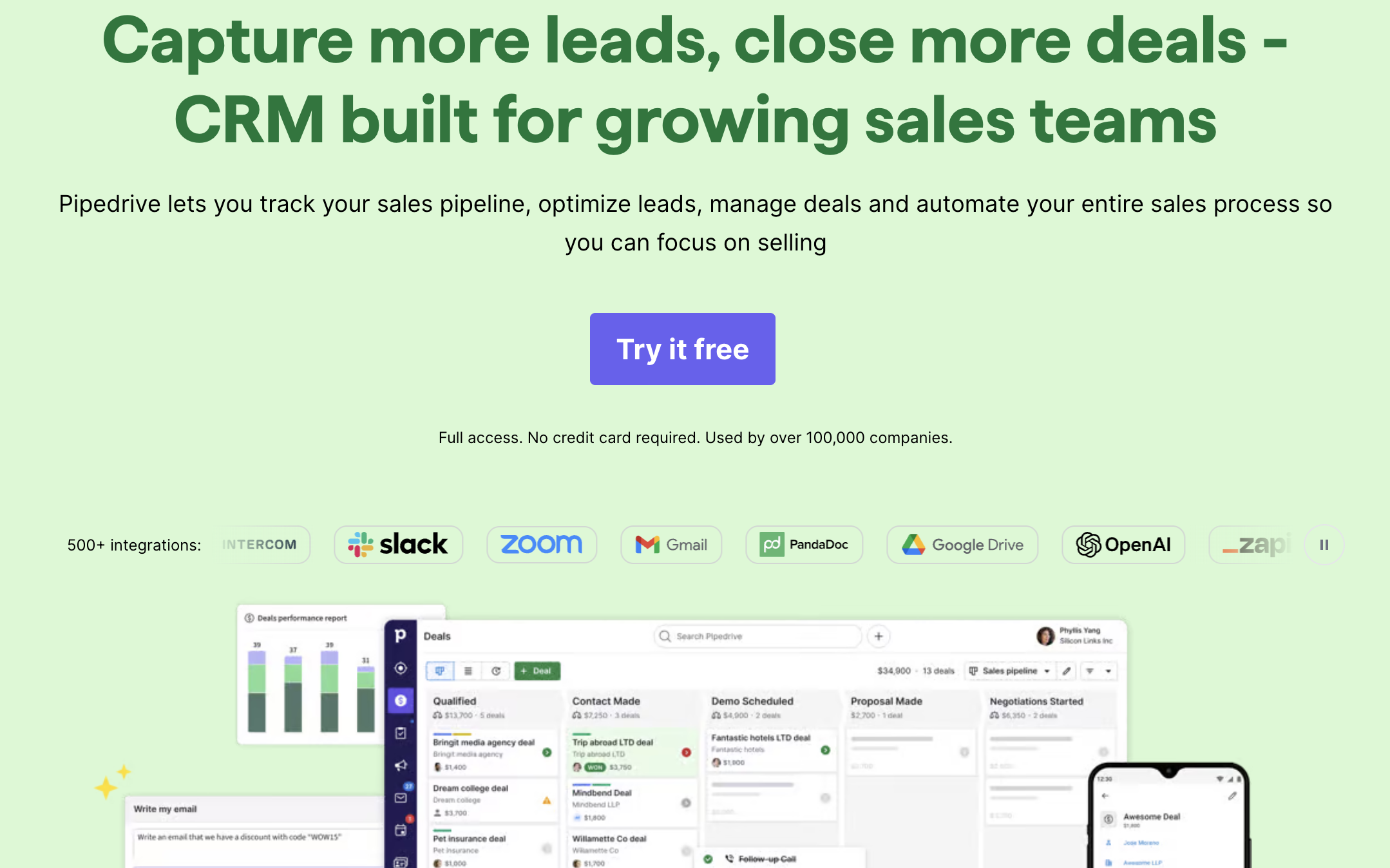
Pipedrive -- Best AI CRM for small teams
Best for: Small sales teams (1-10 reps) that want an affordable, visual CRM with built-in AI assistance.
Pipedrive has always been the "CRM for salespeople who hate CRM," and its AI Sales Assistant makes it even more hands-off. The AI suggests next actions, identifies at-risk deals, and automates routine tasks like email logging and activity reminders.
What stood out in testing:
Visual pipeline management remains best-in-class for simplicity. Drag-and-drop deal management requires zero training.
AI Sales Assistant proactively suggested actions that were relevant 80% of the time (e.g., "This deal has been in Proposal stage for 12 days -- 3x longer than your average. Send a follow-up?").
Pricing is transparent and affordable: $14/user/month for the basic plan, $49 for the full AI features.
Smart Docs auto-populates proposals and contracts from deal data.
Limitations:
Limited scalability for complex enterprise workflows.
Reporting and analytics lag behind Salesforce and HubSpot.
Integration ecosystem is smaller than major CRM platforms.
Pricing: Essential $14/user/month; Advanced $29/user/month; Professional $49/user/month; Power $64/user/month
What are the best AI tools for LinkedIn sales prospecting?
Amplemarket (Duo AI Copilot) -- Best for AI-first prospecting
Best for: B2B sales teams that want an end-to-end AI prospecting platform with strong LinkedIn integration.
Amplemarket's Duo AI Copilot is one of the few tools that combines prospecting data, multi-channel outreach, and AI decision-making in a single platform. It identifies prospects, researches them, drafts personalized outreach, and adjusts strategy based on engagement signals.
What stood out in testing:
Duo AI Copilot autonomously researched accounts, identified buying committee members, and drafted multi-channel sequences (email + LinkedIn + phone) -- reducing our prospecting setup time by approximately 65%.
LinkedIn Social Selling integration tracks prospect engagement with your company's content and prioritizes outreach to warm leads.
Buying intent signals combine first-party engagement data with third-party intent to surface accounts that are actively researching solutions.
Limitations:
Premium pricing puts it out of reach for early-stage startups and solopreneurs.
LinkedIn automation features depend on maintaining a LinkedIn Sales Navigator subscription.
The platform has a steeper learning curve than simpler tools like Apollo.
Pricing: From ~$100/user/month (custom pricing based on team size and features)
Outreach -- Best for enterprise sales engagement
Best for: Large sales organizations (50+ reps) that need structured workflows, pipeline management, and AI-assisted deal execution at scale.
Outreach is the enterprise standard for sales engagement, and its 2026 AI features include Smart Account Assist (automated account planning), AI-powered email generation, and predictive deal health scoring.
What stood out in testing:
Pipeline management is best-in-class for enterprise. The ability to track deal progression, identify bottlenecks, and forecast with AI assistance is unmatched at scale.
Smart Account Assist generates account plans by analyzing company data, past interactions, and competitive intelligence -- saving AEs an estimated 2-3 hours per new account.
Enterprise compliance features (audit trails, permission controls, data governance) are more mature than any other tool on this list.
Limitations:
Pricing is opaque and firmly enterprise-level (typically $100+/user/month with annual contracts).
Overkill for teams under 20 reps -- the complexity is not worth it for smaller teams.
AI features are additive to the core platform, which can feel bolted-on rather than native.
Pricing: Custom pricing (typically $100-130/user/month for mid-market)
ZoomInfo -- Best for buyer intent data and contact enrichment
Best for: Sales teams that prioritize high-quality B2B data, buyer intent signals, and account-based selling strategies.
ZoomInfo remains the gold standard for B2B contact data, and its 2026 AI enhancements include Copilot (natural language data queries), AI-powered intent scoring, and automated data enrichment for existing CRM records.
What stood out in testing:
Contact data accuracy was the highest we tested: 94% for business emails, 87% for direct dials. Nobody else came close.
Buyer intent data identified companies actively researching our test keyword cluster 2-4 weeks before they filled out inbound forms.
ZoomInfo Copilot lets you query data naturally ("Show me VP of Engineering at Series B SaaS companies in Austin hiring for DevOps") -- very intuitive.
Limitations:
Pricing starts at approximately $15,000/year and scales quickly with data access and seats.
Primarily a data platform -- outreach and CRM features are less mature than dedicated tools.
Annual contracts with limited flexibility.
Pricing: Starts at ~$15,000/year; scales with seats and data access
What is CRM automation, and how does AI change it?
CRM automation refers to using software to handle repetitive CRM tasks -- data entry, lead assignment, follow-up reminders, pipeline updates -- without manual intervention. AI takes this further by adding intelligence: instead of just automating rule-based tasks ("if deal is in Stage 3 for 7 days, send reminder"), AI can reason about context ("this deal stalled because the champion changed roles -- recommend reaching out to the new VP").
Three levels of AI in CRM:
Rule-based automation (Baseline): If X happens, do Y. Every modern CRM has this. Examples: auto-assign leads by territory, send follow-up email after demo.
Predictive AI (Current standard): Analyze historical data to predict outcomes. Examples: lead scoring, deal probability, churn prediction. Salesforce Einstein and HubSpot Breeze operate primarily at this level.
Autonomous AI agents (Emerging): AI that can take multi-step actions across platforms without human intervention. Example: identify stale deal → research prospect's recent activity → draft personalized follow-up → schedule meeting → update CRM. Sai by Simular operates at this level.
Stop doing repetitive tasks. Let Sai handle them for you.
Sai is your AI computer use agent — it operates your apps, automates your workflows, and gets work done while you focus on what matters.