Oops! Something went wrong while submitting the form.
Every guide tells you to enter a competitor's domain. None of them tell you how to know who your SEO competitors actually are. Sai reads your own content, extracts the terms you already rank for conceptually, and gives you the seed list that determines who you should be analyzing.
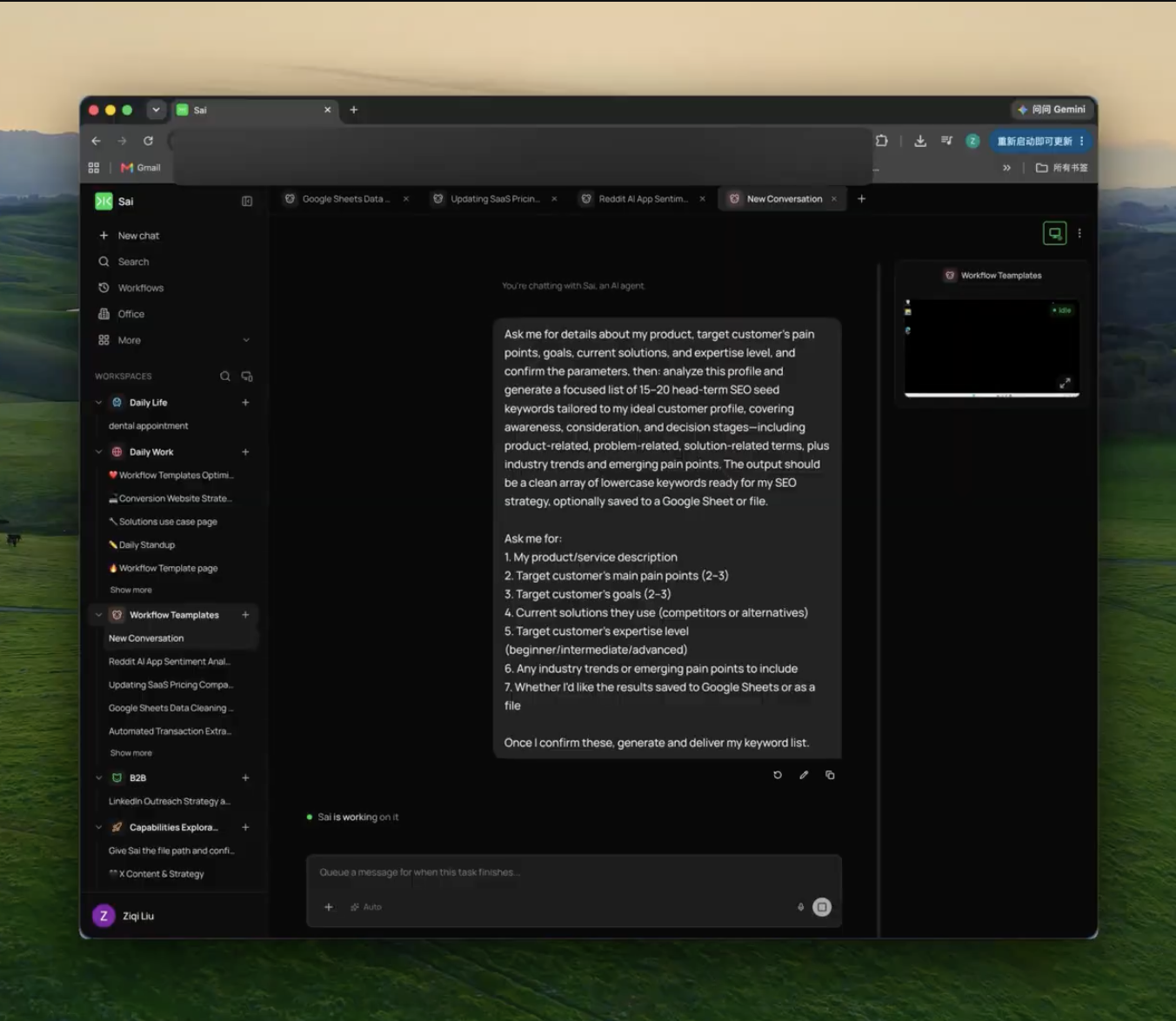
The recording is a real session. The sheet on the right is what it produced.
Sai opens each profile, pulls the signal, and writes the row, live, in a real browser.
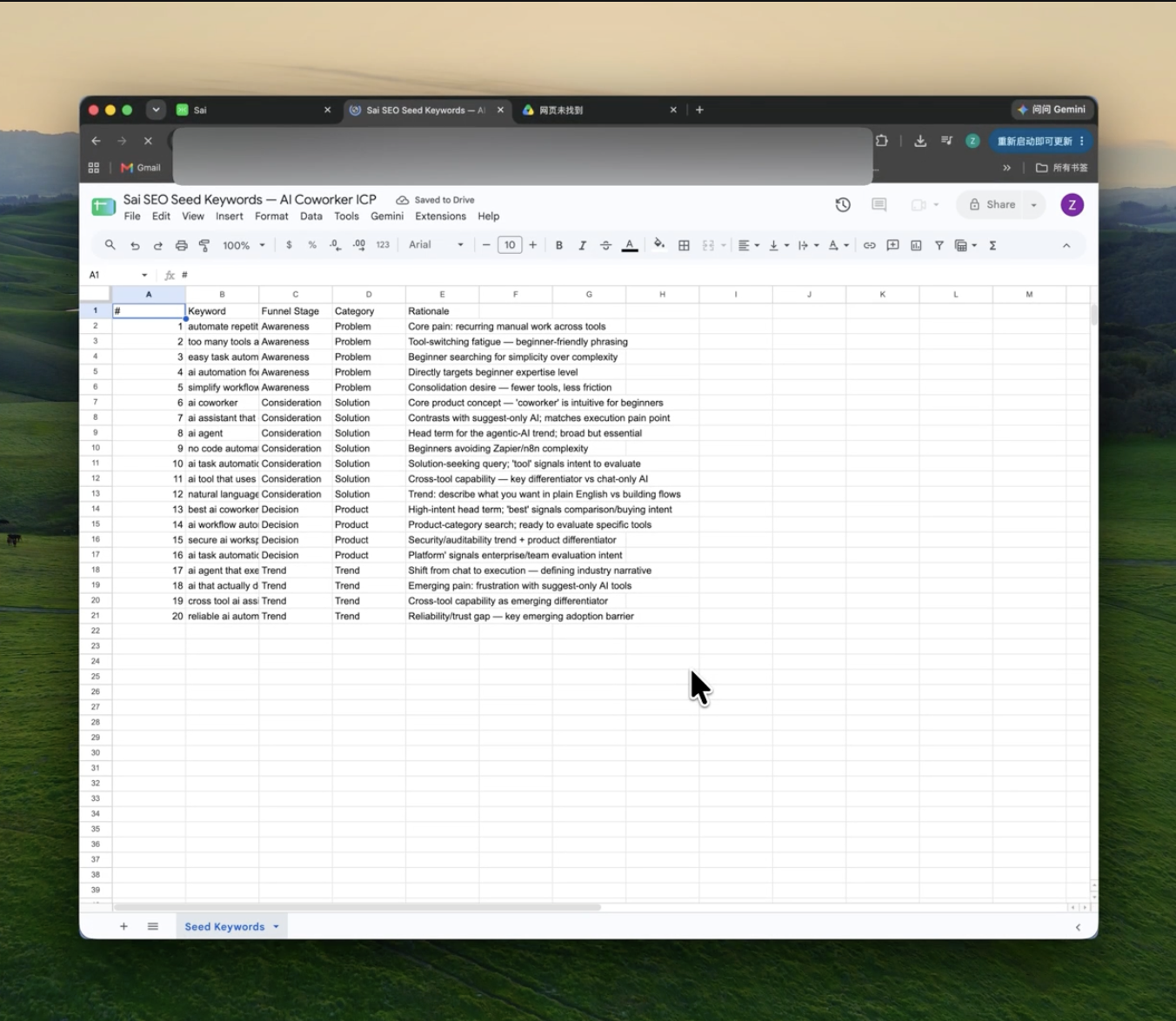
Eight columns, sorted by score, with a source link behind every claim.
Your website URL, and any content you want included — a blog, docs, or landing pages.
A grouped list of seed keywords drawn from your actual content, sorted by theme and intent, with the likely competitors for each cluster.
Around 10 minutes.
Re-run each quarter, or after any significant content push, to catch the themes your newer pages introduced.
Seed keywords are the short, unmodified head terms that describe what a product does, what problem it solves, and what category it competes in. They typically run one to three words, carry no qualifiers, and are not yet filtered for search volume or difficulty. "Expense management software", "invoice reconciliation", and "spend controls" are seed keywords; "best expense management software for startups under 50 employees" is a long-tail term derived from one.
Seed keywords are the input to every other step in keyword research. Keyword tools such as Ahrefs, Semrush, and Google Keyword Planner do not generate a starting list from nothing — each requires a seed term or a competitor domain before it can return suggestions. Long-tail expansion, keyword clustering, site architecture, and competitor gap analysis all inherit whatever bias exists in the seed list. A seed set that describes the product in internal vocabulary rather than buyer vocabulary produces a downstream keyword universe that no buyer ever searches.
Competitor gap analysis compares a domain against a set of rival domains and reports the keywords those rivals rank for. The method assumes the rival set is correct. In search, a competitor is any domain ranking on the queries a buyer types — not any company with a similar product, a similar funding stage, or a similar sales motion.
Those two definitions diverge often. A B2B software company's named competitors in a sales deck are other vendors. Its competitors on the SERP are frequently review aggregators, Reddit threads, accounting blogs, and a consultancy's resource hub. Running a gap analysis against the sales-deck list returns keywords the search market does not reward, with no error message indicating the input set was wrong.
The order that resolves this is: define the ideal customer profile, derive seed keywords from that profile, search those keywords, and read the actual ranking domains off the results. The ranking domains are the empirical competitor set. Gap analysis in Ahrefs or Semrush then runs against a set the search engine itself selected. The toolkit does not change — the sequence does.
Ahrefs and Semrush remain the stronger option for volume, keyword difficulty, backlink data, and historical rank tracking. Neither decides what the seed list should contain — both start from whatever term or domain is typed into the box. This template produces that input, grounded in the buyer profile, and identifies which domains actually rank before the paid tool is opened.
Founders and solo marketers running SEO without an agency, and content leads at seed-to-Series-B B2B companies who have a keyword tool subscription but no validated seed list. The shared situation: a product with a clear buyer, a short list of assumed competitors, and no evidence that the assumed list matches the SERP.
The task opens with a structured interview rather than a blank prompt. It asks for the product and what it does, the target customer's role and company profile, their pain points, the goal they are trying to reach, the solutions they use today, their expertise level, any emerging trends to include, and the delivery destination. Parameters are confirmed before any research starts, so a wrong profile is corrected at the beginning instead of surfacing in the final list.
It then generates 15–20 head-term seed keywords mapped to the awareness, consideration, and decision stages, covering product-related, problem-related, solution-related, and alternative-seeking phrasings. Each keyword is searched live, and the domains ranking on the first page are recorded. The result is a seed list plus an evidence-based competitor set, delivered to a Google Sheet or a file.
The seed list is an input, not a deliverable. Three things typically follow it.
The first is expansion and prioritization: the seed terms go into a keyword tool for volume, difficulty, and long-tail variants, and the ranking domains recorded in the output become the competitor set for gap analysis.
The second is production planning. Each keyword carries a funnel stage, which maps to a format — problem-stage terms to explainer content, decision-stage terms to comparison and pricing pages. The content calendar generator turns a stage-tagged keyword set into a dated publishing plan, and the AI SEO writer drafts against a specific target term rather than a topic.
The third is coverage in AI answers. Seed terms also describe the questions buyers put to ChatGPT, Perplexity, and Google's AI Overviews, where the winning surface is a citation rather than a blue link. The GEO audit template scores a site's retrievability for those engines, and checking whether ChatGPT cites your brand tests the same seed terms against an assistant to see which domains get named.
Two adjacent inputs are worth running before or alongside the seed list. If the buyer profile is assumption-based rather than researched, the buyer persona research template produces the profile this task interviews you for. If the competitor set matters beyond search, competitor monitoring tracks the domains this task surfaces on an ongoing basis.
Seed keywords are short, foundational head terms — usually one to three words — that describe a product, the problem it solves, and its category. They are the starting input for keyword tools, long-tail expansion, keyword clustering, and competitor gap analysis.
This template generates 15–20, spread across awareness, consideration, and decision stages. That range is wide enough to expose category vocabulary a single term misses, and narrow enough that each keyword can be searched and reviewed in one pass.
Derive them from the buyer rather than from analytics. Describe the product, the customer's role, their pain points, and the alternatives they use today, then convert each of those into the phrasing a buyer would type. A new site has no ranking history to mine, so the profile is the only available source.
After. Search competitors are defined by the queries being contested, so the query set has to exist first. Searching the seed keywords and recording which domains rank produces a competitor set selected by the search engine rather than by internal assumption.
No. Ahrefs and Semrush supply volume, difficulty, backlink data, and rank tracking that this template does not produce. It supplies the seed list and the empirical competitor set those tools require as input.
Ranking on a commercial query does not require selling a competing product. Review aggregators, forums, editorial sites, and consultancies frequently occupy page one for category terms. Gap analysis run against a sales-deck competitor list therefore measures a different market from the one the buyer is searching in.
Yes. Assistants answer the same underlying questions, and the seed terms describe those questions. The difference is the outcome measured: a cited source rather than a ranked link, which is what a GEO audit evaluates.