Oops! Something went wrong while submitting the form.
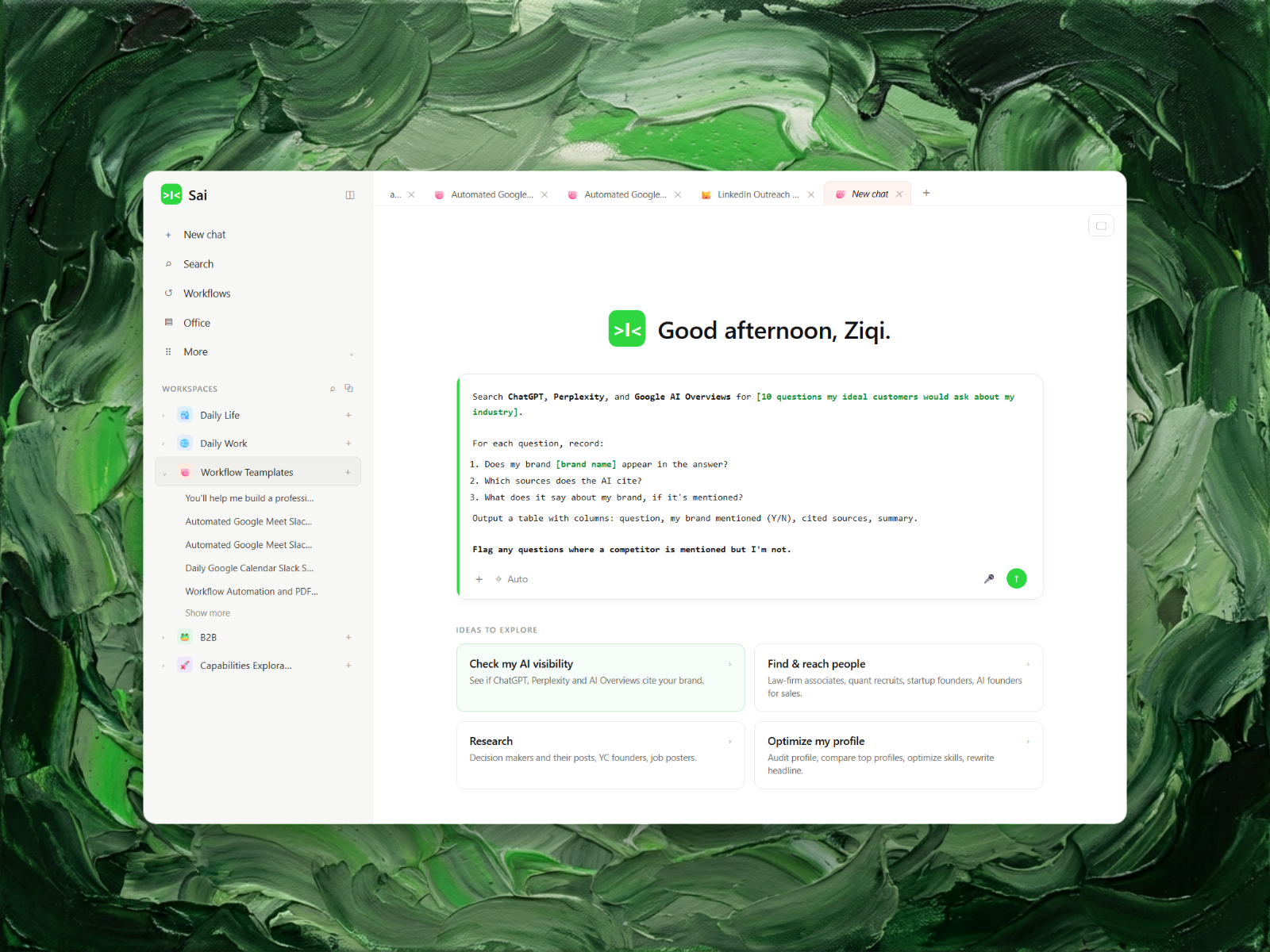
Sai checks whether your brand appears in AI answers for your topic, inspects your key pages for schema, heading structure and answer-formatted paragraphs, and returns a fix list ordered by effort. Each item states whether it is a measurable technical gap or an unverified convention.



The recording is a real session. The sheet on the right is what it produced.
Sai opens each profile, pulls the signal, and writes the row, live, in a real browser.
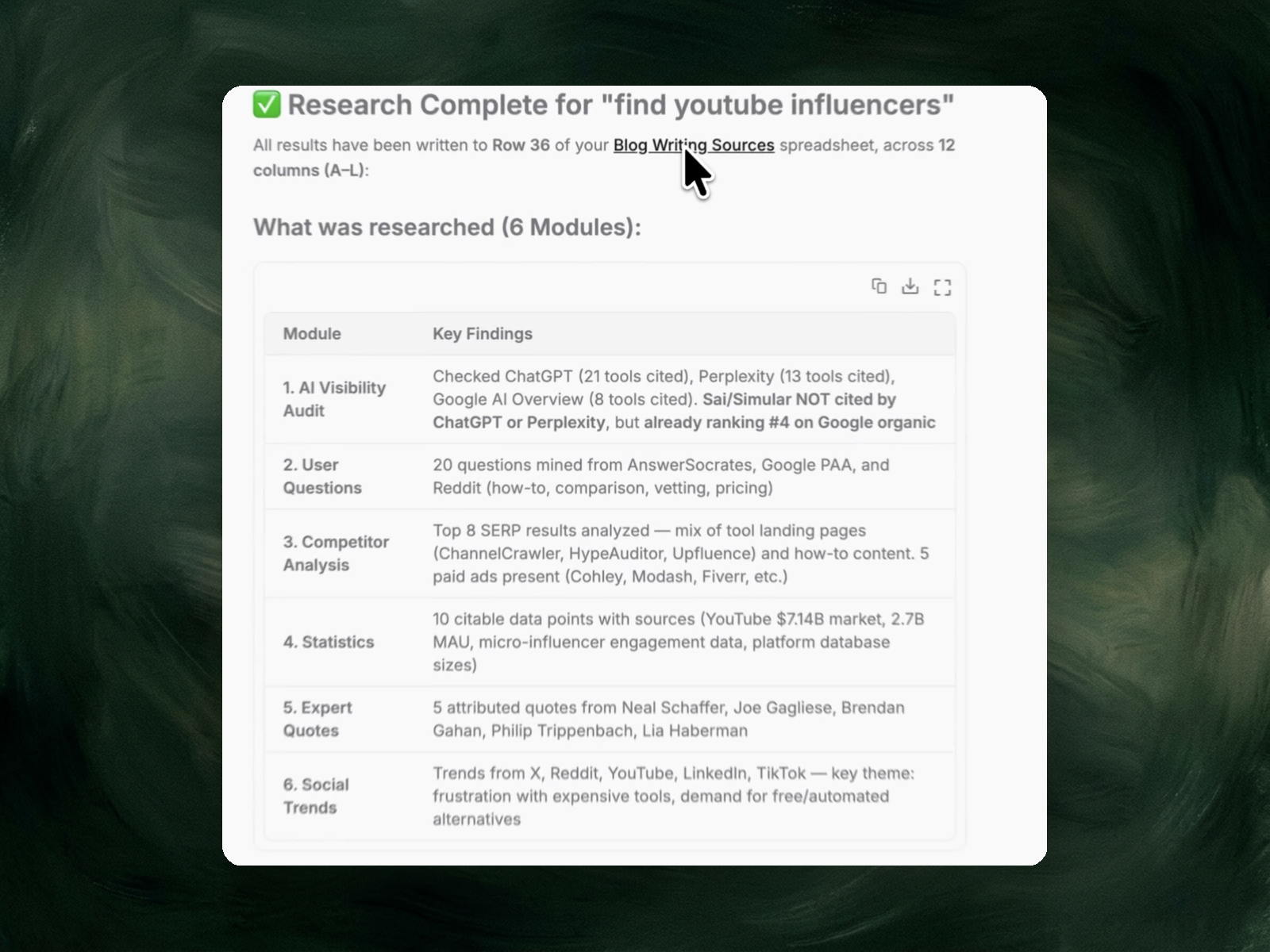
Eight columns, sorted by score, with a source link behind every claim.
Your site URL, a list of key pages to inspect, your brand name, competitor names, and your industry or topic. A Google Sheet if you want the fix list written to a spreadsheet.
A fix list with the page affected, an effort estimate, and an evidence label for each item — Measured for gaps observed on your site, Documented for items backed by official documentation with the source cited, Convention for industry practice with no published evidence. Preceded by the citation results and the on-page inspection they came from.
Run it quarterly, or after a set of fixes has been shipped. Comparing two runs shows which Measured items closed and whether the citation results changed.
Generative engine optimization refers to work intended to make a site's content appear in AI-generated answers — ChatGPT, Perplexity, Google AI Overviews, and similar systems.
A GEO audit typically covers three areas: whether the brand currently appears in AI answers, whether the site's pages carry the technical markers those systems read, and how the pages differ from the sources being cited instead.
Published checklists cover these areas consistently. They generally list items without ordering — schema markup, FAQ sections, heading structure, concise answers, llms.txt, third-party mentions, entity consistency — as a flat set.
The items differ substantially in cost. Adding a schema block to a page template is a one-day change. Earning citations on third-party review sites is a multi-month effort with an uncertain outcome. A flat list does not distinguish them.
This audit returns the list ordered, and labelled by how well each item is supported.
Each fix carries one of three labels.
Measured. A gap observed directly on the site during the run. A page with no schema markup, a heading sequence that skips levels, a robots.txt that blocks GPTBot. These are facts about the site, verifiable by looking.
Documented. Recommended in official documentation from Google, Schema.org, or an AI provider, with the specific page cited. This establishes that the recommendation exists — not that following it produces citations.
Convention. Common industry practice with no published causal evidence. Most GEO advice is in this tier.
The distinction matters because the field lacks controlled studies. No published research establishes that adding FAQPage schema increases the rate at which ChatGPT cites a page. The practices in circulation are drawn from correlation, from analogy to traditional SEO, and from vendor claims.
An audit that presents all three tiers with equal confidence misrepresents what is known.
The fix list carries no predicted traffic gains or citation-rate improvements.
Producing such a figure requires a causal model relating a specific change to a change in citation frequency. No such model is published. Agency pages and tool marketing frequently state figures of this kind; they are not derived from published data.
Effort is estimated instead, in three bands — under a day, days, weeks or more. Effort is estimable from the work itself.
One check can produce a definite causal finding: whether the site blocks AI crawlers.
If robots.txt disallows GPTBot, ClaudeBot, PerplexityBot or Google-Extended, or if meta tags do the equivalent, the pages are not available to those systems. Absence from their answers follows directly.
This is checked and reported before anything else, because it is the only case where the cause of non-citation can be established rather than inferred. It also happens to be a fast fix.
Blocking is sometimes intentional. The audit reports the state; the decision is separate.
For each key page, five observed fields:
These are recorded as observations, not judgments. "No schema markup present" is a fact. "The H1 is not compelling" is not, and is not produced.
The sources cited most often in the citation check are inspected using the same fields.
The output is a set of differences: the cited pages carry Article and FAQPage schema, this page carries none; the cited pages average 60-word paragraphs, this page averages 140.
These are differences, not causes. The cited pages may be cited for reasons unrelated to any of these fields — domain authority, age, inbound links, or being on a platform the engines weight heavily. The comparison narrows the candidates; it does not identify the mechanism.
The first part of the audit checks whether the brand appears in AI answers for the topic, across the three engines.
Its main output for this audit is the list of sources cited most often, which determines which competitor pages get inspected in the comparison step.
Where the requirement is the citation check on its own — more questions, full wording, competitor tracking, without the on-page inspection — checking whether ChatGPT cites your brand covers that as a separate task.
Implementation. It produces a fix list. No code, markup, or content is written to the site.
Traffic forecasting. No projected gains, for the reason given above.
Continuous monitoring. It runs on request. Profound, Peec AI and similar platforms track citation rates on a schedule.
Full-site crawling. It inspects the pages listed. It is not a site-wide crawler.
Guaranteed causes. Except for crawler blocking, the audit identifies candidates rather than causes.