Oops! Something went wrong while submitting the form.
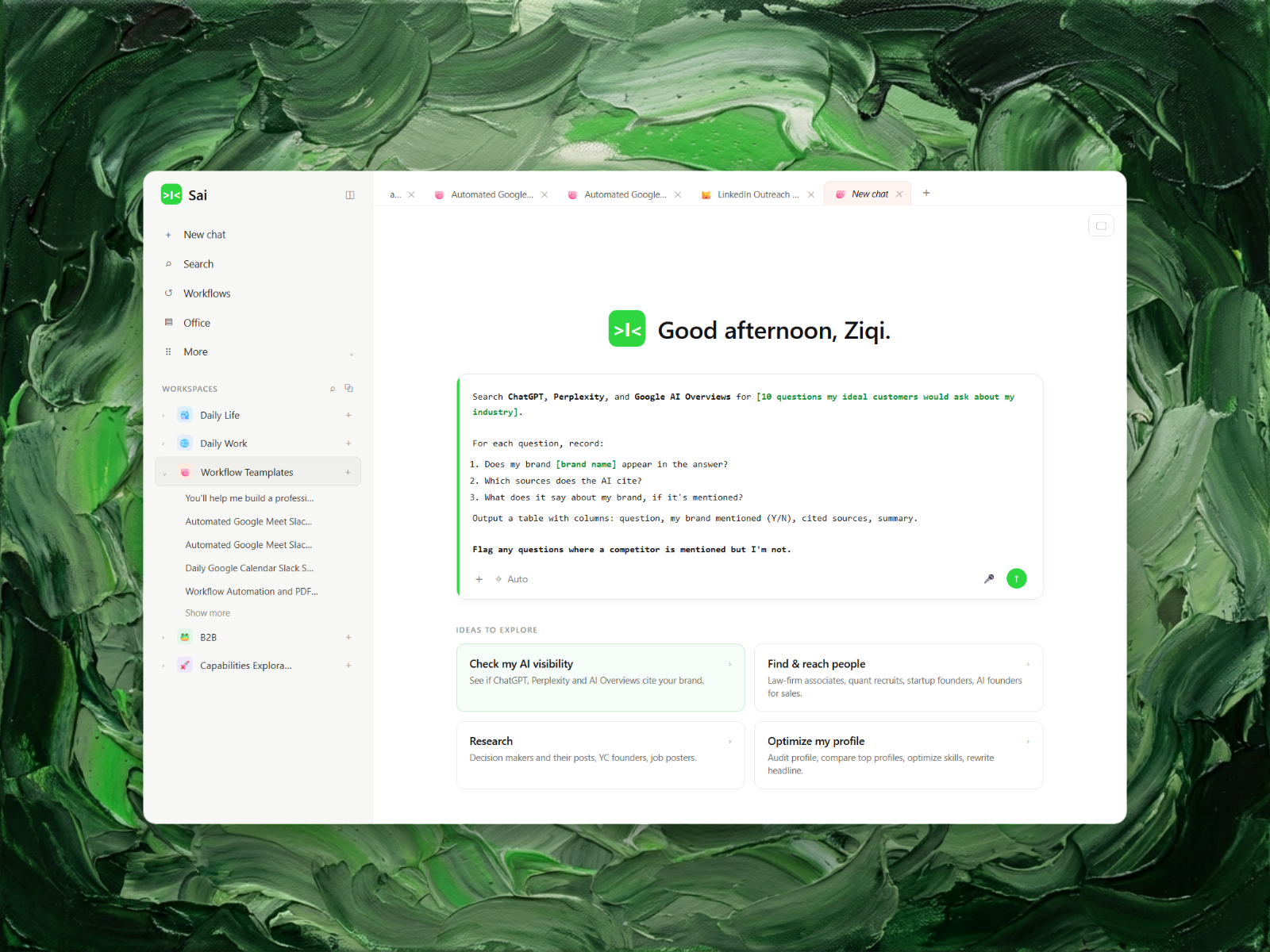
Sai runs your questions through ChatGPT, Perplexity and Google AI Overviews, records whether your brand appears in each answer, and lists the sources each engine cited. Questions where a competitor appears and you do not are flagged.



The recording is a real session. The sheet on the right is what it produced.
Sai opens each profile, pulls the signal, and writes the row, live, in a real browser.
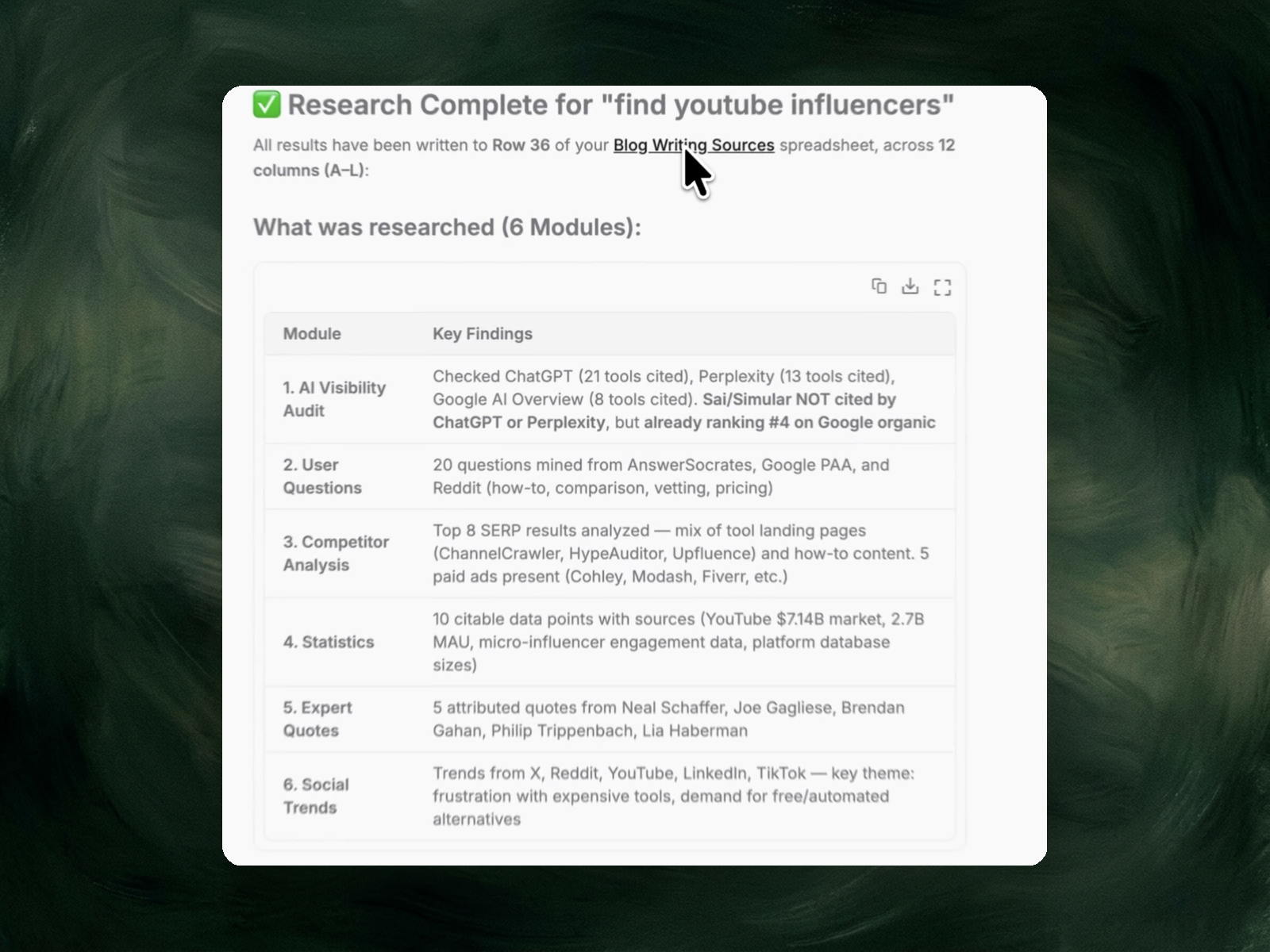
Eight columns, sorted by score, with a source link behind every claim.
A list of 10 questions your customers would ask, your brand name, and the competitor names you want tracked. A Google Sheet if you want results written to a spreadsheet rather than a file.
A table with one row per question per engine, recording whether your brand appeared, which competitors appeared, every source cited, and the exact wording used about your brand. Plus two summaries: questions where a competitor appears and you do not, and cited sources ranked by frequency.
Set it to run monthly with the same question set. Comparing two runs shows which questions changed and which sources entered or dropped out of the citation list.
A category of tools now tracks brand presence in AI-generated answers. Profound, Peec AI, Otterly.ai, Scrunch AI and AthenaHQ run prompt sets against ChatGPT, Perplexity, Gemini and Google AI Overviews on a schedule. Semrush and Ahrefs have added equivalent modules to their existing platforms.
Their primary output is a visibility metric: the share of tracked prompts in which the brand appears, tracked over time, usually alongside a set of named competitors.
They sample repeatedly, which matters — AI answers vary between runs for the same question. A single query returns one sample; a platform running the same prompt daily produces a distribution. They also alert when the number moves.
Persistent monitoring is a function this task does not perform. What follows is a different output, not a cheaper version of the same one.
A visibility score states how often a brand appears. It does not state what the engine read to produce the answer.
When ChatGPT answers a question about a product category, it draws on specific sources — review sites, listicles, documentation, forum threads, vendor pages. Those sources determine which brands appear. A brand absent from the answer is usually absent from the sources.
The score reports the outcome. The citation list reports the cause. Changing the outcome requires acting on the sources, which means knowing what they are.
This task records the citations.
For each question, on each engine, six fields:
Results are split by engine rather than merged. The three engines draw on different sources and frequently disagree — appearing in Perplexity and not in ChatGPT is a specific finding, and a merged row loses it.
Two summaries follow the table. The first lists every question where a competitor appears and the brand does not. The second ranks cited sources by frequency across all questions.
The second summary is the actionable output.
A source cited across multiple questions is a page the engines rely on for that topic. Being present on it is a defined task with a known target — a review site listing, a comparison page, a documentation reference, a forum thread.
An overall visibility score does not decompose into targets. A ranked list of sources does.
Where a brand is mentioned, the sentence is quoted rather than summarized.
Two failure modes are only visible in the exact wording: being described in the wrong category, and being described with outdated or incorrect specifics. Both count as appearances in a visibility metric. Both are problems.
AI answers vary between runs. The same question asked twice can return different brands and different citations.
A run is recorded and labelled as one sample. It is not presented as a stable ranking, because it is not one.
For a stable measure, repeated sampling is required, and the platforms above are built for it. A single run establishes what the engines are drawing on, which is comparatively stable even when the specific answers are not — the source pool changes more slowly than the wording.
Continuous tracking. It runs on request. No trend line, no history.
Alerting. Nothing is sent when results change.
Large-scale sampling. It runs the questions given, once. Statistical confidence requires repeated sampling.
Content production. It reports which sources are cited. It does not write or place anything on them.
Gemini and Copilot. This template covers ChatGPT, Perplexity and Google AI Overviews.
Where the requirement is a monitored metric with alerts across hundreds of prompts, a tracking platform addresses that directly. This task addresses a defined question — what are the engines citing on my topic, and am I in it.
Run monthly with an unchanged question set, two runs can be compared: which questions changed state, which sources entered the citation list, which dropped out.
This is a coarse signal compared to daily sampling, but it uses the same question set and records full citations each time, so a change points to a specific source rather than a movement in an index.
For tracking how a brand is discussed in forums rather than in AI answers, Reddit sentiment analysis covers that separately. For research runs that cite every source they draw on, the newsletter generator applies the same citation handling to news.