Oops! Something went wrong while submitting the form.
How to Do a Comparative Market Analysis: Step-by-Step Guide for Agents and Homeowners
How to do a comparative market analysis in 6 steps: research the subject, find comps, calculate adjustments, analyze competition, and price the listing. Free CMA template and tools compared.
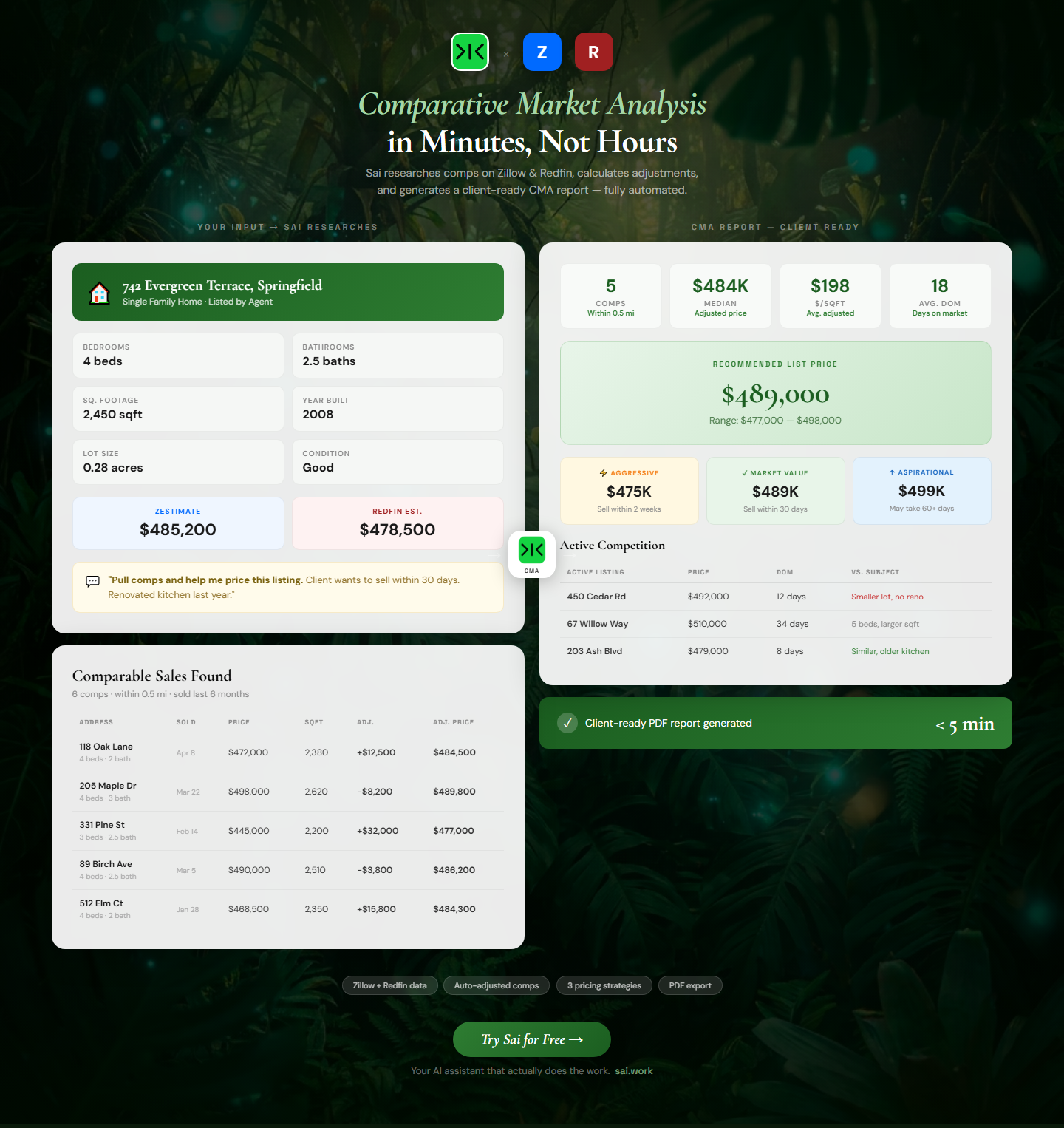
Say "Run a comparative market analysis for 456 Oak Street, Austin TX 78701." Sai researches the subject property on Zillow and Redfin, finds 5-8 comparable sales within your specified radius and time frame, calculates adjustments across 10 dimensions, analyzes active competition, and produces a client-ready PDF report with three pricing strategies. The entire process takes minutes instead of hours.
Cross-reference multiple data sources automatically
ai pulls the Zillow Zestimate, Redfin Estimate, tax assessment value, and price-per-square-foot data from comparable sales — then presents all four benchmarks side by side. You see where the estimates agree and where they diverge, giving you a stronger basis for your pricing recommendation.
Extend the CMA into a full listing workflow
After the CMA, say "Now generate a listing description for this property" or "Create a lease agreement for this address" or "Draft a follow-up email to the seller with the CMA attached." Sai connects the pricing analysis to listing descriptions, lease agreements, and email follow-ups — all from the same conversation.
Every listing appointment starts with the same question: "What is my house worth?" A comparative market analysis is how you answer it with data instead of guesswork.
A comparative market analysis (CMA) compares a subject property to similar properties that recently sold nearby, then adjusts for differences in size, condition, and features to estimate market value. It is the single most important document in a real estate transaction — it sets the listing price, guides buyer offers, and anchors negotiations.
According to the National Association of Realtors, overpriced listings sit on the market an average of 3x longer than correctly priced homes, and typically sell for less than they would have if priced right from the start. The CMA prevents that.
This guide walks through the complete process — from pulling comps to calculating adjustments to presenting the pricing recommendation. Whether you are a real estate agent preparing for a listing appointment or a homeowner trying to understand your property's value, the steps are the same.
A comparative market analysis is a data-driven estimate of a property's value based on recently sold comparable properties (comps). It answers: "Based on what similar homes have sold for recently, what should this property be worth?"
A CMA is not a formal appraisal. According to theAppraisal Institute, a certified appraisal follows Uniform Standards of Professional Appraisal Practice (USPAP) and is required by lenders for mortgage origination. A CMA is prepared by a real estate agent and is used for pricing strategy — not lending decisions.
When you need a CMA:
Listing a property for sale (pricing recommendation)
Making an offer as a buyer (offer strategy)
Evaluating a home's value before refinancing
Estate planning or divorce settlements (informal valuation)
A CMA is not optional — it is the difference between a property that sells in 14 days and one that sits for 6 months with two price reductions.
For listing agents:
The CMA is your credibility document. Sellers interview 2-3 agents before choosing one, and the agent who presents the most thorough, data-backed pricing recommendation wins the listing. A well-prepared CMA demonstrates market expertise, justifies your pricing strategy, and gives the seller confidence that you are not just guessing.
Without a CMA, you are relying on gut feel. According to Zillow research, homes priced more than 10% above market value receive 60% fewer showings in the first two weeks — the critical window when buyer interest peaks. Every week a listing sits unsold, the eventual sale price drops by an average of 0.5-1%.
For buyer agents:
A CMA protects your client from overpaying. In competitive markets with multiple offers, buyers need data to set their ceiling. In slower markets, a CMA identifies properties priced above market value where there is room to negotiate.
For homeowners (FSBO or pre-listing research):
Even if you are not working with an agent, a CMA gives you a realistic value range before you set an asking price. Free online estimates (Zillow Zestimate, Redfin Estimate) provide a starting point, but they do not account for interior condition, recent renovations, or hyperlocal factors like school district boundaries and street-level desirability.
For investors:
A CMA is the foundation of every acquisition decision. It tells you whether a property is priced below market (potential deal), at market (fair value), or above market (walk away or negotiate). Combined with rental income analysis, it drives cap rate and cash-on-cash return calculations.
How to Do a Comparative Market Analysis in 6 Steps
Step 1: Research the Subject Property
Before finding comps, document everything about the subject property:
Essential data points:
Full address and legal description
Property type (single-family, condo, townhouse, multi-family)
Bedrooms and bathrooms (including half baths)
Total living square footage (above-grade)
Lot size
Year built
Garage (attached/detached, number of cars)
Basement (finished, unfinished, none)
Current condition (excellent, good, fair, poor)
Recent renovations (kitchen, bathrooms, roof, HVAC — with approximate cost and year)
Unique features (pool, view, corner lot, solar panels, smart home features)
Pro tip: Start with the tightest criteria and expand if you cannot find enough comps. A comp that sold last month 0.3 miles away is worth more than one that sold 8 months ago 2 miles away.
Step 3: Calculate Price Adjustments
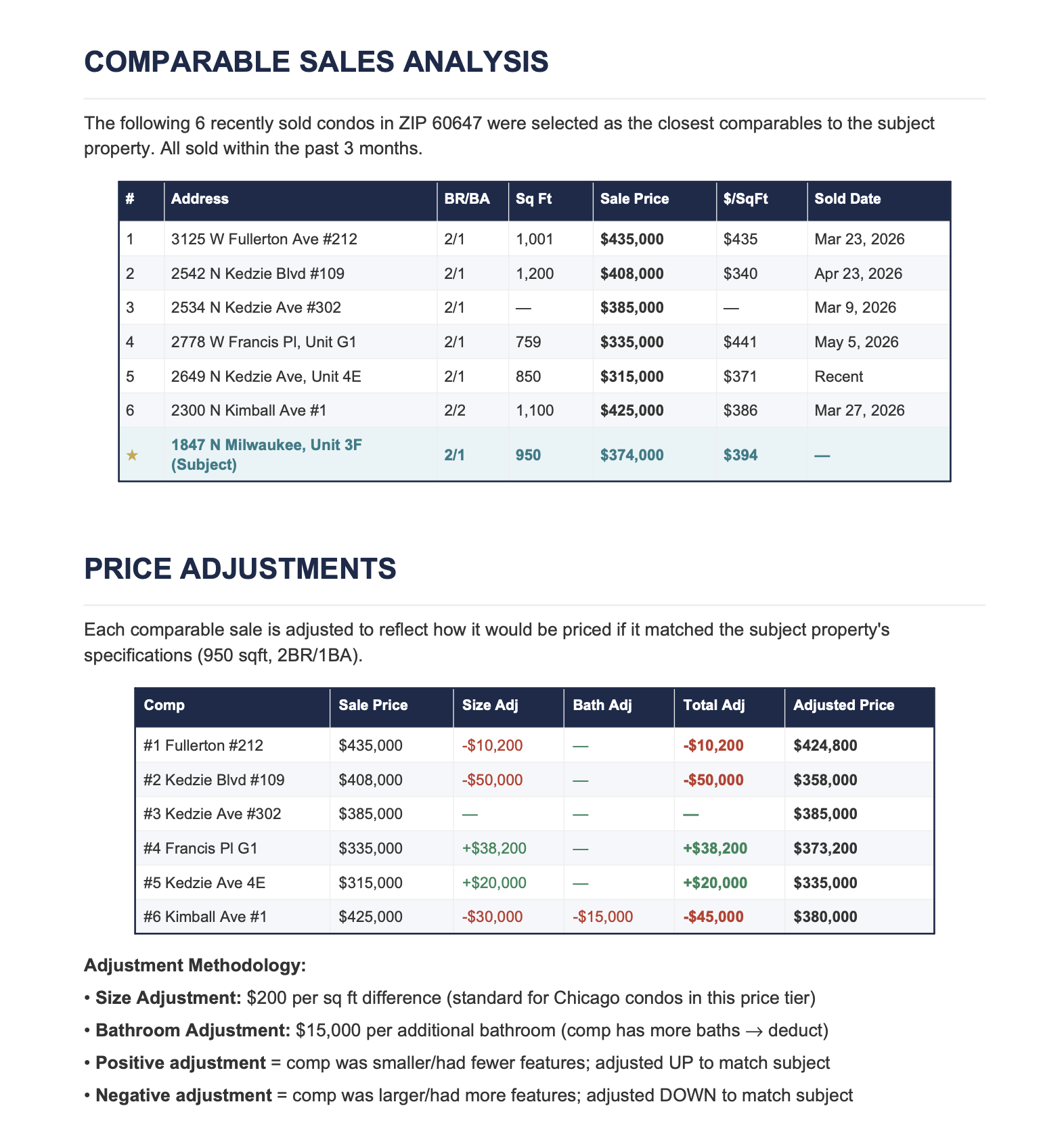
Raw comp prices are meaningless without adjustments. A 2,400-sqft home that sold for $500,000 is not directly comparable to a 1,800-sqft subject property — you need to adjust for the 600-sqft difference.
The adjustment principle: Adjust the comp to match the subject property. If the comp has something the subject does not (extra bedroom, pool, newer build), subtract value. If the subject has something the comp does not, add value.
Standard adjustment values (vary by market — these are starting points):
Method
Time Per CMA
Cost
Accuracy
Best For
Manual (MLS + Spreadsheet)
2-4 hours
Free (MLS subscription)
High (agent expertise dependent)
Experienced agents with strong local knowledge
CMA Software (Cloud CMA, RPR)
30-60 minutes
$0-35/month
Medium-High (data quality varies)
Agents wanting polished client presentations
AVM Tools (Zillow, Redfin)
Instant
Free
Low-Medium (no adjustments)
Quick ballpark estimates for initial conversations
Comp sold for $480,000 — 3 bed, 2 bath, 2,200 sqft, built 2015, good condition, no pool. Subject property — 3 bed, 2 bath, 1,900 sqft, built 2018, good condition, pool.
AdjustmentCalculationAmountSquare footage(1,900 - 2,200) x $150/sqft-$45,000Year built2018 vs 2015 = 3 years newer+$9,000PoolSubject has pool, comp does not+$20,000Net adjustment-$16,000Adjusted comp price$480,000 - $16,000$464,000
The 15% rule: If your net adjustments exceed 15% of the comp's sale price, the comp is probably too different from the subject. Consider replacing it with a more similar property.
Step 4: Analyze Active Competition
Sold comps tell you what the market has paid. Active listings tell you what the market is currently offering. Both matter for pricing strategy.
Research 3-5 currently active listings that compete with the subject property:
What are they listed at?
How long have they been on the market?
How do they compare to the subject (better or worse condition, more or fewer features)?
Have they had price reductions?
A subject property priced above all active competition will likely sit. A subject property priced at or below active competition will generate more showings and potentially multiple offers.
Step 5: Determine the Price Recommendation
After adjusting all comps, calculate:
Adjusted price range: Lowest adjusted comp to highest adjusted comp
Average adjusted price: Mean of all adjusted comp prices
Median adjusted price: Middle value (less sensitive to outliers)
Price per square foot: Average adjusted price / subject sqft
Present three pricing strategies:
Aggressive pricing (below market): Price at or below the lowest adjusted comp. Targets 1-2 week sale. Best in balanced or buyer's markets where speed matters.
Market value pricing (at market): Price at the median adjusted comp. Targets 30-day sale. The most common and defensible strategy.
Aspirational pricing (above market): Price above the highest adjusted comp. Tests the market. Risk of extended DOM and eventual price reduction.
Factors beyond the data:
Current market temperature (seller's vs. buyer's market)
Seasonal trends (spring/summer stronger in most markets)
The six steps above represent 2-4 hours of manual work: searching Zillow and Redfin for subject property data, filtering recently sold properties, building an adjustment spreadsheet, checking active listings, running the pricing math, and formatting a client-ready report. Sai compresses that entire workflow into a single instruction.
Steps 1-2 (Research + Comps): Sai opens Zillow and Redfin in a browser, pulls the subject property's details (beds, baths, sqft, lot, year built, Zestimate, Redfin Estimate, tax assessment), then searches recently sold properties within your specified radius and time frame. It selects 5-8 comps that match the subject on property type, size, and age — the same criteria an experienced agent would use.
Step 3 (Adjustments): Sai calculates line-item adjustments across 10 dimensions: square footage, bedrooms, bathrooms, lot size, year built, condition, garage, pool, basement, and location premium. It flags any comp where net adjustments exceed 15% of the sale price and suggests a replacement.
Step 4 (Competition): Sai searches active listings in the same area and identifies 3-5 properties competing with the subject. It notes their list prices, days on market, and how they compare in size and features.
Step 5 (Pricing): Sai calculates the adjusted price range, average, median, and price per square foot — then presents three pricing strategies (aggressive, market value, aspirational) with the rationale for each.
Step 6 (Report): Sai generates a professional PDF report with all sections: subject property profile, comparable sales grid with adjustments, active competition analysis, market overview, and pricing recommendation. Ready to present at a listing appointment.
The agent's role shifts from data collection to data validation. Review Sai's comp selection, verify the adjustment values against your local market knowledge, and apply your professional judgment to the final pricing recommendation. The 2-4 hours of manual work becomes 10-15 minutes of expert review.
After the CMA, the workflow continues in the same conversation: "Now write a listing description for this property" produces three versions (MLS, marketing, social media). "Create a 12-month lease agreement" generates a state-compliant lease with the property details already filled in. "Draft a follow-up email to the seller" produces a personalized message with the CMA highlights attached. One conversation, one property, every deliverable.
Stop doing repetitive tasks. Let Sai handle them for you.
Sai is your AI computer use agent — it operates your apps, automates your workflows, and gets work done while you focus on what matters.

.svg)


.svg)