
Oops! Something went wrong while submitting the form.

Artificial intelligence is not replacing real estate agents. It is replacing the 60% of an agent's workweek that is not client-facing: pulling comps, writing listing descriptions, following up with leads, scheduling showings, creating marketing materials, and generating lease agreements.
According to the National Association of Realtors 2024 Member Profile, the average agent spends only 34% of their time on client-facing activities. The rest goes to administrative tasks, marketing, and transaction coordination. AI is compressing that administrative overhead, giving agents more hours for the work that actually wins listings and closes deals.
This guide covers twelve specific ways AI is being used in real estate today — not speculative future applications, but tools and workflows agents and brokerages are deploying right now.
The traditional CMA process takes 2-4 hours: research the subject property, search for comps in the MLS, adjust for differences, format the report. AI compresses this into minutes.
How AI changes the process:
Tools: Sai (automated end-to-end CMA), HouseCanary (AI-powered AVM), Cloud CMA (MLS-connected presentation)
For a detailed comparison of CMA tools, see our best comparative market analysis tools roundup, or follow our step-by-step CMA guide.
Writing compelling listing descriptions is a learned skill that most agents have not mastered. AI generates multiple versions — MLS-compliant factual, marketing-focused emotional, and social media posts — from property data.
What AI produces:
Tools: Sai (3-version output: MLS, marketing, social), ChatGPT/Claude (general writing), Listing descriptions.ai
Video tours have become essential in real estate marketing, especially for out-of-area buyers. AI tools now create professional-quality property videos from raw footage — adding transitions, music, voiceover, and captions automatically.
Top AI avatar tools for real estate video walkthroughs:
Why agents use AI video tools: According to the National Association of Realtors, listings with video receive 403% more inquiries than those without. But professional video editing costs $200-$500 per property. AI tools reduce this to minutes and near-zero marginal cost.
AI is transforming how agents identify, qualify, and nurture leads. Predictive analytics identify homeowners likely to sell; chatbots qualify inbound leads 24/7; and automated follow-up sequences keep agents top-of-mind.
Key applications:
Tools: Sai (automated email follow-up and meeting scheduling), Lofty/Chime (AI CRM), Rechat (real estate CRM), Follow Up Boss (lead management)
Creating lease agreements manually means either paying a lawyer ($500-$1,500 per lease) or using generic templates that miss jurisdiction-specific requirements. AI generates complete, state-compliant lease agreements from natural language descriptions.
What AI lease generators handle:

Tools: Sai (complete lease generator with all 50 states), LegalZoom (template-based), Rocket Lawyer (template + attorney review)
For a step-by-step guide, see our article on how to create a lease agreement. For a comparison of AI lease and contract tools, see our AI contract generator roundup.
Automated Valuation Models (AVMs) use machine learning to estimate property values from public data, tax records, and market trends. While not replacements for agent-prepared CMAs or formal appraisals, AVMs provide instant baseline estimates.
Key platforms:
AI processes market data at a scale and speed no human analyst can match — identifying trends, predicting price movements, and surfacing investment opportunities.
What AI market analysis covers:
Tools: HouseCanary (3-year forecasts), CoreLogic (market trends), Zillow Research (public data and reports), ATTOM Data (property data analytics)
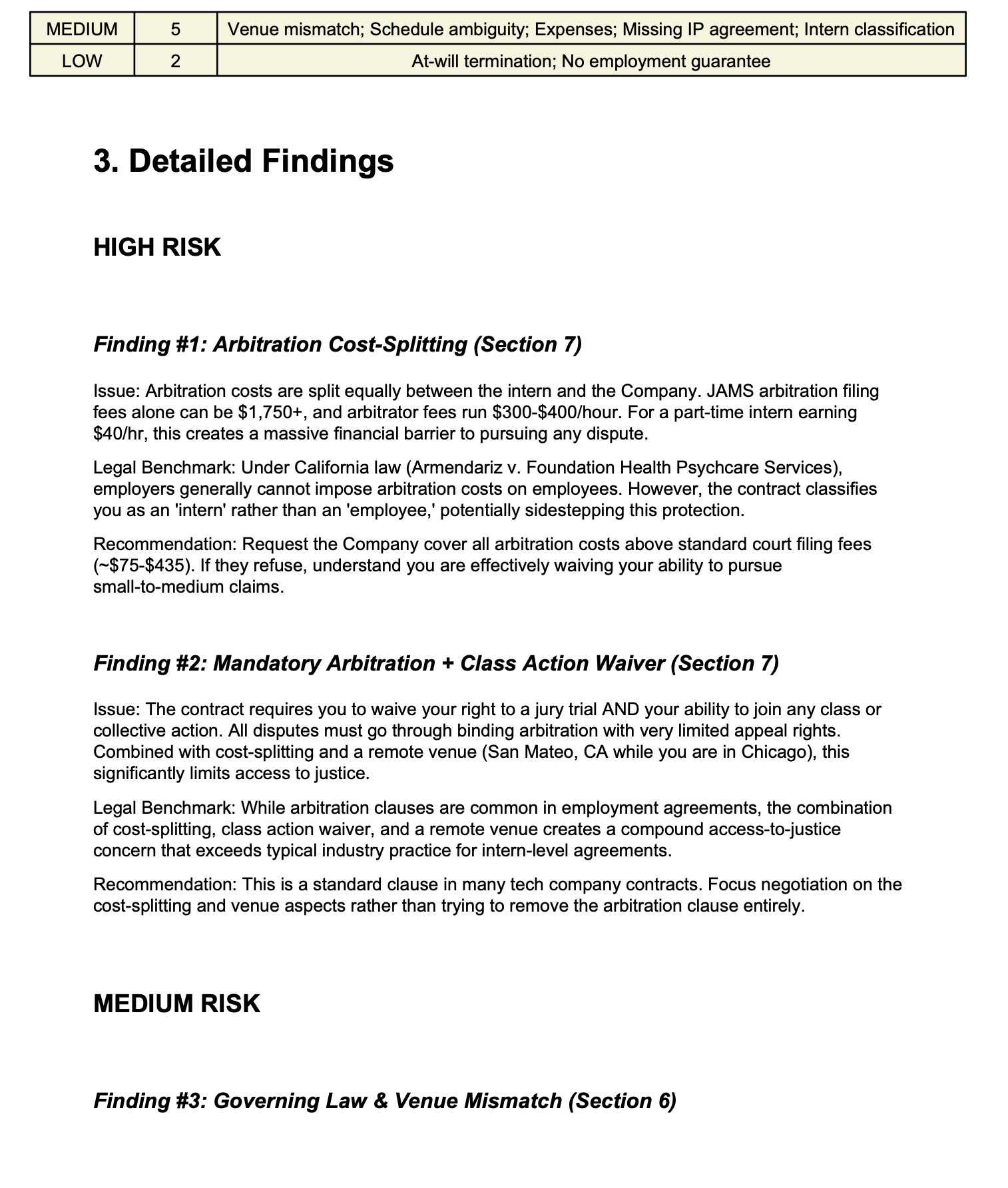
Real estate transactions involve multiple contracts: purchase agreements, lease agreements, inspection contingencies, and closing documents. AI contract review identifies risks, missing clauses, and unfavorable terms before signing.
Real estate contract review applications:
Tools: Sai (AI contract review with 10 contract types, 4-severity risk scoring), Juro (CLM platform), LawGeex (policy-based review)
For details on AI contract review, see our how to do contract review guide.
Real estate is a relationship business, and most deals are lost through poor follow-up — not poor negotiation. AI automates the follow-up sequences that keep agents top-of-mind without manual effort.
What AI email automation handles:
Tools: Sai (automated email drafting and follow-up sequences), Follow Up Boss (CRM with automation), Mailchimp (email marketing)
Scheduling property showings involves coordinating buyer availability, seller access, and agent calendars — often across multiple time zones. AI scheduling tools eliminate the back-and-forth.
What AI scheduling handles:
Tools: Sai (AI meeting scheduling), Calendly (booking links), ShowingTime (MLS-integrated showing management)
First impressions in real estate are visual. AI tools enhance listing photos, virtually stage empty rooms, and even create twilight versions of daytime exterior shots.
Key applications:
Tools: Virtual Staging AI, BoxBrownie, Restb.ai (image classification), Apply Design (AI interior design)
Transaction coordination — managing the 30-60 tasks between contract acceptance and closing — is one of the most tedious parts of real estate. AI automates task tracking, deadline management, and document collection.
What AI transaction coordination covers:
Tools: Dotloop (Zillow-owned transaction management), SkySlope (transaction management), Sai (automated task tracking and email reminders)
The adoption of AI in real estate is accelerating. Key data points:
Where AI is not replacing agents:
The agents who will thrive in 2026 and beyond are not the ones who avoid AI — they are the ones who use it to eliminate administrative work and spend more time on the high-value, human-centric work that clients actually hire them for.
The 12 use cases above describe categories. Most AI tools address one or two of them — a CMA tool here, a virtual staging tool there, a CRM with automated drip campaigns somewhere else. An agent stitching together five or six single-purpose tools still spends hours switching between platforms, re-entering data, and manually connecting outputs.
Sai is different because it is not a single-purpose tool. It is an AI agent — software that operates a computer the way a human assistant would. It opens browsers, navigates websites, reads documents, fills out forms, writes emails, and produces finished deliverables. The difference between an AI tool and an AI agent: a tool answers questions, an agent completes tasks.
Here is what that looks like across a real estate workflow:

You say: "I have a listing appointment for 456 Oak Street, Austin TX 78701 tomorrow. Prepare everything I need."
Sai opens Zillow and Redfin, researches the property, pulls 5-8 comparable sales, calculates adjustments across 10 dimensions, analyzes active competition, cross-references the Zestimate and Redfin Estimate, and produces a client-ready CMA report with three pricing strategies. Time: 5-10 minutes instead of 2-4 hours.

You say: "Write the listing description, create a social media post, and edit this walkthrough video into a 60-second highlight reel."
Sai generates three listing description versions: MLS-compliant factual, marketing-focused emotional, and social media caption. It processes your raw walkthrough footage into a polished video with transitions, AI voiceover, subtitles, and branded intro/outro cards. All outputs are ready to publish — no reformatting, no switching between Canva, a video editor, and a word processor.
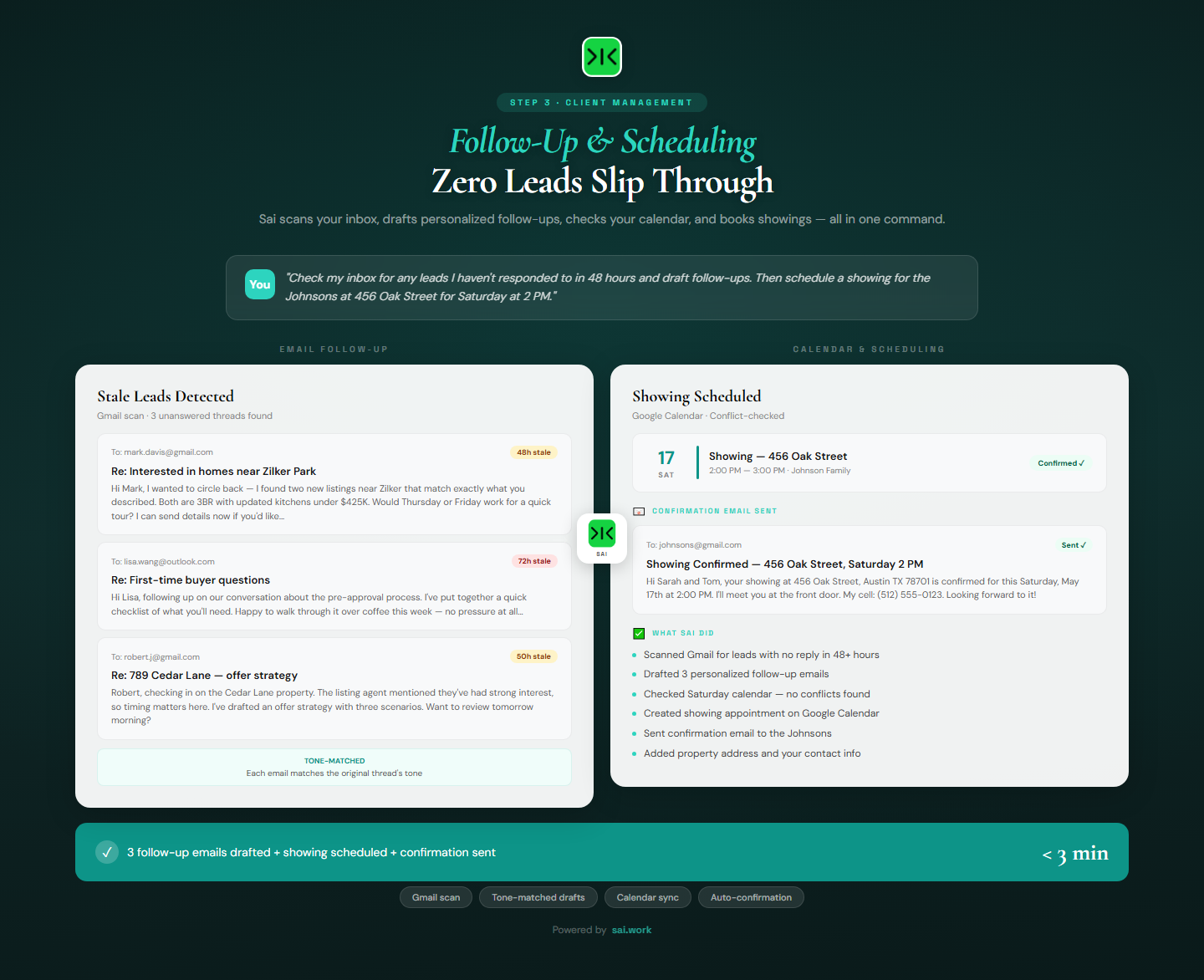
You say: "Check my inbox for any leads I have not responded to in the past 48 hours and draft follow-up emails. Then schedule a showing for the Johnsons at 456 Oak Street for Saturday at 2 PM."
Sai scans your Gmail, identifies stale conversations, drafts personalized follow-up emails that match the tone and context of each thread, and queues them for your review. Then it checks your Google Calendar for conflicts, creates a showing appointment, and sends a confirmation email to the buyers with the property address and your contact information. See our AI scheduling assistant comparison for how this compares to traditional scheduling tools.

You say: "The seller accepted an offer. Create a 12-month lease agreement for this property — tenant is John Smith, $1,800/month, $1,800 deposit, small dogs allowed with $300 pet deposit."
Sai generates a complete 20-section lease agreement with Texas-specific provisions: no security deposit cap (Texas has no statutory limit), required disclosures, proper notice periods, pet addendum, and federal lead-based paint disclosure (if pre-1978). Output: Google Doc for editing and PDF for signing.
You then say: "Now review the purchase agreement the buyer's agent sent over."
Sai reads the contract, flags risks by severity (critical, high, medium, low), identifies missing contingencies, checks earnest money and closing cost allocations, and produces a structured risk assessment report. You know exactly which clauses to push back on before you call the other agent.
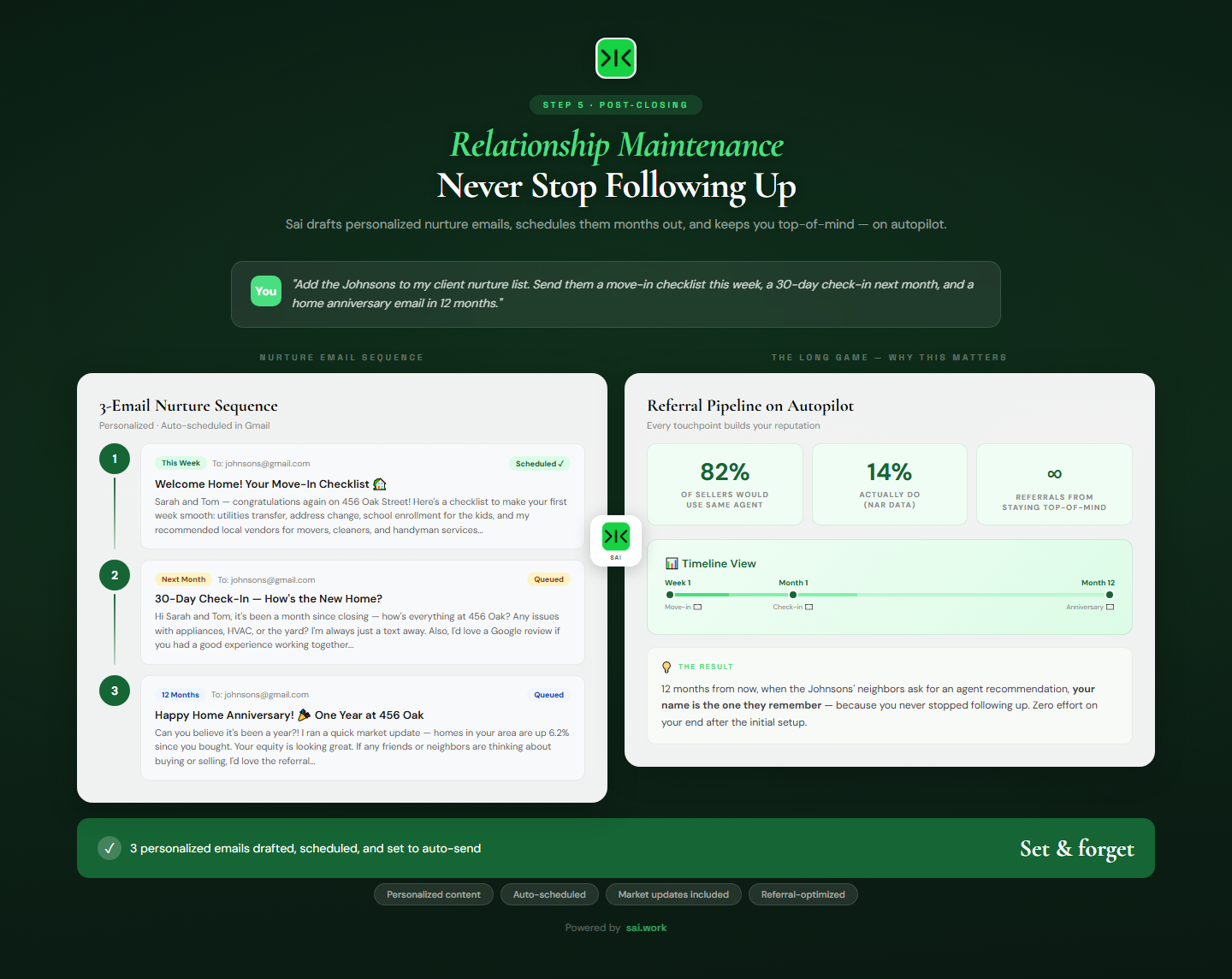
You say: "Add the Johnsons to my client nurture list. Send them a move-in checklist email this week, a 30-day check-in next month, and a home anniversary email in 12 months."
Sai drafts all three emails, personalizes them with the property address and closing details, and schedules them in your Gmail. Twelve months from now, when the Johnsons' neighbors ask for an agent recommendation, your name is the one they remember — because you never stopped following up.
ChatGPT and Claude are language models. They generate text when you type a prompt. Sai is an agent that operates your computer. The difference:
The difference is not intelligence. It is agency. Sai does not wait for you to copy-paste data into a prompt. It goes and gets the data, processes it, and delivers the finished work product.
One conversation, one property, every deliverable. CMA, listing descriptions, video, lease agreement, contract review, follow-up emails, showing schedule — all produced in the same session, with context carrying forward from one task to the next. No re-entering the property address. No switching between six different platforms. No copying data from one tool and pasting it into another.
That is what an AI agent does that a collection of AI tools cannot.