
Oops! Something went wrong while submitting the form.
The best low-code workflow automation tool in 2026 depends on where your process runs. If every step lives in apps with good connectors, Zapier has the widest coverage (9,000+ apps), Make gives you the most visual control for the money, and n8n is the strongest choice if you want to self-host. If you run on Microsoft 365, Power Automate is already in your stack. If parts of the process live in software with no connector at all (a supplier portal, an admin console, a desktop app), Sai by Simular is the strongest choice: you describe the job in plain language, Sai does it on its own computer, and it turns a run that worked into a repeatable workflow.
Two things changed in 2026 that most lists still miss. Every major platform added AI agents to its canvas, so "low-code" now often means "describe it and let AI draft the flow". And Pipedream, a popular developer pick, announced that its Workflows product shuts down on 31 March 2027. We compared ten tools as they stand on 31 October 2026, using each vendor's own documentation and pricing pages.
Low-code workflow automation is software that lets you connect apps and automate multi-step business processes mostly by configuring, not coding. You pick a trigger (a new form entry, a schedule, an email), add steps on a visual canvas or in plain language, map data between apps, and drop into code only for the edge cases. The platform then runs the workflow for you, logs every run, and retries or alerts when a step fails.
The tools in this category fall into two groups. Integration-first platforms (Zapier, Make, n8n, Workato, Tray.ai, Activepieces) move data between apps through APIs and connectors. Process platforms (Power Automate, Appian, Retool) add approvals, forms, internal apps and, in Power Automate's case, desktop RPA. Most listicles mix the two without saying so.
Every integration-first tool works only where a connector or API exists. That covers most modern SaaS, but not the vendor portal your finance team logs into every Monday, the legacy ERP screen, or the government website you download reports from. Teams usually cover those steps by hand, or with brittle RPA scripts that break when a button moves.
This is the gap AI computer-use agents now fill. An agent such as Sai sees the screen and clicks and types like a person, so it can finish the steps your low-code tool cannot reach. The practical question for 2026 is not "which low-code tool" alone, but "which tool for the API steps, and what handles the screen steps".
We compared each tool on six things a builder lives with: how you build (visual canvas, code steps, natural language); whether you can self-host; the number of integrations the vendor states; AI and agent features shipped in 2026; what it can do when no connector exists; and public pricing, including the free tier. Every fact comes from the vendor's own website, documentation or pricing page, checked on 31 October 2026. Where a vendor does not publish a price, we say so.
| Tool | Best for | How you build | Integrations | Self-host | Free tier | Paid from |
|---|---|---|---|---|---|---|
| Sai by Simular | Steps in apps with no connector | Plain language; API for developers | Any app on screen | Runs on your own Mac or PC, or a cloud computer | Yes, daily credits | $50/mo |
| n8n | Technical teams who self-host | Visual canvas + JS/Python | 500+ native | Yes | Community Edition (self-hosted) | €20/mo (annual) |
| Zapier | Widest app coverage | Step builder, Copilot, Canvas | 9,000+ apps | No | 100 tasks/mo | $19.99/mo |
| Make | Complex visual scenarios | Visual canvas, Maia assistant | 3,000+ apps | No | 1,000 credits/mo | Credit-based plans |
| Power Automate | Microsoft 365 organisations | Flow designer, Copilot, desktop RPA | 1,400+ connectors | No | 30-day trial | $15/user/mo (annual) |
| Workato | Enterprise IT | Low-code recipes, Agent Studio | 17,000+ apps, APIs, MCP servers | On-prem agent add-on | Trial | Quote only |
| Tray.ai | Governed agents + integrations | Visual builder, Merlin Agent Builder | 700+ connectors | Enterprise only | 30-day trial | From $50/mo (Helix Builder) |
| Activepieces | Open-source Zapier alternative | Visual flows, chat builder | 770+ pieces | Yes (MIT core) | 1,000 credits/mo | $20/mo |
| Gumloop | Business teams building agents | Natural language + node canvas | 400+ connectors | No (VPC on Enterprise) | 14-day trial | $37/mo |
| Retool Workflows | Engineering teams | Canvas + JS/Python blocks | Any REST, GraphQL, gRPC API | Enterprise only | 500 runs/mo | $10/builder/mo + $5/user |
Sai is an autonomous computer: an AI agent with its own Windows or Linux cloud computer (or your own Mac or PC) that does screen work for you. Instead of drawing a flow, you describe the job in plain language, for example "every Monday, download last week's invoices from the supplier portal and add them to the finance tracker". Sai opens the apps, clicks and types like a person, and asks for your approval before sign-ins and sensitive steps.
What makes it a workflow tool rather than a one-off assistant is what happens after the first run. Sai saves a task that worked and replays it on a schedule, calling the AI model only where the screen actually changes, so repeat runs get faster and cheaper. When an app moves a button, Sai notices, finishes the job and updates the workflow instead of failing silently. The agent underneath holds the highest partial score on the official OSWorld 2.1 leaderboard, 79.38% in October 2026, at a published $14.34 per task. Developers can call the same agent from their own code or from n8n, Zapier or Make through the Sai API.
Key strengths: Works in any app a person can use, including desktop software and portals with no API. Plain-language setup, no canvas to learn. Learned workflows replay on a schedule and repair themselves when a screen changes. Approval before sensitive steps and a history of every run.
Limitations: It is not a drag-and-drop canvas, so teams that want to see every branch drawn out may prefer n8n or Make. For pure API-to-API syncs, a connector-based tool is faster and cheaper per run. Logins and passwords are completed by a person through an approval link, by design.
Best for: Operations, finance and sales teams whose processes cross web portals, desktop apps and internal tools that no low-code connector reaches.
Pricing: Free plan with daily credits. Pay as you go $50/month. Sai Unlimited $500/month. Enterprise custom (pricing).
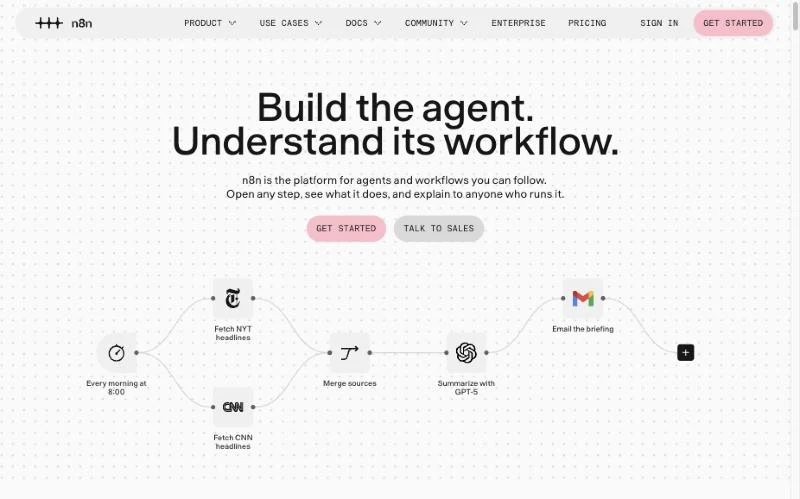
n8n calls itself "the platform for agents and workflows you can follow". You build on a visual node canvas, drop into JavaScript or Python when you need to, and can run everything on your own servers with Docker. It lists 500+ native integrations plus any API over HTTP. In July 2026 n8n replaced its AI Workflow Builder with an AI Assistant that builds, tests and fixes workflows from chat; it is in preview on n8n Cloud.
Key strengths: Full control and data residency through self-hosting. Every step is visible and debuggable. Mature AI agent nodes with MCP, human-in-the-loop approvals and evaluations.
Limitations: More technical than Zapier or Make (expressions and JSON). The Starter cloud plan caps runs at 5 minutes and keeps logs for 7 days. Git version control, SSO and multiple environments start on the Business plan.
Best for: Technical operations and engineering teams that want self-hosting and transparent AI workflows. Compare more options in our n8n alternatives guide.
Pricing: Self-hosted Community Edition is free. Cloud Starter €20/month (2,500 executions), Pro €50/month (10,000), Business €667/month, all billed annually (pricing).
Zapier connects more than 9,000 apps through trigger-and-action "Zaps" and now leads with "automation in the agentic era". You build step by step, describe a workflow to Copilot, or map larger processes on Canvas. Zapier Agents, Tables and a Zapier MCP server (available on every plan) round out the platform.
Key strengths: The largest connector catalogue. The easiest learning curve for non-technical teams. A real free plan.
Limitations: Task-based billing grows quickly with volume. The free plan allows only two-step Zaps with 15-minute polling. Agents are billed separately from Zaps.
Best for: Business teams that need to connect many SaaS tools quickly. See our Zapier alternatives for other options.
Pricing: Free (100 tasks/month). Professional from $19.99/month. Team from $69/month. Enterprise custom (pricing).
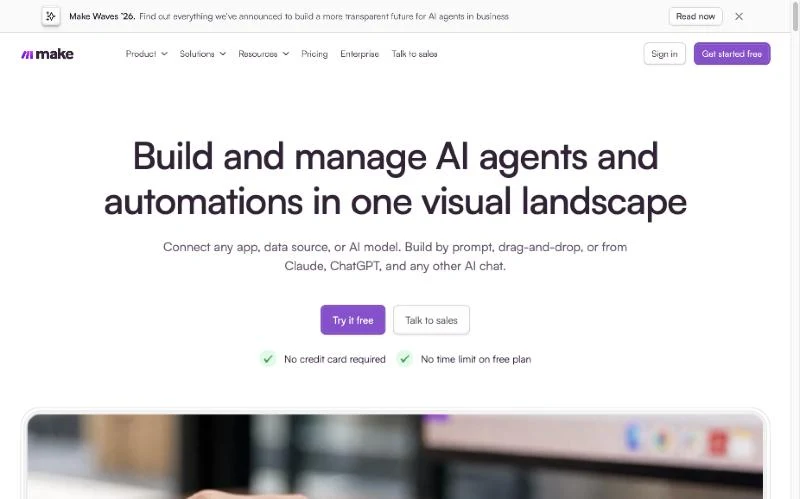
Make lets you "build and manage AI agents and automations in one visual landscape". Its scenario canvas handles branching, iterators and error routes better than linear builders, and you can start from a prompt with the Maia assistant or trigger scenarios from Claude, ChatGPT or Gemini through Make's MCP server.
Key strengths: The most expressive visual canvas in this list. Strong value for multi-step logic. AI Agents with a visible reasoning view.
Limitations: Credit billing is hard to forecast, and AI steps can use more than one credit. Since November 2025, extra credits cost 25% more than plan credits. No self-hosting.
Best for: Operations and marketing builders who want fine control over branching without writing code.
Pricing: Free plan with 1,000 credits/month. Paid Core, Pro and Teams plans are priced by monthly credits; check the current rates on make.com/pricing.
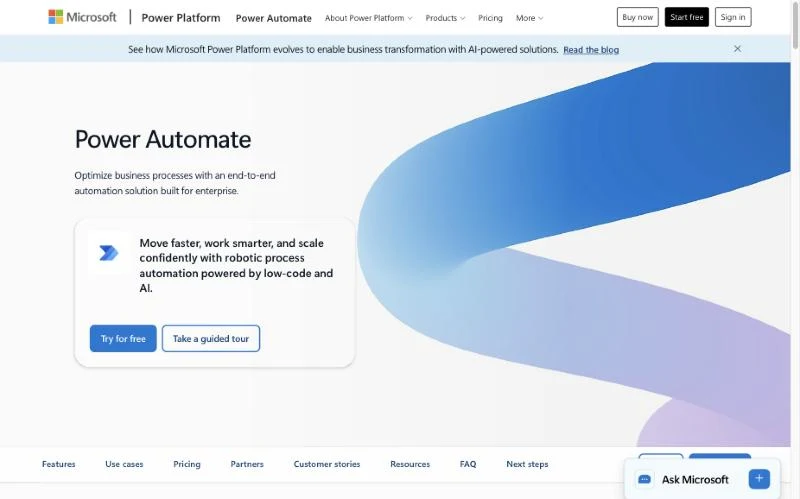
Power Automate combines cloud flows with more than 1,400 prebuilt connectors, desktop RPA for Windows apps, and process mining. You build in a visual designer or describe a flow to Copilot. Because it ships with Microsoft 365 and Dynamics, many organisations already have it.
Key strengths: Deep integration with Microsoft 365, Teams, SharePoint and Dataverse. Attended and unattended desktop RPA in the same product. Enterprise governance through the Power Platform admin centre.
Limitations: Licensing is complex: per user, per bot and a separate Copilot Studio credit model for agents. Premium connectors require a paid licence. Weaker outside the Microsoft ecosystem.
Best for: IT-led teams standardised on Microsoft 365.
Pricing: Premium $15/user/month (annual), including attended RPA. Process $150/bot/month (unattended). Hosted Process $215/bot/month. 30-day trial (pricing).
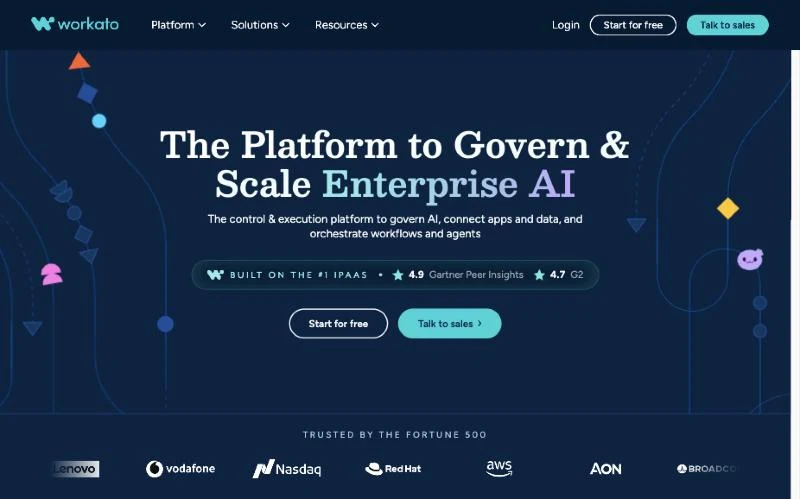
Workato positions itself as "the platform to govern and scale enterprise AI". Teams build low-code "recipes" across more than 17,000 apps, APIs, databases and MCP servers, and in 2026 added AIRO, a multi-agent system, alongside Agent Studio and Genies.
Key strengths: Enterprise-grade governance, security and audit. The broadest catalogue of enterprise connectors. Strong fit for cross-department processes such as quote-to-cash.
Limitations: No public pricing; every plan is quoted. Concurrency and workbots are capped by edition. Overkill for small teams.
Best for: Enterprise IT and business-systems teams automating across ERP, CRM and HR systems.
Pricing: Quote only; usage-based editions from Standard to Workato ONE (pricing).
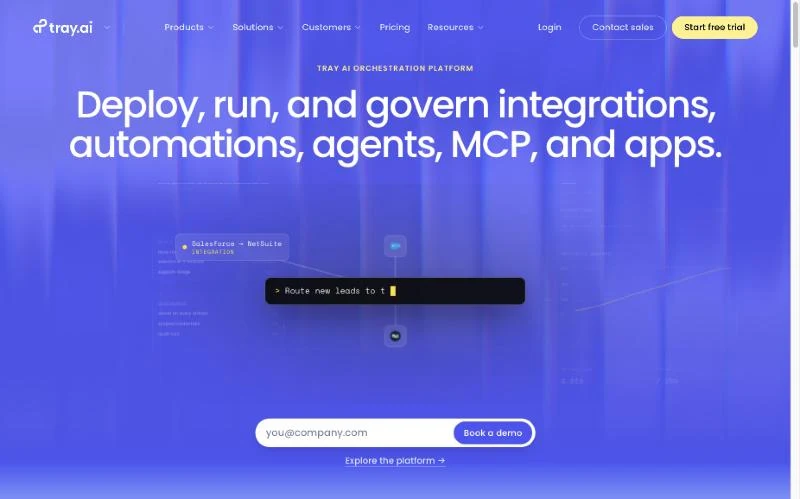
Tray.ai offers "one governed platform for agents, MCP, intelligent automation, and integration". You build in a visual low-code builder or drive it headlessly from coding agents, and the Merlin Agent Builder adds no-code agents on top. Billing is usage-based on tasks, with no per-user fees.
Key strengths: Agents, integrations and MCP under one governance layer. No per-seat pricing. A generous 30-day trial with 1 million tasks.
Limitations: Plan prices are not public beyond an entry figure. Agent features sit in a paid add-on. SSO and HIPAA are add-ons below Enterprise.
Best for: Mid-market and enterprise teams that want agents and integrations governed together.
Pricing: Pro, Team and Enterprise are quoted; Tray states its iPaaS "starts at $50 a month" with the Helix Builder Edition (pricing).
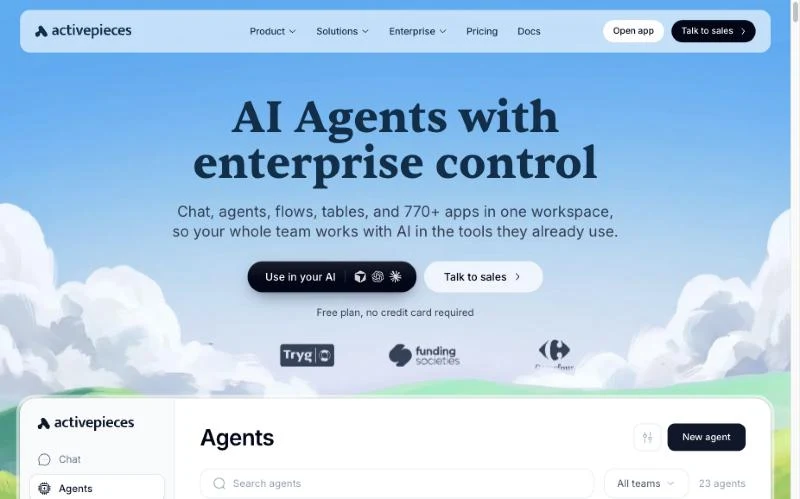
Activepieces is an MIT-licensed automation platform with 770+ integrations ("pieces"), a visual flow builder, a chat builder that drafts flows from plain language, and AI agents with approval steps. You can use the cloud version or self-host it, including fully air-gapped.
Key strengths: Open source and self-hostable. Simple, flat pricing where a run costs one credit regardless of steps. Easy to embed in your own product.
Limitations: Fewer integrations than Zapier or Make. AI steps cost 2 to 20 credits each depending on the model. A younger ecosystem.
Best for: Teams that want a low-cost, open-source Zapier alternative.
Pricing: Free (1,000 credits/month, 5 users). Plus $20/month (10,000 credits). Team $200/month. Enterprise custom (pricing).
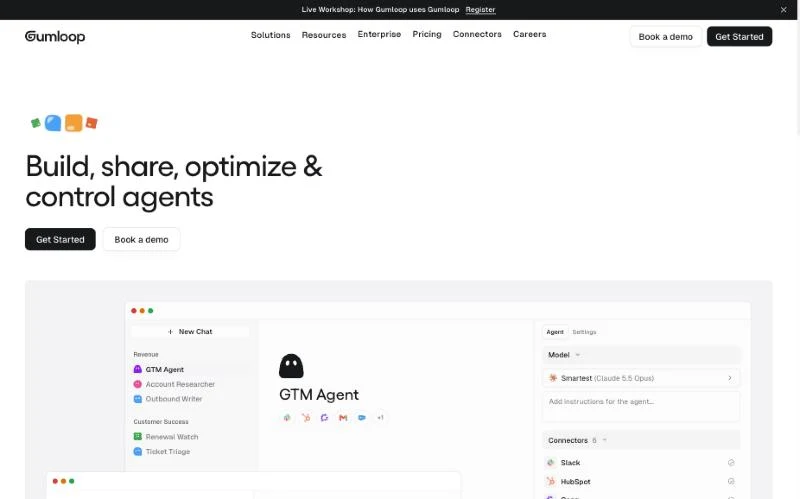
Gumloop lets teams "build, share, optimize and control agents". You describe an agent in plain language, connect 400+ connectors or custom MCP servers, and trigger it from events or Slack. A node-based workflow canvas sits underneath for teams that want deterministic steps.
Key strengths: Polished no-code experience for marketing, sales and ops. Agents that can improve their own instructions. A model router so you can choose the model per task.
Limitations: No free plan and no self-hosting. The Pro plan allows five concurrent runs. Credit use depends on the model you pick.
Best for: Business teams who want AI agents without engineering help.
Pricing: Pro from $37/month (20,000 credits) plus an orchestration fee; Enterprise custom; 14-day trial (pricing).
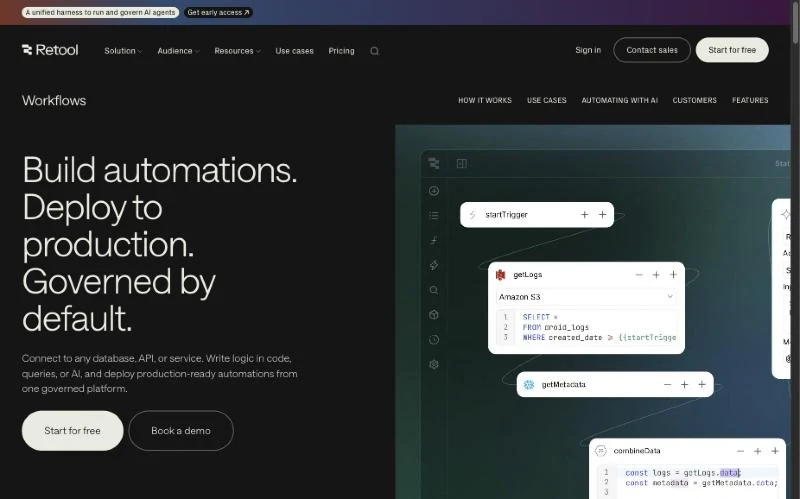
Retool Workflows is for developers: "Build automations. Deploy to production. Governed by default." You connect to any database or API, write logic in code blocks, queries or AI, and schedule or trigger the result. It pairs naturally with Retool's internal-tool builder.
Key strengths: Full code flexibility inside a visual frame. Works with any REST, GraphQL or gRPC API. Self-hosted and air-gapped deployment on Enterprise.
Limitations: Needs JavaScript or Python skills. A small library of prebuilt connectors. Low run caps unless you buy more.
Best for: Engineering teams already using Retool for internal tools.
Pricing: Free (500 workflow runs/month, up to 5 users). Team $10/builder plus $5/internal user per month (annual). Business $50 plus $15 per user. Extra runs $75 per 5,000 (pricing).
Sai is built for work that happens on a screen. If every step of your process has a reliable connector, Zapier, Make or n8n will be quicker to set up and cheaper per run. If your team wants every branch drawn on a canvas for review, a visual builder fits better. If you need everything to run inside your own data centre today, n8n, Activepieces and Retool offer self-hosting; Sai runs on Simular's cloud computers or on your own Mac or PC. Many teams use both: a low-code tool for the API steps and Sai for the steps no connector reaches.
Yes. In 2026 Zapier, Make, n8n, Workato, Tray.ai, Activepieces and Gumloop all ship AI agents or AI builders, and most support MCP so agents can call your workflows as tools.
Related reading: Best AI agent builders · Best n8n alternatives · Zapier alternatives · AI workflow automation for SMBs · What is an autonomous computer?
Product details and prices were checked on each vendor's official website on 31 October 2026.