
Oops! Something went wrong while submitting the form.
The best AI agent platform in 2026 depends on where your agent has to do its work. If the job ends inside software that has no API (a vendor portal, an admin console, a legacy Windows app), Simular Platform is the strongest choice: one API call hands the task to an agent with its own cloud computer, and it holds the highest partial score on the official OSWorld 2.1 leaderboard. If you build on one model vendor, OpenAI's Agents API and Anthropic's Claude Managed Agents now host the whole agent loop for you. If your company already runs on a cloud, Amazon Bedrock AgentCore, Google's Gemini platform and Microsoft Foundry give you a managed runtime next to your data. If you want a model-neutral, open-source stack, LangGraph with LangSmith Deployment, CrewAI and Mastra are the leading choices.
The category changed more in 2026 than in the previous two years. OpenAI, Anthropic, Google, LangChain and AWS each launched a hosted agent runtime. Google renamed Vertex AI. OpenAI is shutting down its visual Agent Builder on 30 November 2026, and AWS closed the original Bedrock Agents to new customers on 30 July 2026. Most "best AI agent platform" lists still recommend products that no longer take new users. This guide compares nine platforms as they stand on 28 October 2026, using each vendor's own documentation and pricing pages.
An AI agent platform is the software you use to build, run and govern AI agents: programs that take a goal, decide which steps to take, call tools to take them, and check the result. A complete platform covers four layers. The framework defines the agent loop, its tools and its memory. The runtime hosts that loop so it can run for minutes or hours, in parallel, with state that survives restarts. The tools let the agent act: APIs, code execution, a browser or a full computer. Governance covers what the agent may do without asking, who approved what, and how you trace and evaluate each run.
No single product owns all four layers equally well. Frameworks such as LangGraph or CrewAI are strongest at the first layer; cloud platforms such as AgentCore are strongest at the second; and very few platforms give the agent a real computer to act on. That last gap matters more than it looks, because much of the work companies want agents to do lives in software with no API.
Every platform below can call an API. The differences appear when the next step lives behind a login screen, inside a desktop app, or in a web portal that was never built for machines. There are three ways a platform can handle that:
If none of your agent's work touches a screen, choose on the other three layers. If some of it does, decide this first, because it shapes the rest of the stack. For a deeper look at the primitives approach, see our guide on how to give your AI agent a computer use tool.
We compared each platform on six things a developer has to live with: how you build (SDK, languages, visual tools); which models it supports; whether the platform hosts the agent loop; what the agent can act on, including browsers and full computers; governance (approvals, tracing, evaluations); and pricing, including any free tier. Every fact comes from the vendor's own documentation, pricing page or launch post, read on 28 October 2026. Where a vendor does not publish a price, we say so rather than estimate.
| Platform | Best for | How you build | Models | Hosted agent runtime | Acts on a computer | Starting price |
|---|---|---|---|---|---|---|
| Simular Platform (Sai API) | Agents that must use apps with no API | REST, MCP, CLI, Python and TypeScript SDKs | Model-agnostic | Yes, agent plus cloud computer | Yes, full Windows or Linux desktop, or your Mac or PC | Free tier; $50/mo pay as you go |
| OpenAI Agents API and SDK | Teams standardised on OpenAI models | Python (TypeScript SDK separate) | OpenAI; others via beta adapters | Yes, Agents API (beta) | Primitives: computer tool, you run the machine | Token rates only |
| Claude Platform (Agent SDK, Managed Agents) | Long-running, tool-heavy agents on Claude | Python, TypeScript | Claude only | Yes, Managed Agents (beta) | Primitives: computer and browser tools | Tokens + $0.08 per session-hour |
| Google Gemini platform (ADK, Agent Runtime) | Teams on Google Cloud | ADK 2.0: Python, Go, Java | Gemini, Claude, 200+ in Model Garden | Yes, Agent Runtime | Primitives: Computer Use (preview) | 50 free vCPU-hours/mo, then usage |
| Amazon Bedrock AgentCore | AWS shops, any framework | Any framework, or the config-based harness | Any | Yes, serverless Runtime | Managed browser; Nova Act for UI workflows | Usage-based; Free Tier credits |
| Microsoft Foundry Agent Service | Azure and .NET teams | Agent Framework (.NET, Python) or any container | Azure OpenAI, Claude and others | Yes, hosted agents | Computer Use tool (preview, gated); Browser Automation | Azure usage; rates not listed |
| LangGraph + LangSmith Deployment | Model-neutral, open-source stacks | Python, TypeScript | Any | Yes, LangSmith Deployment | Not first-party | Free dev tier; Plus $39/seat/mo |
| CrewAI (open source + AMP) | Multi-agent crews in Python | Python, or Crew Studio | Any | Yes, AMP | Not first-party | Free (50 executions/mo); Enterprise custom |
| Mastra | TypeScript teams | TypeScript | Any | Yes, Mastra Platform | Not first-party | Open source free; Teams $250/mo |
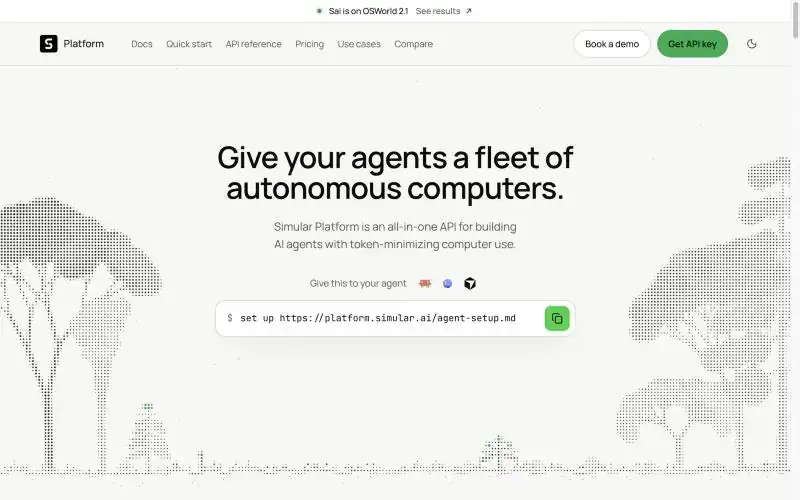
Simular Platform is an all-in-one API for giving AI agents a fleet of autonomous computers. It is not another framework; it plugs into the one you already use. Your agent, or your backend, sends a task in plain language to one endpoint. Sai, Simular's computer-use agent, picks it up on a Windows or Linux cloud computer that already has everything installed, sees the screen, clicks and types through whatever app the task needs, stops to ask before sign-ins and sensitive steps, and returns structured output, files and events. You never build the virtual machine, the display driver, the screen capture or the agent loop.
What separates it from the computer-use tools sold by model vendors is what happens on the second run. Simular's neuro-symbolic layer saves a task that worked as code (a Simulang function you can read, test and version) and replays it with new inputs, asking the model only where the screen actually matters. Simular reports up to 90% fewer tokens on repeat runs. When an app moves a button, independent judges notice before the next step, the agent finishes the job from that point and updates the code, so a layout change does not break a scheduled job. This is what we mean by an autonomous computer: a machine that learns the work instead of paying a model to rediscover it every time.
The reliability numbers are public. Simular holds the highest partial score on the official OSWorld 2.1 leaderboard, 79.38% in October 2026, and its $14.34 per task is the only cost published on that leaderboard, with about 1.5x fewer model calls than models used on their own. The agent is built on Simular's open-source Agent S research (12.2k GitHub stars).
Getting started takes one line. Paste set up https://platform.simular.ai/agent-setup.md into Claude Code, Codex or Cursor and your coding agent installs the Sai MCP server and skill itself; the only thing you do is create an API key. From your own code, the loop is a POST to /v1/agents/message, polling /v1/agents/events, and answering approvals with /v1/agents/approve. The use case library has worked examples, from giving your agent a computer for tools with no API to automating a legacy Windows app.
Key strengths: Agent and cloud computer in one API, no desktop infrastructure to run. Works with any framework over REST, MCP or CLI, plus Python and TypeScript SDKs. Learned tasks replay as code with self-healing. Approvals before sensitive steps and a history of every run. Model-agnostic, with BYOK and end-to-end encryption.
Limitations: It hands back results, not raw screenshots and click primitives, so it is the wrong layer if your own model must reason about pixels. Logins, site passwords and phone verification are link-only approvals that a person completes in a browser. A free account's first request of the day can take about two minutes while its computer starts.
Best for: Developers whose agents need to finish work in vendor portals, admin consoles, desktop software and internal tools, and teams that want GUI automation to get cheaper with repetition.
Pricing: Free plan with daily credits and limited access to a cloud Windows computer. Pay as you go at $50/month for 50,000 credits ($50 of usage) with a dedicated Windows or Linux cloud computer billed only while it runs, up to five at once, or your own Mac or PC with no computer cost. Sai Unlimited at $500/month. Enterprise is custom (pricing).
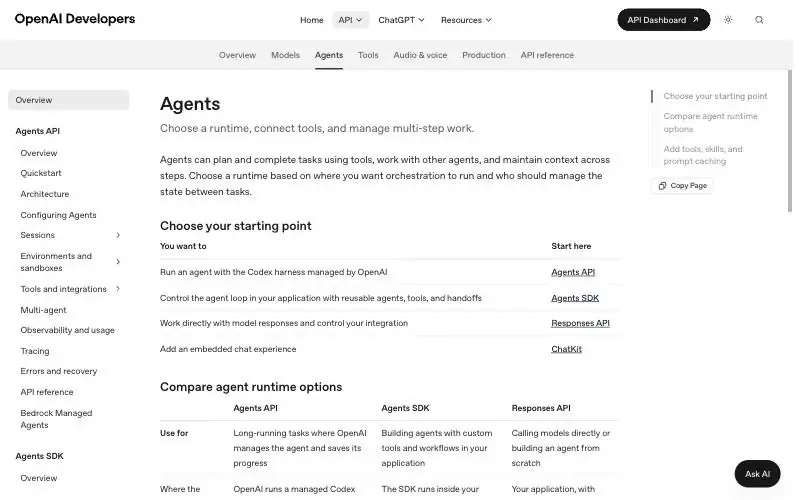
OpenAI now offers three ways to run agents (docs): the Agents API, where "OpenAI manages the agent" on a hosted Codex harness for long-running tasks (public beta since September 2026); the Agents SDK, which runs the loop inside your own application; and the Responses API for building from scratch. Sandboxes for the Agents API can be OpenAI-hosted, self-hosted or from partners including E2B, Daytona, Modal and Vercel (announcement). GPT-5.5 in the Responses API supports web search, file search, code interpreter, a hosted shell, MCP, tool search and a computer use tool.
Key strengths: Strong models with native tools in one place. A hosted runtime that saves agent state. A large partner ecosystem for sandboxes.
Limitations: Built around OpenAI models; other providers run through adapters OpenAI calls "best-effort, beta". Computer use is a primitive: your code executes each action on a machine you provide. The visual Agent Builder and the Evals platform shut down on 30 November 2026 (deprecations), so do not start new work there.
Best for: Teams already committed to OpenAI who want hosted, long-running agents with minimal glue code.
Pricing: No platform fee; you pay model and tool rates. GPT-5.4 is $2.50 per million input tokens and $15 per million output tokens; GPT-5.5 is $5 and $30.
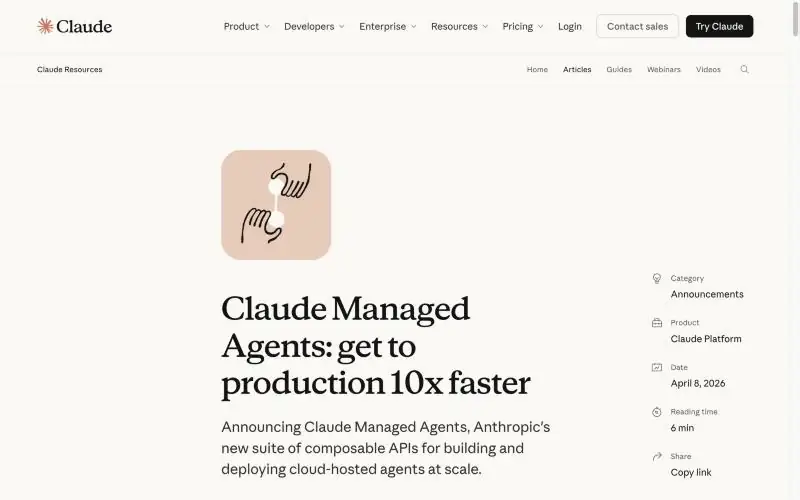
Anthropic offers two layers. The Claude Agent SDK is "Claude Code as a library" for Python and TypeScript, with built-in file, shell and web tools, subagents, hooks, MCP and skills. Claude Managed Agents, in beta since April 2026, hosts the harness for you with managed sandboxes, long-running sessions, vaults, scoped permissions and tracing in the Console (announcement); later updates added rubric-based Outcomes, multi-agent orchestration, webhooks and self-hosted sandboxes. Computer use became generally available on 20 August 2026, alongside a new browser use tool.
Key strengths: The same agent harness that powers Claude Code. Clear per-hour runtime pricing. Strong long-horizon behaviour and permission controls.
Limitations: Claude models only. Computer and browser use still need a machine or browser you supply, directly or through partner drivers. Managed Agents is in beta.
Best for: Engineering teams building coding, research or operations agents that run for a long time and call many tools.
Pricing: Managed Agents is model usage plus $0.08 per session-hour of active runtime. Sonnet 5.5 costs $2/$10 per million input/output tokens, Opus 5.5 $4/$20 (pricing).
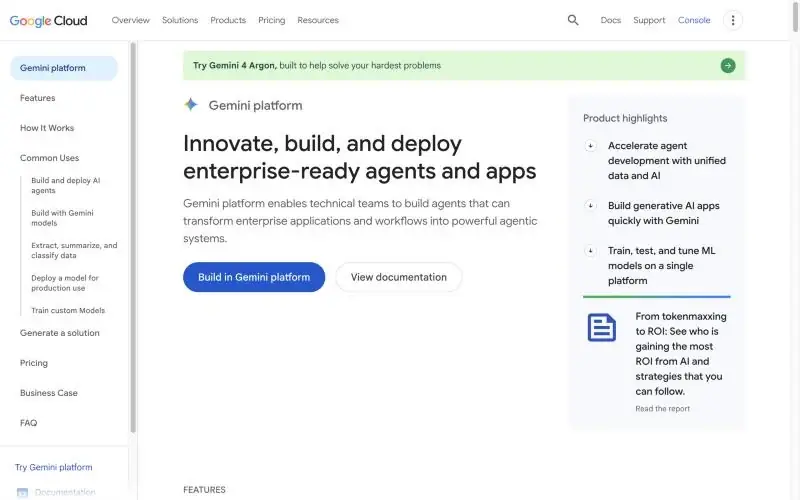
In April 2026 Google folded Vertex AI into a single agent platform, now presented on Google Cloud as the Gemini platform. Agent Engine became Agent Runtime, which handles sessions, Memory Bank, code execution and computer-use sandboxes, and a Managed Agents API launched at Google I/O in May. You build with Agent Development Kit 2.0 in Python, Go or Java, or low-code in Agent Studio. Model Garden offers Gemini, Claude and more than 200 other models. Gemini's Computer Use model, which covers browser, Android and desktop, is still in preview and runs as a client-side loop, typically with Playwright (docs).
Key strengths: Deep integration with BigQuery and Google data. Broad model choice. A generous free monthly allowance on Agent Runtime.
Limitations: Product names have changed twice this year, so documentation and tutorials disagree. Computer use is preview. Best value only if you already run on Google Cloud.
Best for: Data-heavy teams already on Google Cloud who want agents next to their warehouse.
Pricing: Agent Runtime costs $0.085 per vCPU-hour after 50 free vCPU-hours a month and $0.009 per GiB-hour after 100 free GiB-hours; idle time between turns is not billed. New customers get $300 in credits (pricing).

AgentCore is AWS's "platform for production AI agents. Any framework. Any model." It is a set of managed parts: a serverless microVM Runtime (v2 generally available since September 2026), Memory, a Gateway that turns APIs into MCP tools, Identity, Policy, Observability, Evaluations, a managed Browser and a Code Interpreter. You can bring Strands, LangChain, the OpenAI Agents SDK or the Claude Agent SDK, or use the config-based harness. For UI workflows AWS also sells Nova Act, an agent service that automates browser tasks.
Key strengths: Framework- and model-neutral. Strong isolation, identity and policy controls. Pay-per-use with no fixed fee.
Limitations: Many separately metered components make costs harder to predict. The managed browser covers web apps, not desktop software. The original Bedrock Agents (now "Classic") closed to new customers on 30 July 2026, so older tutorials point to a dead end.
Best for: Platform teams on AWS that want to host agents built with any framework under existing IAM and governance.
Pricing: Runtime v2 is $0.1276 per vCPU-hour plus $0.0169 per GB-hour; Browser and Code Interpreter are $0.0895 per vCPU-hour plus $0.00945 per GB-hour; Gateway is $0.005 per 1,000 calls (pricing). Nova Act is $4.75 per agent hour.
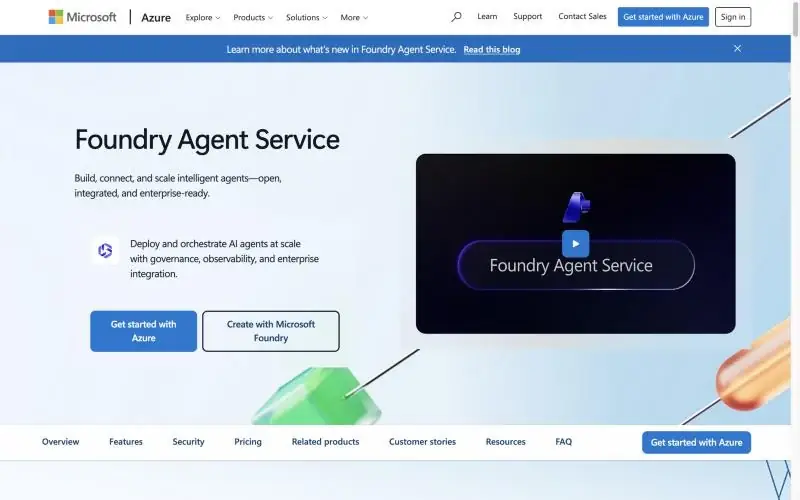
Foundry Agent Service runs production agents "on a trusted, managed platform": bring your framework and model, then deploy to a session-isolated runtime with built-in identity and observability. Hosted agents run any framework packaged as a container, each session in a VM-isolated sandbox with a persistent file system and an Entra agent identity. The open-source Microsoft Agent Framework 1.0 (April 2026) merges Semantic Kernel and AutoGen for .NET and Python. Foundry offers a Computer Use tool (preview, gated access) and a Browser Automation tool that uses your own Playwright resource (docs).
Key strengths: Enterprise identity, compliance and Microsoft 365 integration. First-class .NET support. Runs third-party frameworks.
Limitations: The offering is split across Foundry, Agent Framework and Copilot Studio, which makes the right entry point unclear. Computer use is gated and preview. Agent Service rates were not listed on the public pricing page when we checked.
Best for: Enterprises standardised on Azure and Microsoft 365, especially .NET shops.
Pricing: Usage-based through Azure; check the Azure pricing calculator for your region.
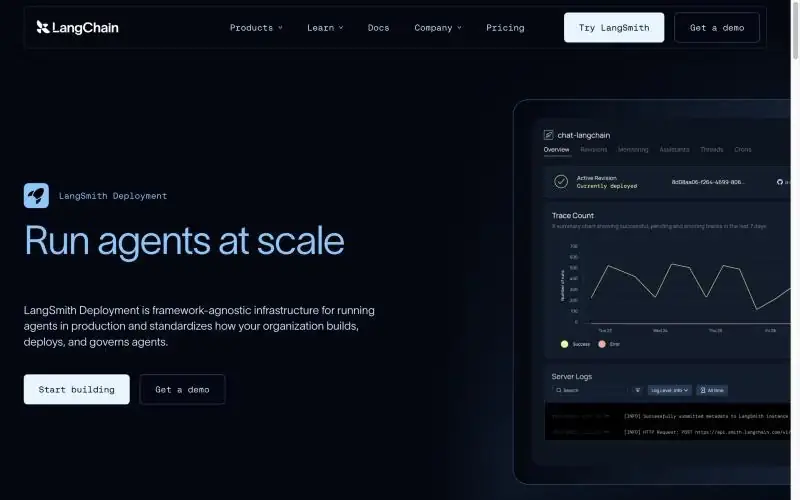
LangChain's open-source LangGraph (and the higher-level Deep Agents) remains the most widely used way to build stateful agent graphs in Python and TypeScript. LangSmith Deployment, formerly LangGraph Platform, is "framework-agnostic infrastructure for running agents in production" with durable execution, human-in-the-loop, cron jobs and an agent registry, and it exposes your agents over MCP and A2A (product page). LangSmith adds tracing and evaluations; Managed Deep Agents entered public beta in August 2026.
Key strengths: Any model, any tool. Mature observability and evaluation. Large community and integration catalogue.
Limitations: No first-party computer use; you add a tool for that. Usage-unit pricing stacks on top of seats. The abstractions are heavier than some teams want.
Best for: Teams that want full control of the agent graph and the freedom to switch models.
Pricing: Developer plan free (one seat, 5,000 traces a month); Plus $39 per seat per month; deployment runtime 0.0675 LSU per vCPU-hour, where one LSU is $1 (pricing).

CrewAI combines an open-source Python framework for role-based multi-agent "crews" and event-driven "flows" with CrewAI AMP, a managed platform for deploying them. You write Python or use the low-code Crew Studio, then deploy from GitHub, Studio or the CLI to get a REST API, traces, OpenTelemetry, guardrails and human-in-the-loop. It supports OpenAI, Anthropic, Gemini, Azure, Bedrock and others, plus MCP and A2A.
Key strengths: Simple mental model for teams of agents. Business and technical users can work in the same platform. Can run in your VPC.
Limitations: Python only. No first-party computer use. No public mid-tier price, so moving past the free tier means a sales conversation.
Best for: Python teams building multi-agent workflows such as research, content or back-office processing.
Pricing: Basic is free with 50 executions a month; Enterprise is custom (pricing).
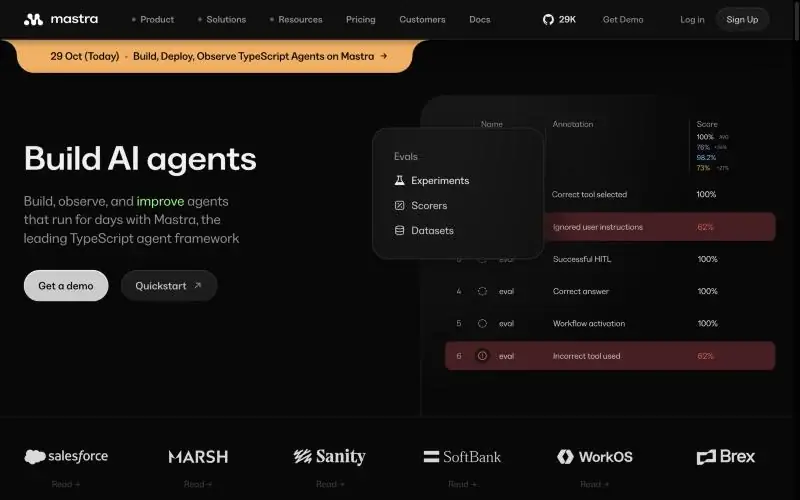
Mastra is one of the most widely used TypeScript agent frameworks: version 1.0 shipped in January 2026, and the Mastra Platform (Studio, Server and Memory Gateway) followed in April. It covers agents, workflows, memory, evals and observability in one package, and teams can self-host the Apache 2.0 framework or deploy to Mastra's cloud.
Key strengths: Idiomatic TypeScript. Evals and observability built in. Open source with a free starter tier.
Limitations: Not for Python-first teams. No first-party computer use. A younger platform than the cloud offerings.
Best for: Product teams building agents into TypeScript and Node.js applications.
Pricing: Open source is free; Starter $0; Teams $250 per month; persistent server $100 per project (pricing).
Simular Platform is a computer for your agent, not a replacement for the agent's brain. If your agent only calls APIs and never needs a screen, a framework such as LangGraph or a hosted runtime such as Claude Managed Agents is simpler and cheaper. If your team needs pixel-level control of each click to train or study a model, use OpenAI's, Anthropic's or Google's computer-use primitives directly. If you only need a headless browser for scraping public pages, a cloud browser service is a lighter fit. And if your organisation requires everything to run inside one hyperscaler's account, AgentCore or Foundry may win on procurement alone; Simular Platform can still serve as the computer-use step inside those stacks.
OpenAI deprecated Agent Builder in June 2026 and shuts it down on 30 November 2026. AWS put Bedrock Agents into maintenance as "Classic" and stopped accepting new customers on 30 July 2026. New projects should use the Agents SDK or Agents API and AgentCore respectively.
Hosted runtimes charge for compute time (for example $0.08 per session-hour on Claude Managed Agents, or per vCPU-hour on AgentCore and Agent Runtime) on top of model tokens. For computer-use work, the most comparable public number is cost per task: Simular's is $14.34 on OSWorld 2.1, and replaying learned tasks as code cuts tokens on repeat runs by up to 90%.
Related reading: Best AI Agent Builders in 2026 · Best Computer Use APIs · Best Autonomous Computers · What Is Computer Use? · Best AI Agent for everyday work
Product details and prices were checked on each vendor's official website on 28 October 2026.