Oops! Something went wrong while submitting the form.


.svg)
Most businesses don’t lose money in one dramatic mistake. They lose it drip by drip: a digit mistyped on a deposit slip, a check recorded twice, a cash amount forgotten in the rush to get to the bank or close out the day.
A deposit slip template slows that drip. It standardizes how you capture dates, account numbers, cash, checks, and notes so anyone on your team can record deposits the same reliable way. Over time, those clean, consistent records make reconciliations faster, audits less painful, and cash flow more predictable. Whether you’re a solo founder or a growing agency, templates turn banking from “tribal knowledge” in one person’s head into a shared, repeatable system.
Now layer in an AI computer agent. Instead of you squinting at receipts and keying figures into Google Sheets or Excel, the agent can read amounts, update rows, check totals, and flag mismatches automatically. You stay in control of approvals and exceptions, while the agent quietly eliminates typos, late-night data entry, and that knot in your stomach when the bank balance doesn’t match your books.
If you’re like most business owners or agency leads, deposit slips are the kind of task that steals time without you noticing. Ten minutes here, twenty minutes there, suddenly an hour is gone just moving numbers from checks and receipts into a spreadsheet.
This guide walks through practical ways to build and manage deposit slip templates manually in Google Sheets and Excel—and then shows how to hand the repetitive parts to an AI computer agent so you can get that hour back.
Step-by-step setup
Subtotal, use =SUM(range_of_cash_and_checks) and in Total Deposit subtract any cash back you’re taking from the deposit.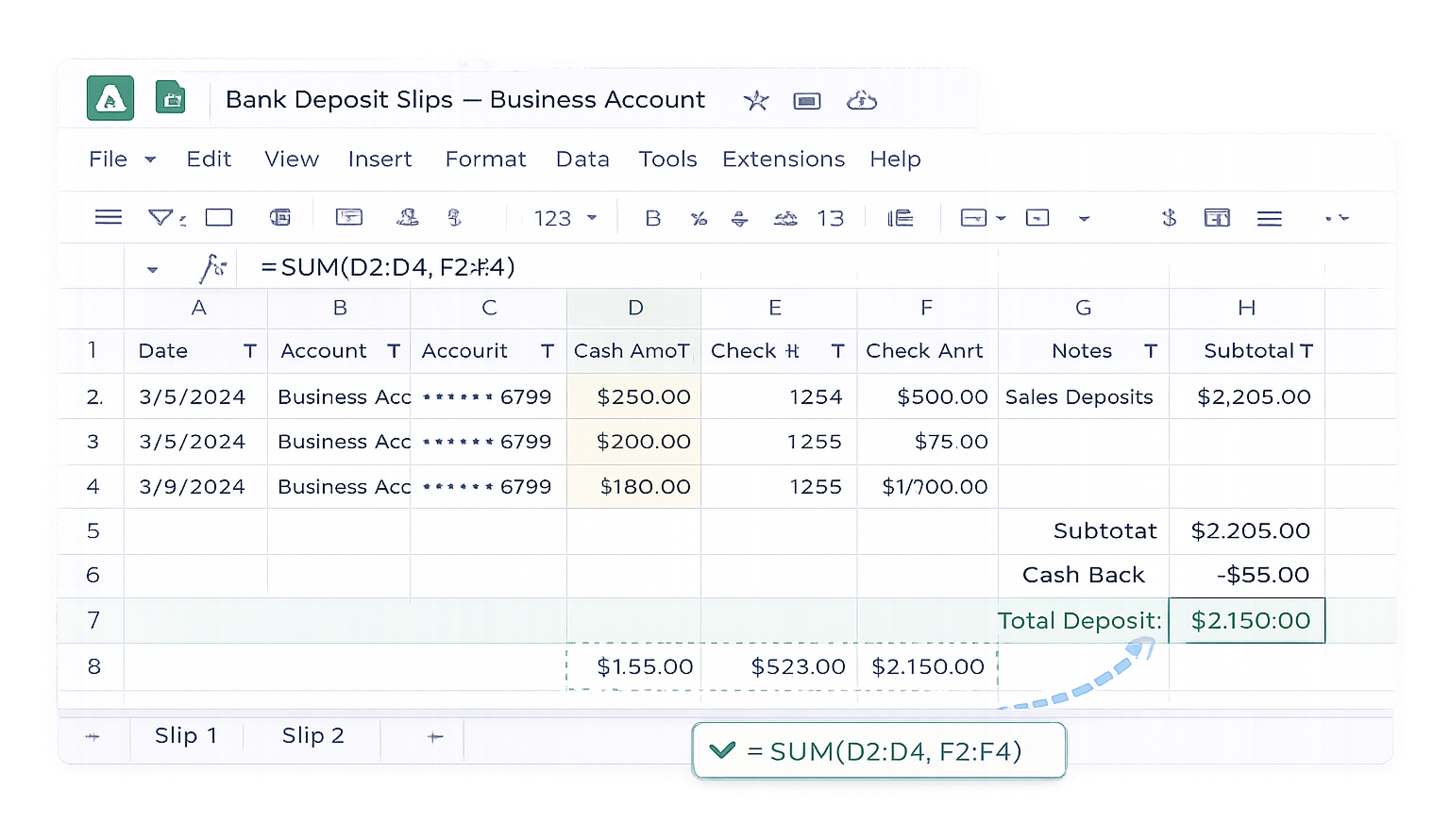
Pros
Cons
Step-by-step setup
Pros
Cons
Another option is to build a simple online form (Typeform, Google Forms, or similar) that captures deposit details. Responses then feed into a Google Sheet or export to Excel.
Workflow
This reduces formatting mistakes but still relies on humans to read receipts and key values.
At some point, even semi-automation hits a ceiling. When you’re processing multiple deposits a day across clients, locations, or bank accounts, the real bottleneck isn’t the template—it’s the human doing copy-paste.
This is where Simular’s AI computer agents step in.
What the agent can do
Because Simular Pro operates like a highly reliable digital coworker on your actual computer, you don’t have to restructure your entire finance stack. The agent just follows the same steps your team already uses—only without distraction or fatigue.
Example automated workflow
Pros of AI automation
Cons
If you’re just starting out or handle occasional deposits, a simple Google Sheets or Excel template is enough. As your transaction volume grows—or as you juggle multiple client accounts—the real win is freeing your brain from routine data entry.
The sweet spot for many teams is: design a solid template once, then let a Simular AI computer agent drive it day to day. You stay focused on decisions and exceptions; the agent handles the clicks, keystrokes, and checks that nothing falls through the cracks.