])

10 Best AI Travel Planners Alternatives for Teams & SMBs in 2026

AI travel planners promise to replace hours of tab-switching with a single conversation. Describe your trip, get a full itinerary. In practice, most of them generate the same generic suggestions you could find on any travel blog.

We tested 10 AI travel planners by giving each one the same prompt: a 7-day trip to Japan for two people, mid-range budget, mix of culture and food, flying from San Francisco. We evaluated each tool on itinerary quality, booking integration, customization, and whether it actually saved time compared to planning manually.

Here is what we found.

Tool Best For Pricing Books Trips Standout Feature
Layla Conversational planning Free / $9.99/mo No Natural chat-based refinement
TripPlanner AI Detailed itineraries Free / $7.99/mo No Time-blocked schedules with transit
Wonderplan Budget travelers Free No Real-time budget tracking
KAYAK Booking integration Free Yes (flights/hotels) Real-time prices in itinerary
GuideGeek On-the-go answers Free No Works via WhatsApp
Roam Around Visual map planning Free / $4.99/mo No Map-first itinerary view
Tripnotes Fast drafts Free / $4.99/trip No 30-second itinerary generation
Pilot Personalized recs Free / $10/mo No Learns your travel preferences
ChatGPT / Perplexity Custom freeform planning Free / $20/mo No Handles complex multi-constraint requests
Sai End-to-end planning + booking Free / $20/mo Yes (all sites) Books, compares, and organizes across real websites

How we evaluated

We tested each tool with the same trip request and scored them across five dimensions:

Itinerary quality — How detailed, accurate, and useful is the generated plan?

Booking integration — Can it actually book flights, hotels, and activities, or just recommend them?

Customization — How easily can you refine and adjust the plan after generation?

Speed — How quickly does it generate a usable itinerary?

Value — What do you get relative to the price?
Tool Itinerary Quality Booking Customization Speed Value
Layla 8/10 2/10 9/10 7/10 8/10
TripPlanner AI 9/10 2/10 7/10 6/10 7/10
Wonderplan 7/10 1/10 5/10 8/10 9/10
KAYAK 5/10 8/10 4/10 7/10 8/10
GuideGeek 4/10 1/10 6/10 10/10 9/10
Roam Around 6/10 1/10 5/10 7/10 7/10
Tripnotes 6/10 1/10 3/10 10/10 7/10
Pilot 7/10 1/10 8/10 6/10 6/10
ChatGPT / Perplexity 7/10 2/10 10/10 6/10 7/10
Sai 9/10 10/10 9/10 5/10 9/10

Comparison Summary

Feature Layla TripPlanner AI Wonderplan KAYAK GuideGeek Roam Around Tripnotes Pilot ChatGPT / Perplexity Sai
Best For Conversational planning Detailed itineraries Budget travelers Flight and hotel deals On-the-go answers Map-based planning Fast first drafts Personalized recs Freeform custom planning End-to-end planning and booking
Pricing Free / $9.99/mo Free / $7.99/mo Free Free Free Free / $4.99/mo Free / $4.99/trip Free / $10/mo Free / $20/mo Free / $20/mo
Platforms Web, iOS, Android Web, iOS, Android Web only Web, iOS, Android WhatsApp, IG, Web Web only Web only Web, iOS Web, iOS, Android Desktop, Mobile control
Itinerary Generation Chat-based, iterative Form-based, structured Budget-first, visual Booking-first, basic itinerary Q&A only, no full itinerary Map-based, geographic clusters Form-based, instant Preference-based, adaptive Prompt-based, freeform Agent-based, multi-source research
Generation Speed 1-2 minutes 1-3 minutes Under 1 minute 1-2 minutes Under 10 seconds Under 1 minute Under 30 seconds 1-3 minutes 1-3 minutes 10-30 minutes (full workflow)
Day-by-Day Schedule Yes Yes, with time blocks Yes Basic No Yes Yes Yes Yes (text only) Yes, with time blocks and transit
Transit and Logistics Basic Detailed, with real schedules No Flights only On request Walking distances only No Basic On request (text) Full: flights, trains, local transit, visa
Budget Tracking No Estimated daily costs Real-time running total Real-time flight/hotel prices No No No No Estimated on request Live prices, full cost breakdown in Google Sheet
Map View Google Maps links Map pins per day Destination photos Hotel map only Google Maps links Interactive route map No Basic No Opens Google Maps to verify locations
Flight Booking No No No Yes, direct No No No No Links only Yes, cross-site comparison and booking
Hotel Booking No No No Yes, direct No No No No Links only Yes, cross-site comparison and booking
Restaurant Booking No No No No No No No No No Yes, via OpenTable and Google Maps
Price Monitoring No No No Price alerts No No No No No Auto-monitors and rebooks on price drops
Calendar Sync No Google Calendar export No No No No No No No Auto-adds each day with locations and times
Spreadsheet Export No No No No No No No No No Google Sheet with confirmations, costs, contacts
Multi-City Trips Basic Yes No Multi-stop flights No Basic No Basic Yes (text only) Full: intercity transport, per-city bookings
Collaboration Shareable link Invite co-planners to edit No Shared trips No No No Share and save Share conversation Shared Google Sheet for group input
Customization Depth High, conversational refinement Medium, edit individual days Low Low Medium, ask follow-ups Low Low High, learns over time Unlimited, freeform prompts High, natural language instructions
Personalization Per-trip only Per-trip only Per-trip only Saved preferences No memory Per-trip only Per-trip only Learns across trips Per-conversation Per-session
Offline Access Saved itineraries on mobile No No Saved searches No No Printable PDF No No Google Sheet accessible offline
Free Plan Limits Basic features, limited history 3 trips No limits No limits No limits 5 trips/month Limited detail Basic features Rate limited, no browsing Limited daily actions
Hallucination Risk Low Low Low None (real listings) Medium Low Medium Low Medium-High None (verifies on real websites)
Business Travel No No No Basic No No No No On request Yes, calendar integration and expense tracking
Overall Rating 8/10 7.5/10 7/10 7.5/10 7/10 6.5/10 6.5/10 7/10 7.5/10 9.5/10

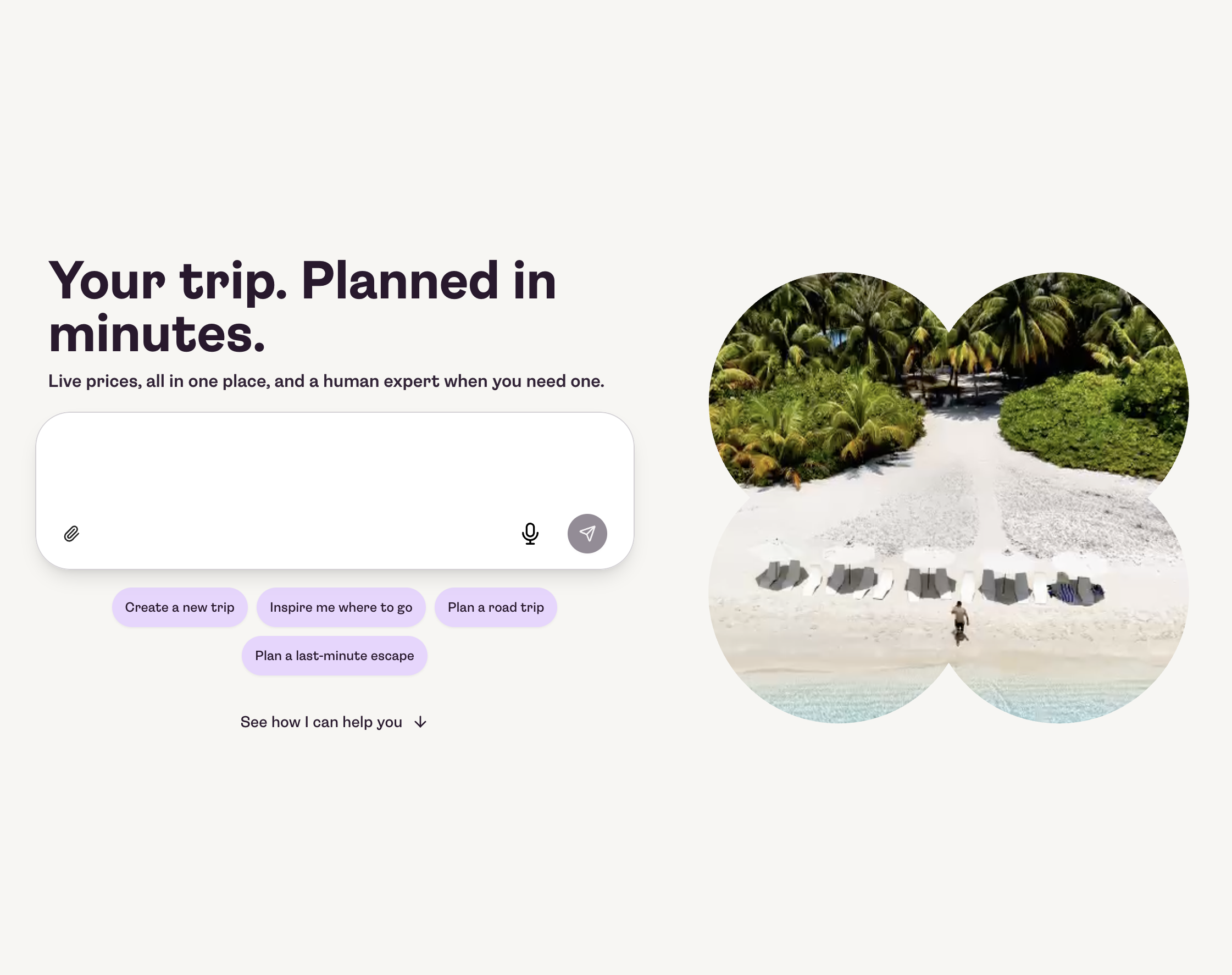
1. Layla — Best for Conversational Trip Planning

Pricing: Free (premium features from $9.99/month) Platforms: Web, iOS, Android

Layla works like texting a knowledgeable friend. You describe your trip in natural language — "I want a week in Portugal, mostly beaches but one or two days in Lisbon, budget around $150/day" — and it builds a day-by-day itinerary through a chat interface.

What it does well:

  • Conversational refinement — say "swap day 3 for something less touristy" and it adjusts
  • Good restaurant and activity recommendations with Google Maps integration
  • Generates shareable trip links
  • Mobile app works offline for saved itineraries

Where it falls short:

  • No direct booking integration — it recommends hotels and flights but you book separately
  • Itineraries lean toward popular tourist spots unless you specifically ask for hidden gems
  • Group trip coordination is limited to sharing links

Layla is the best option for solo travelers or couples who enjoy the planning process and want a tool that feels like a conversation, not a form.
2. TripPlanner AI — Best for Detailed Day-by-Day Itineraries

Pricing: Free basic plan; Pro from $7.99/month Platforms: Web, iOS, Android

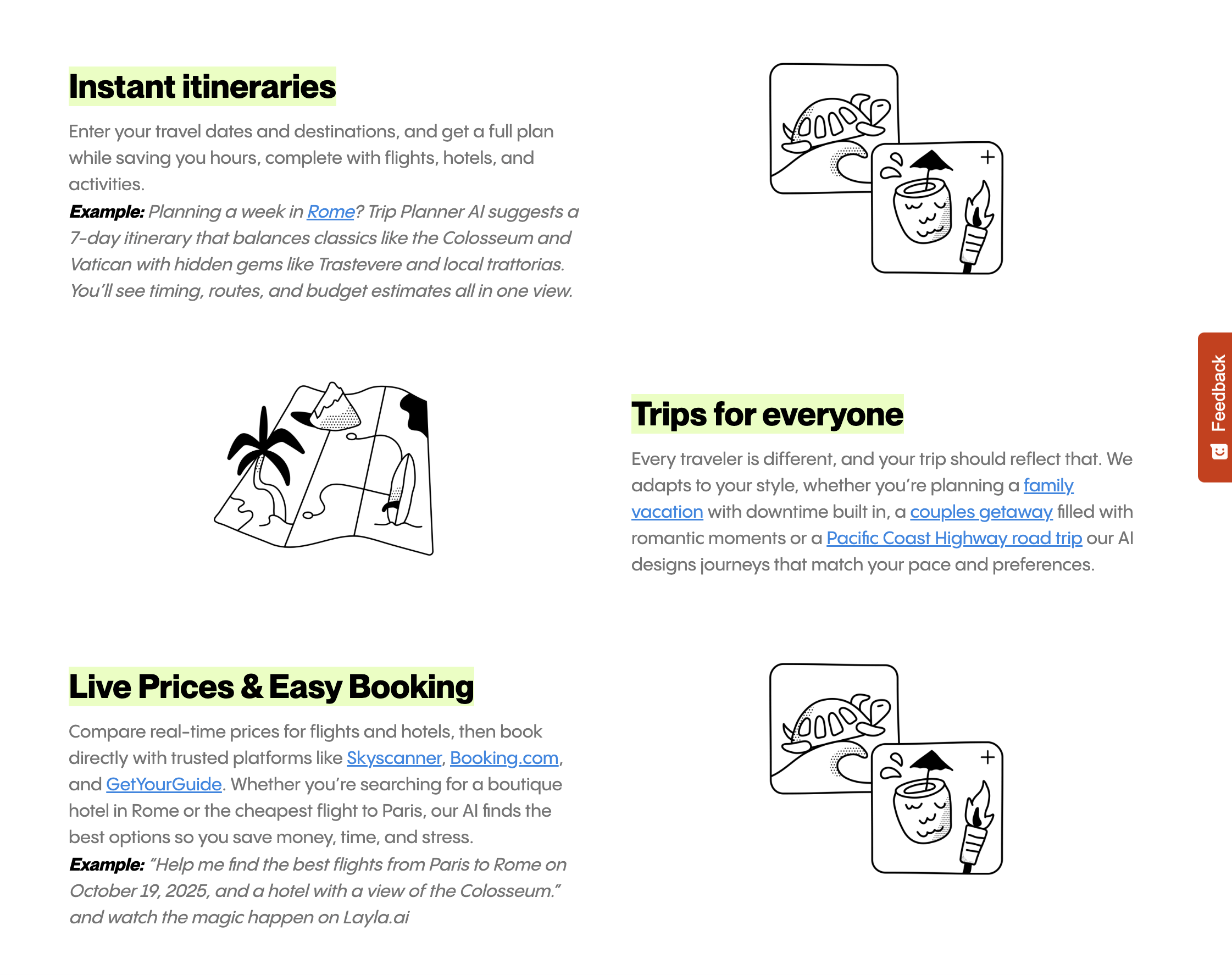
TripPlanner AI generates the most structured itineraries of any tool we tested. Each day includes time blocks, travel time between locations, estimated costs, and map pins. For our Japan test, it broke each day into morning, afternoon, and evening segments with realistic transit times using Japan Rail schedules.

What it does well:

  • Detailed time-blocked schedules with transit logistics
  • Cost estimates per activity and daily totals
  • Collaborative planning — invite travel partners to edit the itinerary
  • Exports to Google Calendar

Where it falls short:

  • Free plan limits you to 3 trips
  • AI suggestions can feel formulaic — it tends to follow the same patterns across similar destinations
  • Hotel recommendations prioritize partners over best value

For travelers who want a structured, minute-by-minute plan they can follow without thinking, TripPlanner AI delivers the most organized output.

3. Sai (by Simular) — Best for End-to-End Trip Planning and Booking

Pricing: 7-day Free Trial,  Starter: $20/month (Plus tier), Pro: $500/month Platforms: Desktop (macOS, Windows), Mobile control

Every other tool on this list does one thing: generate an itinerary. Sai does the entire workflow.

Sai is an AI desktop agent — it operates your computer the way you would. For travel planning, this means it does not just suggest a hotel. It opens KAYAK, compares prices across dates, checks reviews on TripAdvisor, cross-references with Google Maps for location, and books the one that fits your criteria. It does not just recommend a restaurant. It checks current ratings, verifies hours for your travel dates, and adds a reservation through OpenTable.

What it does well:

  • Full booking automation — researches, compares, and books flights, hotels, and activities across real websites
  • Multi-source research — checks prices across KAYAK, Google Flights, Booking.com, Expedia simultaneously
  • Calendar integrationsyncs your itinerary directly to Google Calendar with correct time zones
  • Real-time verification — opens actual booking sites to confirm prices and availability, not cached estimates
  • Spreadsheet export — organizes all trip details (confirmation numbers, addresses, costs) into a Google Sheet
  • Handles complex logistics — multi-city routes, visa requirements, travel insurance comparison
  • Works while you are away — runs on a cloud desktop, so it can monitor price drops and rebook automatically

Where it falls short:

  • Not a quick itinerary generator — Sai is built for comprehensive planning, not 30-second drafts
  • Requires more upfront context to get started compared to simple chat-based tools
  • Desktop-first experience — though you can steer it from your phone

How it works in practice:

You tell Sai: "Plan a 7-day Japan trip for two, flying from SFO, mid-range budget, focus on food and culture. Book the flights and hotel."

Sai then:

  1. Searches Google Flights and KAYAK for the best fares on your dates
  2. Compares hotel options on Booking.com and Hotels.com near your preferred neighborhoods
  3. Builds a day-by-day itinerary with restaurants, attractions, and logistics
  4. Checks opening hours and availability for specific dates
  5. Books flights and hotels through the actual booking sites
  6. Creates a Google Sheet with all confirmation numbers, addresses, and costs
  7. Adds each day to your Google Calendar with locations and times

No other AI travel planner does steps 4 through 7. Every other tool stops at step 3 — generating the plan. Sai executes it.
4. Wonderplan — Best for Budget-Conscious Travelers

Pricing: Free Platforms: Web

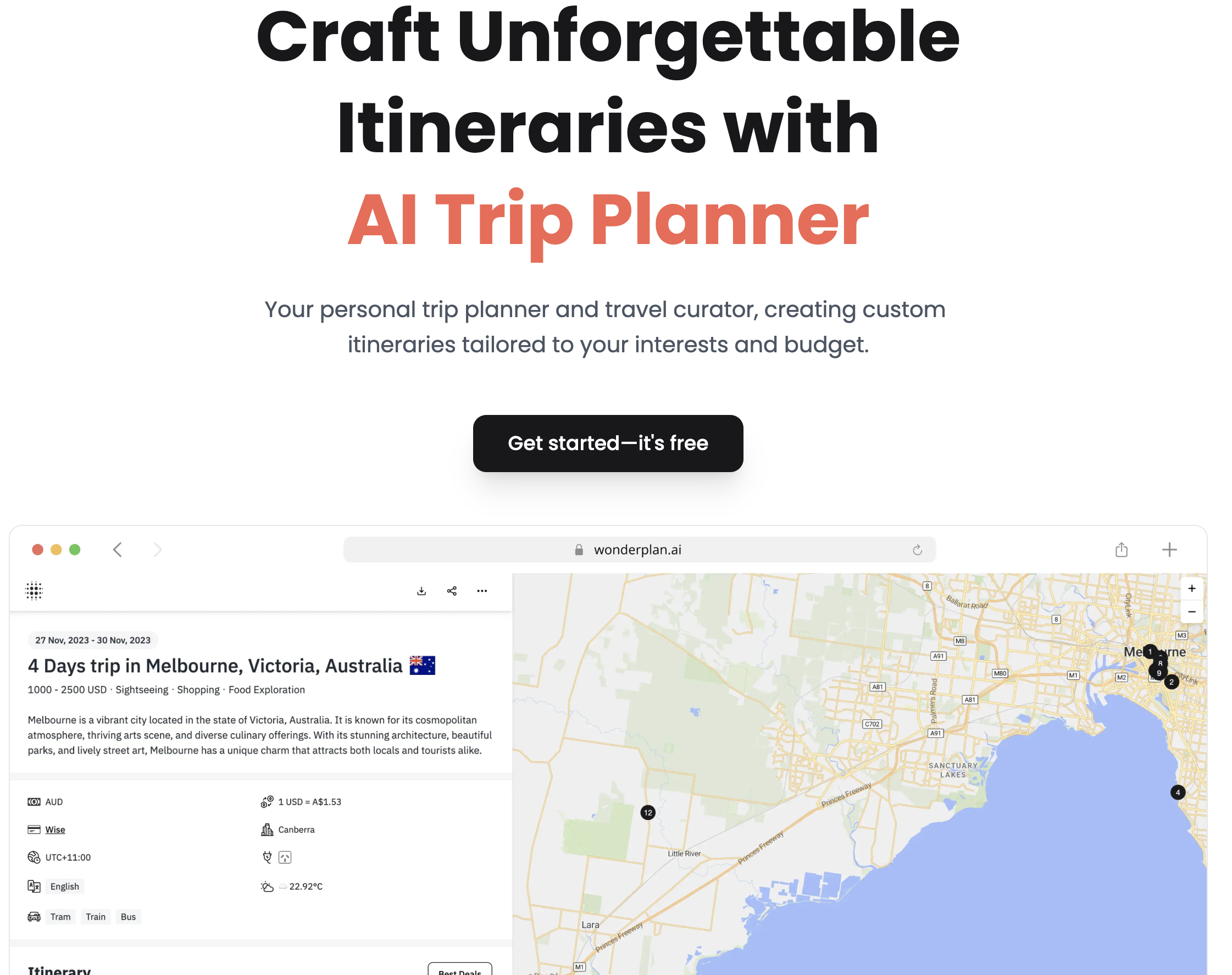
Wonderplan differentiates itself by putting budget at the center of trip planning. You set your total budget, travel dates, and interests, and it generates an itinerary that stays within your spending limit. Every recommendation includes price estimates, and the total running cost updates as you customize.

What it does well:

  • Budget-first planning with real-time cost tracking
  • Suggests money-saving alternatives (local restaurants instead of tourist traps, free attractions)
  • Clean visual layout with photos for each destination
  • No account required for basic use

Where it falls short:

  • No booking integration — purely a planning tool
  • Limited to popular destinations — off-the-beaten-path locations get generic suggestions
  • No mobile app
  • Cannot handle multi-city trips with complex logistics

Wonderplan is ideal for travelers who need to stick to a budget and want the itinerary to reflect that constraint from the start.

5. KAYAK — Best for Booking-Integrated Planning

Pricing: Free Platforms: Web, iOS, Android

KAYAK added AI trip planning to its existing flight and hotel search engine. The advantage is obvious: the AI generates an itinerary, and you can book flights, hotels, and car rentals without leaving the app. Prices are real-time, not estimates.

What it does well:

  • Real-time flight and hotel prices embedded directly in itineraries
  • Price alerts — get notified when flights to your destination drop
  • Strong flight search with flexible date options
  • Integrates with existing KAYAK account and saved trips

Where it falls short:

  • Itinerary quality is secondary to booking — activity recommendations are basic
  • AI feels like a booking assistant, not a trip planner
  • Limited restaurant or experience suggestions
  • Does not handle complex multi-destination routing well

KAYAK is the best choice when you already know roughly where you want to go and care most about finding the best flight and hotel prices. It is a booking tool with an AI layer, not a planning tool with booking.

6. GuideGeek — Best for Quick On-the-Go Answers

Pricing: Free Platforms: WhatsApp, Instagram, Web

GuideGeek, built by Matador Network, works through WhatsApp and Instagram DMs. You message it like you would a friend: "What should I eat near Shibuya Station?" and it responds with 3-5 recommendations, each with a brief description and a Google Maps link.

What it does well:

  • Zero friction — works through apps you already use
  • Fast, specific answers to point questions (restaurants, attractions, neighborhoods)
  • Good for in-trip decisions — "what should I do this afternoon?"
  • No signup or download required

Where it falls short:

  • Not designed for full itinerary generation
  • No trip saving or organization features
  • Cannot remember context across conversations well
  • Limited for pre-trip planning — better as a real-time travel companion

GuideGeek fills a different niche than most tools on this list. It is not a planner — it is a travel concierge you text when you need a quick recommendation on the ground.

7. Roam Around — Best for Visual, Map-Based Planning

Pricing: Free (premium from $4.99/month) Platforms: Web

Roam Around generates itineraries and displays them on an interactive map, making it easy to see how your days flow geographically. Each suggestion includes walking distances, transit options, and a visual route. For our Japan test, it grouped Shinjuku, Shibuya, and Harajuku into one day because they are walkable — something text-only planners often miss.

What it does well:

  • Map-first interface shows geographic relationships between activities
  • Clusters nearby attractions into logical daily routes
  • Clean, visual presentation
  • Good for walking-heavy city trips

Where it falls short:

  • Activity descriptions are shallow — you still need to research specifics
  • Limited customization after the initial generation
  • No booking integration
  • Premium required for more than 5 trips per month

Roam Around is the best tool for visual planners who want to see their trip on a map before committing to a schedule.

8. Tripnotes — Best for Fast Itinerary Drafts

Pricing: Free (limited), Pro from $4.99/trip Platforms: Web

Tripnotes generates itineraries in under 30 seconds. Enter your destination, dates, and interests, and it produces a complete day-by-day plan. The speed comes from a more structured approach — less conversational, more form-driven — but the output is surprisingly detailed for how fast it generates.

What it does well:

  • Fastest itinerary generation we tested (under 30 seconds)
  • Clean, printable output format
  • Good for getting a starting framework to customize manually
  • Includes local tips and cultural notes

Where it falls short:

  • Limited refinement — you cannot iterate on specific days easily
  • Tends toward popular tourist attractions
  • No booking, no maps, no collaboration features
  • Per-trip pricing adds up for frequent travelers

Tripnotes is best for travelers who want a quick first draft to work from, not a complete planning solution.

9. Pilot (copilot.us) — Best for Personalized Recommendations

Pricing: Free basic; premium from $10/month Platforms: Web, iOS

Pilot learns your preferences over time. Rate a few past trips or tell it what you liked about previous vacations, and it adjusts future recommendations. For our Japan test, after we indicated a preference for local food over fine dining, it shifted from Michelin-starred restaurants to izakayas and ramen shops — a distinction most other tools missed.

What it does well:

  • Personalization engine that improves with use
  • Good at matching activity style to traveler personality
  • Suggests experiences, not just locations (cooking classes, neighborhood walks, market tours)
  • Clean interface with save and share features

Where it falls short:

  • Requires multiple uses to unlock full personalization value
  • Smaller destination database than competitors
  • No booking integration
  • Mobile app is limited compared to web version

Pilot rewards repeat users. If you travel frequently and want a tool that gets smarter with each trip, it is worth the investment in training it.

10. ChatGPT / Perplexity — Best for Custom, Freeform Planning

Pricing: Free tiers available; ChatGPT Plus $20/month, Perplexity Pro $20/month Platforms: Web, iOS, Android

General-purpose AI assistants are surprisingly effective travel planners if you know how to prompt them. ChatGPT and Perplexity both handle complex, multi-constraint requests well — "plan 5 days in Tokyo for a family with a 10-year-old who loves anime, budget $200/day, we hate crowds."

What it does well:

  • Handles highly specific, multi-constraint requests better than any dedicated travel tool
  • Perplexity includes source citations and links to real booking sites
  • ChatGPT with browsing can check real-time prices and availability
  • Unlimited flexibility — ask follow-up questions, adjust any detail
  • Can be combined with automation tools to research destinations comprehensively

Where it falls short:

  • No built-in trip organization — you get text output, not an interactive itinerary
  • Cannot save, share, or export trips natively
  • Sometimes invents attractions or restaurants that do not exist (hallucinations)
  • No map view or booking integration
  • Requires good prompting skills to get useful output

ChatGPT and Perplexity are the most powerful tools on this list for travelers who know exactly what they want and can articulate it. They are the worst for travelers who want structure and visual organization.

Stop doing repetitive tasks. Let Sai handle them for you.

Sai is your AI computer use agent — it operates your apps, automates your workflows, and gets work done while you focus on what matters.

Try Sai

FAQS