
Oops! Something went wrong while submitting the form.
The best AI customer service agent in 2026 depends on your helpdesk and on what the agent has to do. Fin is the strongest all-round choice, with transparent pricing ($0.99 per outcome) and support for any helpdesk. If you already run Zendesk, Salesforce, HubSpot or Freshdesk, their native agents (Zendesk AI agents, Agentforce, Customer Agent, Freddy AI Agent) are the fastest path. Large consumer brands with complex journeys usually shortlist Sierra and Decagon, and Shopify stores should look at Gorgias. And when resolving a ticket means acting inside a back-office tool that has no API, such as a carrier portal, a legacy billing screen or a supplier dashboard, Simular gives your agent (or your support team) an autonomous computer that does the work.
The market consolidated fast this year. Zendesk acquired Forethought in March 2026, and Salesforce signed an agreement in June 2026 to acquire Fin for about $3.6 billion. Pricing also moved: most vendors now charge per resolution rather than per seat. We compared ten agents on their official pages as of 31 October 2026.
An AI customer service agent is software that resolves customer requests end to end, not just answers questions. It reads the request on chat, email or phone, looks up the customer's account and order, decides what to do, takes the action (a refund, an address change, a cancellation), and replies, handing off to a person with full context when it cannot finish. The difference from a chatbot is the action: a chatbot answers from a script or knowledge base; an agent changes something in your systems.
Every vendor in this list publishes an impressive resolution figure, but they measure different things. Some count a resolution only when the customer's issue is solved with no human involved; others report deflection (the customer did not ask for a human) or automation (the AI handled part of the conversation). Zendesk, for example, now bills only for "verified resolutions", where the outcome passes a check. Treat every rate in this article as vendor-reported, and ask each vendor for its definition before you compare.
The second gap is actions. Every agent here acts through APIs, connectors or MCP. When a fix requires a system with no API, the agent escalates to a person. That is where a computer-use agent fits: it can complete the step in the interface itself.
We compared each agent on the channels it covers, how it takes actions in back-end systems, which helpdesks it works with, its 2026 features, and its public pricing model. Facts come from vendor websites, pricing pages and press releases checked on 31 October 2026; resolution figures are quoted as each vendor publishes them.
| Agent | Best for | Channels | How it takes actions | Pricing model |
|---|---|---|---|---|
| Simular (Sai, Sai API) | Actions in tools with no API | Back office (pairs with any front-line agent) | Operates the app's interface on its own computer | Free plan; $50/mo pay as you go |
| Fin | Any helpdesk, transparent pricing | Chat, email, voice, SMS, WhatsApp, social | APIs, data connectors, MCP, Procedures | $0.99 per outcome |
| Zendesk AI agents | Teams on Zendesk | Messaging, email, voice | Action Flows, 40 prebuilt connectors, MCP | Seats + $1.50–$2.00 per extra resolution |
| Agentforce for Service | Service Cloud enterprises | Voice, web, portal, messaging | Native Salesforce data and flows | $2 per conversation or Flex Credits |
| Sierra | Large consumer brands | Chat, SMS, WhatsApp, email, voice | Integrations with your systems | Outcome-based, sales only |
| Decagon | Configurable enterprise agents | Chat, email, voice | Agent Operating Procedures + integrations | Per conversation or per resolution, sales only |
| Ada | High-volume, multilingual B2C | Messaging, email, voice | Integrations, APIs, Playbooks | Sales only |
| HubSpot Customer Agent | SMBs on HubSpot | Chat, email, voice, WhatsApp, Messenger | HubSpot CRM and connected apps | $0.50 per resolved conversation |
| Freddy AI Agent | Budget-conscious teams on Freshdesk | Chat, email | No-code Skills (e.g. refunds via Shopify, Stripe) | 500 sessions included, then $49 per 100 |
| Gorgias AI Agent | Shopify brands | Email, chat, SMS | Shopify-native actions | $0.90 per resolved interaction |
Front-line AI agents stall when the fix lives in a system they cannot call: the carrier portal where a lost parcel is claimed, the legacy billing console where a credit is issued, or the supplier dashboard where an order is changed. Simular closes that gap. Its agent, Sai, works on its own Windows or Linux cloud computer, sees the screen, and clicks and types through any web or desktop app, pausing for human approval before sign-ins and sensitive steps.
There are two ways to use it in support. Developers connect the Sai API to their existing agent (Fin, Zendesk, Agentforce or an in-house bot) through REST or MCP, so a ticket that needs a portal action is handed to Sai and the result comes back to the conversation. Support operations teams use Sai directly to clear repetitive back-office queues, such as processing refunds in an admin panel or updating orders across two systems. Tasks that work once are saved and replayed, so repeat runs are faster and cheaper, and the agent repairs a task when a screen changes. The agent holds the highest partial score on the official OSWorld 2.1 leaderboard (79.38% in October 2026).
Key strengths: Acts in any interface, including systems with no API. Works alongside the front-line agent you already have. Approvals before sensitive actions and a history of every run.
Limitations: It does not talk to your customers; pair it with a front-line agent or your team. Interface work is slower than a direct API call, so use APIs where they exist. Logins are completed by a person through an approval link.
Best for: Support and operations teams whose resolutions depend on legacy or third-party tools.
Pricing: Free plan with daily credits. Pay as you go $50/month. Sai Unlimited $500/month. Enterprise custom (pricing).
Fin, formerly sold as Intercom Fin, calls itself "the highest performing Customer Agent". It answers and acts across chat, email, voice, SMS, WhatsApp and social, and can update accounts or process refunds through APIs, data connectors or MCP. Multi-step policies run as "Procedures". It works natively in Intercom and also on Zendesk, Salesforce, HubSpot and Freshdesk. Fin reports an average resolution rate of 76% across more than 12,000 customers.
Key strengths: Transparent, per-outcome pricing. Works on any major helpdesk. Fast release pace (Fin 4 and the Apex 2.0 model in 2026).
Limitations: Salesforce agreed to acquire Fin in June 2026 (announcement); the deal is expected to close by early 2027, so roadmap and pricing may change. Per-outcome costs scale with volume. A 50-outcome monthly minimum applies on other helpdesks.
Best for: SaaS and mid-market teams that want a strong agent on the helpdesk they already use.
Pricing: $0.99 per outcome; Intercom helpdesk seats from $19/month; 14-day free trial (pricing).
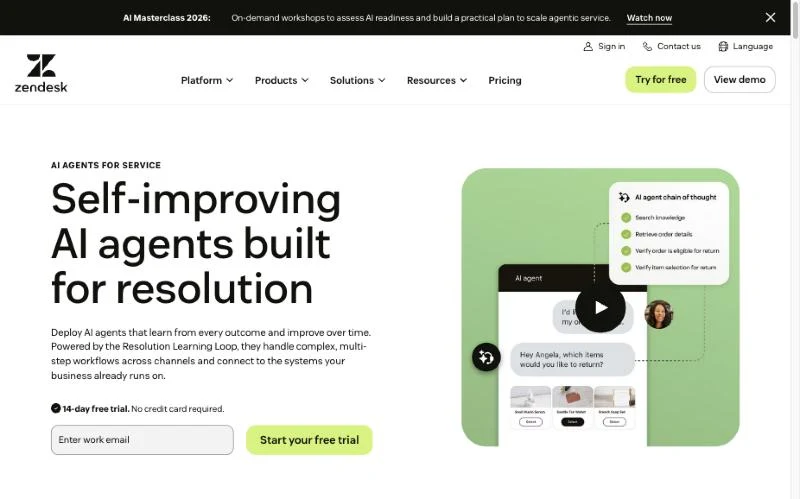
Zendesk AI agents are "self-improving AI agents built for resolution". They run across messaging, email and voice, take actions through Action Flows and 40 prebuilt workflow connectors, and act as an MCP client and server. Zendesk folded Forethought's technology in after acquiring it in March 2026, and at its May 2026 Relate event introduced a Resolution Learning Loop and Voice AI Agents in more than 60 languages.
Key strengths: Native to the Zendesk ticketing and knowledge base. Bills only verified resolutions. Strong voice roadmap.
Limitations: Seat price plus resolution fees adds up. Voice needs Zendesk's own voice stack. The no-code Agent Builder is still in early access.
Best for: Support teams running Zendesk Suite.
Pricing: Suite Team $55/agent/month (annual) with 5 automated resolutions per agent; Suite Professional $115 with 10; extra resolutions $1.50 committed or $2.00 pay-as-you-go (pricing).
Agentforce for Service runs AI agents on voice, web, portals and messaging, using Salesforce data and flows to carry out actions such as processing returns. In June 2026 Salesforce announced the Agentforce Help Agent with guided setup and pay-per-resolution pricing.
Key strengths: Deepest access to Salesforce customer data. Enterprise security and governance. A single vendor for CRM, service and agents.
Limitations: Requires a Service Cloud and Data 360 footprint. Three pricing models make costs hard to forecast. Overlap with Fin is unresolved until that acquisition closes.
Best for: Enterprises already on Salesforce Service Cloud.
Pricing: $2 per conversation, or Flex Credits at $500 per 100,000 credits (an action uses 20 credits); Agentforce add-ons from $125/user/month (pricing).
Sierra builds AI agents for large brands across chat, SMS, WhatsApp, email, voice and ChatGPT. Ghostwriter builds agents from plain-English goals, Agent Studio and Insights handle testing and monitoring, and pricing is tied to outcomes. Sierra publishes customer results such as an 80% resolution rate at Airtable (customers).
Key strengths: Proven at very high volumes. Strong voice and multi-channel support. Outcome-based pricing.
Limitations: Enterprise only, with no self-serve tier or public price. Sales-led deployment. Integration details are set up per customer.
Best for: Consumer brands with millions of customers and complex journeys.
Pricing: Outcome-based; sales only.
Decagon is "the AI concierge for every customer". Teams write Agent Operating Procedures in natural language, connect integrations, and test with simulations, A/B tests and always-on QA (Watchtower). It covers chat, email and voice; Chime reports 70% chat and voice resolution.
Key strengths: Natural-language procedures that ops teams can edit. Strong testing and QA tooling. Voice included.
Limitations: No public pricing. Several published metrics are deflection or cost figures rather than resolution. Enterprise contracts.
Best for: Enterprise and fast-growing consumer tech companies.
Pricing: Per conversation or per resolution; sales only.
Ada is "the agentic customer experience platform", resolving across messaging, email and voice. Playbooks automate complex standard operating procedures, and integrations plus public APIs let the agent complete tasks. Ada reports an 84% automated resolution rate across its platform.
Key strengths: Built for scale and many languages. Mature analytics and reasoning controls. Works with existing helpdesks.
Limitations: Not a helpdesk, so you need one alongside. Sales-only pricing. Best value at high volumes.
Best for: Enterprise B2C teams with high, multilingual volume.
Pricing: Sales only; Ada builds an ROI model from your volume (pricing).
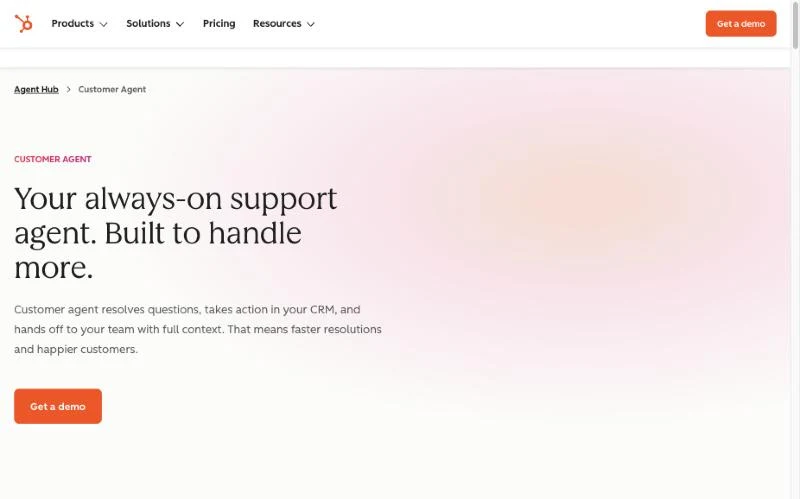
HubSpot's Customer Agent "resolves questions, takes action in your CRM, and hands off to your team with full context" across chat, email, voice, WhatsApp and Messenger. In April 2026 HubSpot cut its price to $0.50 per resolved conversation and reported a 65% resolution rate across 8,000+ customers (announcement).
Key strengths: The lowest per-resolution price in this list. Native to HubSpot CRM. Quick setup.
Limitations: Requires Service Hub Professional or Enterprise. Actions are mostly limited to HubSpot data and connected apps. Credit-based billing to learn.
Best for: SMB and mid-market companies already on HubSpot.
Pricing: $0.50 per resolved conversation (50 HubSpot Credits), on Professional or Enterprise plans.
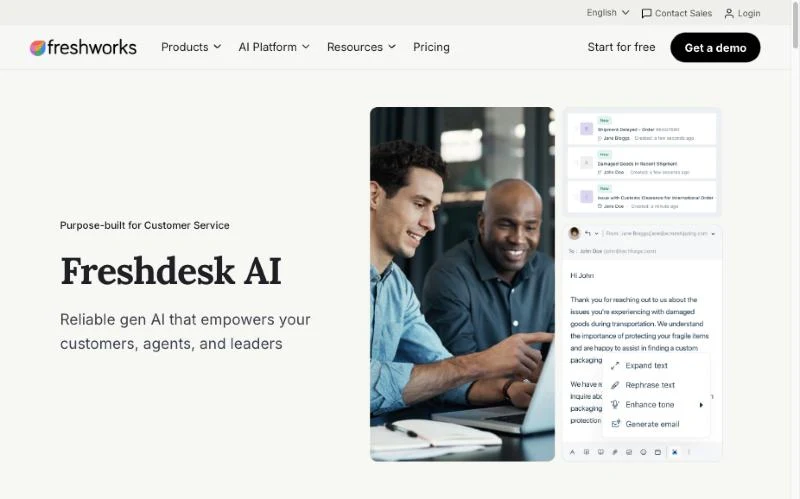
Freddy AI Agent answers on chat and email and takes actions through no-code Skills, including templates for Shopify and Stripe that can issue refunds or process returns. It comes with the Freshdesk helpdesk.
Key strengths: Low entry price with a full helpdesk. No-code Skills Builder. 500 sessions included.
Limitations: Billed per session whether or not the issue is resolved. Published "up to" resolution figures vary across Freshworks pages. Voice is not part of the AI Agent.
Best for: Small and mid-sized teams that want helpdesk and AI agent in one budget.
Pricing: Growth $19, Pro $55, Enterprise $89 per agent/month (annual); first 500 AI Agent sessions included, then $49 per 100 sessions (pricing).
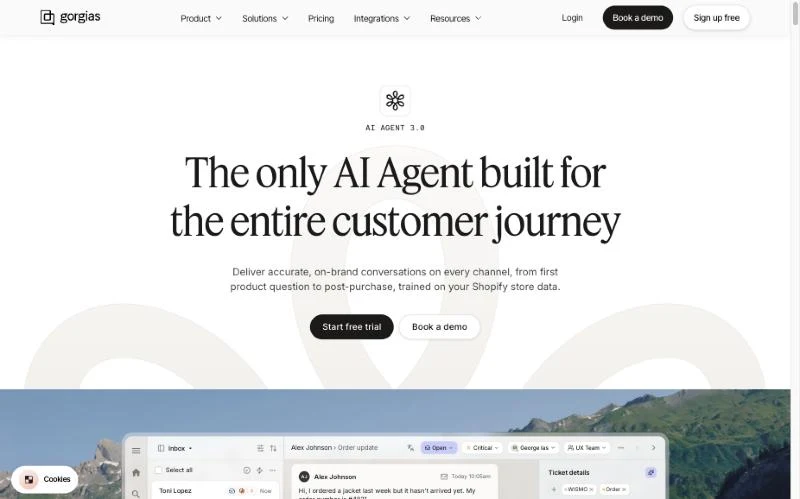
Gorgias AI Agent is built for ecommerce. It answers on email, chat and SMS, trains on your Shopify store data, and takes Shopify-native actions such as cancelling orders, processing returns and changing subscriptions. A Shopping Assistant mode helps with pre-sale questions.
Key strengths: Deep Shopify integration. Covers both support and pre-sale. Simple per-resolution pricing.
Limitations: Ecommerce only. A resolved ticket incurs both a helpdesk ticket fee and an automation fee. Voice is a separate product.
Best for: Shopify direct-to-consumer brands.
Pricing: $0.90 per resolved interaction on most plans ($1 on Starter; $1.50 with Shopping Assistant) (pricing).
Simular does not hold conversations with your customers, so it is not a replacement for Fin, Zendesk or any front-line agent. If every action your agent needs has an API, connect those APIs directly; it is faster and cheaper. Use Simular when resolutions stall because the fix lives in a portal, a legacy console or a desktop app that no connector reaches.
Not fully. Gartner expects agentic AI to resolve 80% of common issues by 2029, but 87% of customers want a human option, and complex or sensitive cases still need people.
Related reading: Best customer service chatbots for SMBs · Best AI agent platforms · Best AI agent builders · What is an autonomous computer?
Product details, prices and metrics were checked on each vendor's official website on 31 October 2026; resolution rates are vendor-reported.