
Oops! Something went wrong while submitting the form.
A traditional market research project takes 4 to 8 weeks and costs between $15,000 and $50,000 when outsourced to a consulting firm (Qualtrics, 2025). Even in-house teams spend an average of 32 hours per competitive analysis cycle -- time that compounds across quarterly reviews, product launches, and investor updates (Crayon State of CI Report, 2025).
AI market research tools have collapsed that timeline. The best ones now deliver competitive intelligence reports in minutes, track competitor moves in real time, and surface audience insights that would take a human analyst days to compile.
But "AI market research" is not a single category. It spans competitive intelligence platforms, audience research tools, social listening systems, data analysis engines, and a new generation of autonomous AI agents that handle the entire research pipeline without human intervention.
We tested nine tools across five categories to help you find the right fit for your team, budget, and research workflow. Whether you need a quick competitor snapshot or a full-cycle industry report, this guide covers it.
Every tool on this list was evaluated through a standardized research scenario: we conducted a competitive landscape analysis of the "AI customer service tools" market using each tool, then measured results across five dimensions.
Our testing methodology:
What it does: Sai is an AI agent that runs on your computer and executes complete market research workflows autonomously. Unlike traditional tools that give you data to analyze, Sai performs the analysis itself: it opens browsers, searches competitors, scrapes pricing pages, reads financial reports, synthesizes findings, and generates structured deliverables (SWOT reports, competitive matrices, trend analyses) without requiring you to intervene at each step.
Why it ranks first: Every other tool on this list handles one slice of market research. Semrush gives you SEO data. Crayon tracks competitor changes. Brandwatch monitors social sentiment. Sai combines all of these steps into a single autonomous workflow. You describe the research question -- "Analyze the AI customer service tools market: top 10 competitors, pricing, market share, and recent product launches" -- and Sai delivers a complete report.
Key capabilities for market research:
Real example: We used Sai to produce a complete AI Agent market research report covering 15+ competitors, market sizing ($5.1B to $47.1B by 2030), vertical segmentation analysis, and a SWOT framework -- in under 30 minutes. The same analysis would take a human researcher 2-3 full days.
Pricing: Free tier available. Pro plan at $20/month.
Best for: Startup founders, GTM teams, and solo operators who need comprehensive market intelligence but lack the budget or headcount for dedicated research analysts. Also strong for teams doing recurring competitive reviews.
Limitations: Requires a computer to run (desktop agent, not a cloud SaaS dashboard). Research quality depends on publicly available information -- Sai cannot access gated databases or proprietary datasets.
Sai Feature Callout: Sai automates the entire market research pipeline that other tools only partially cover: competitor discovery and profiling, pricing and feature comparison, market trend synthesis from news and social sources, SWOT analysis generation, and formatted report delivery to Google Sheets or HTML. Want to see how it works? Follow the step-by-step walkthrough in How to Automate Market Research with AI.
What it does: Semrush is the industry-standard SEO and competitive intelligence platform, used by 10 million marketers worldwide. For market research specifically, it provides keyword-level competitive analysis, backlink intelligence, advertising research, and market positioning data tied to organic and paid search performance.
Why it matters for market research: Search data is a proxy for market demand. When you track which keywords competitors rank for, how their traffic changes quarter over quarter, and where they invest in paid search, you get a real-time signal of their strategic priorities. Semrush makes this data accessible without needing to build custom scrapers or commission panel studies.
Key capabilities:
Real example: Using Semrush Market Explorer for the "AI customer service" vertical, we identified 47 competitors, estimated total monthly search demand at 2.3M queries across related terms, and discovered that three emerging startups had increased organic traffic by 300%+ in the past six months -- a signal of growing market traction.
Pricing: Pro $139.95/mo. Guru $249.95/mo. Business $499.95/mo. Traffic Analytics and Market Explorer require Guru or above.
Best for: Marketing teams, SEO managers, and content strategists who want competitive intelligence grounded in real search demand data. Particularly strong for B2B SaaS companies where SEO is a primary acquisition channel.
Limitations: Primarily focused on search and web data. Limited coverage of social media activity, offline channels, or qualitative market signals. Market sizing estimates are based on search volume proxies, not primary research.
What it does: Similarweb provides the most granular website traffic and digital market share data available. It tracks visits, engagement metrics, traffic sources, audience demographics, and app performance across 100M+ websites and 4.7M+ apps. For market research, it answers the fundamental question: how much digital attention does each competitor command, and where does it come from?
Why it matters for market research: While Semrush shows you search-level competition, Similarweb shows you the full digital picture -- including direct traffic, referral partnerships, social media sources, and display advertising. This is critical for market sizing exercises where you need to estimate total digital reach, not just organic search share.
Key capabilities:
Real example: When analyzing the AI customer service market, Similarweb revealed that Intercom receives 12.4M monthly visits (45% from organic search), while Zendesk receives 42.8M (with 32% from direct traffic -- suggesting stronger brand recognition). This traffic distribution data directly informed our market share estimates.
Pricing: Starter $149/mo. Professional and Enterprise tiers with custom pricing. Free Chrome extension provides limited data.
Best for: Strategy teams, business development professionals, and investors who need accurate digital traffic and market share estimates for competitive analysis, due diligence, or market entry assessments.
Limitations: Traffic estimates are modeled (not exact), with accuracy varying for smaller websites below 50K monthly visits. App intelligence requires higher-tier plans. No access to actual revenue or conversion data.
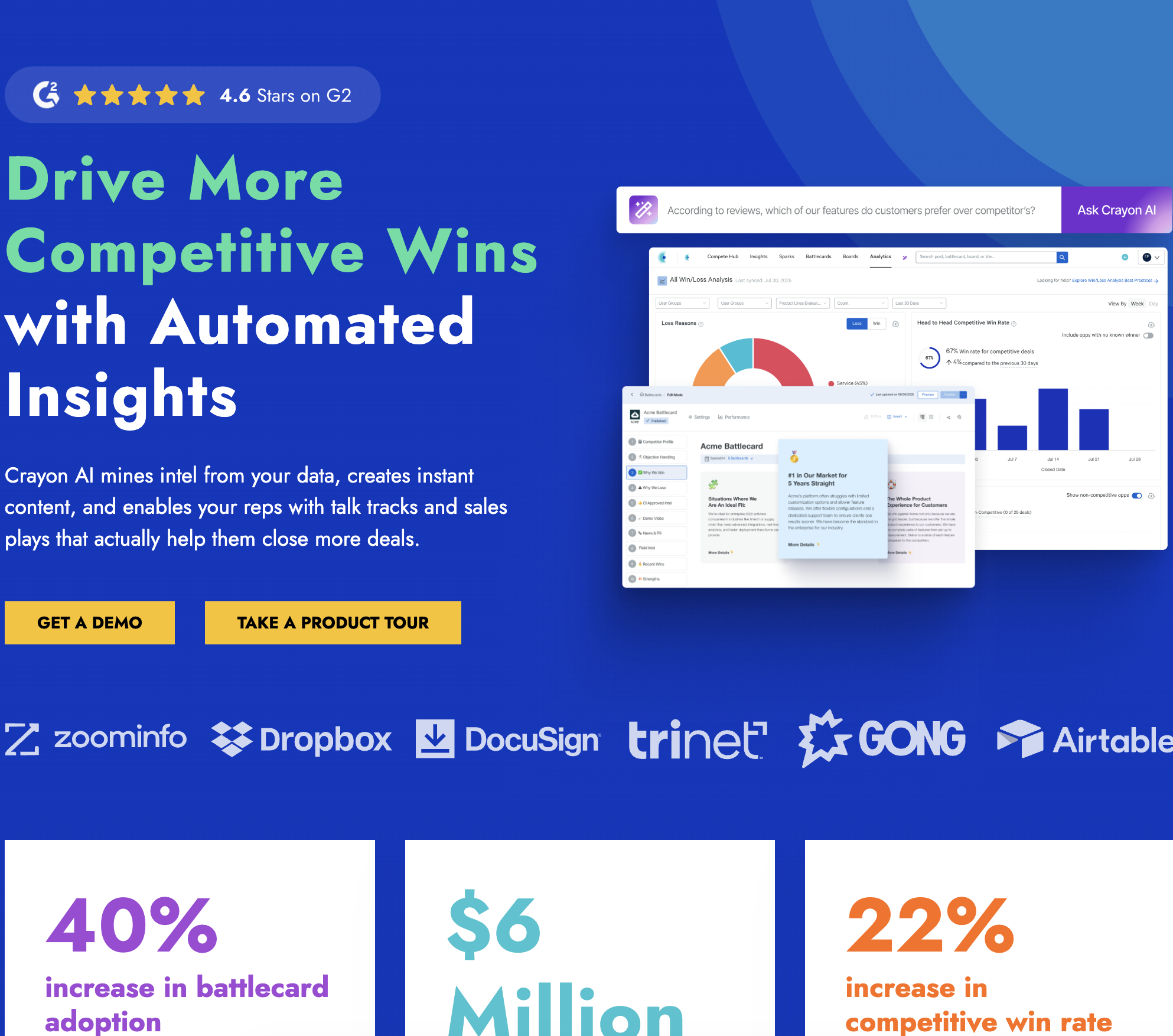
What it does: Crayon is a competitive intelligence platform that automatically tracks and analyzes everything your competitors do online: website changes, pricing updates, product launches, messaging shifts, new hires, ad campaigns, and customer reviews. It captures over 100 types of competitive signals and uses AI to surface the most strategically relevant changes.
Why it matters for market research: Market research is not a one-time event. Competitive landscapes shift weekly -- new features launch, pricing changes, executive hires signal strategic pivots. Crayon turns competitive monitoring from a periodic project into a continuous intelligence stream.
Key capabilities:
Real example: Crayon detected a competitor's pricing page change within 4 hours of it going live -- a 30% price reduction on their enterprise tier that would have taken our team days to notice through manual monitoring. This early detection allowed the sales team to adjust positioning before losing any active deals.
Pricing: Custom pricing (typically $25K-$100K+ annually for enterprise). No free tier. Requires a demo to get started.
Best for: Product marketing teams, competitive intelligence analysts, and B2B organizations where competitive positioning directly impacts revenue. Particularly strong for companies in fast-moving markets with 5-20 direct competitors.
Limitations: Enterprise pricing puts it out of reach for startups and small teams. Primarily focused on digital signals -- limited coverage of offline competitive activity. Requires dedicated CI resources to fully operationalize.
What it does: Klue combines competitive intelligence gathering with sales enablement. It tracks competitor activity across the web, but its differentiator is how it delivers that intelligence to the people who need it most: sales reps in active deals. Klue automatically generates and updates competitive battlecards, integrates with CRM systems, and measures the revenue impact of competitive insights.
Why it matters for market research: Market research has no value if it does not reach decision-makers at the moment they need it. Many organizations produce excellent competitive analyses that collect dust in shared drives. Klue solves this distribution problem by embedding intelligence directly into sales workflows. According to Klue's own research, companies using competitive enablement tools see a 28% increase in win rates against named competitors.
Key capabilities:
Real example: A B2B SaaS company using Klue reported that their sales team accessed competitive battlecards in 73% of competitive deals (up from 15% when intel was shared via email), and win rates against their top three competitors increased by 22% within two quarters.
Pricing: Custom pricing (similar range to Crayon). Designed for mid-market to enterprise B2B organizations. No free tier.
Best for: B2B sales organizations with significant competitive deal volume. Particularly valuable for companies with 10+ sales reps who regularly encounter the same 3-5 competitors. If your primary use case for market research is feeding sales teams, Klue is the strongest option.
Limitations: Sales-centric design means it is less useful for teams doing market research for product strategy, investor relations, or content marketing. Enterprise pricing. Requires CRM integration to deliver full value.
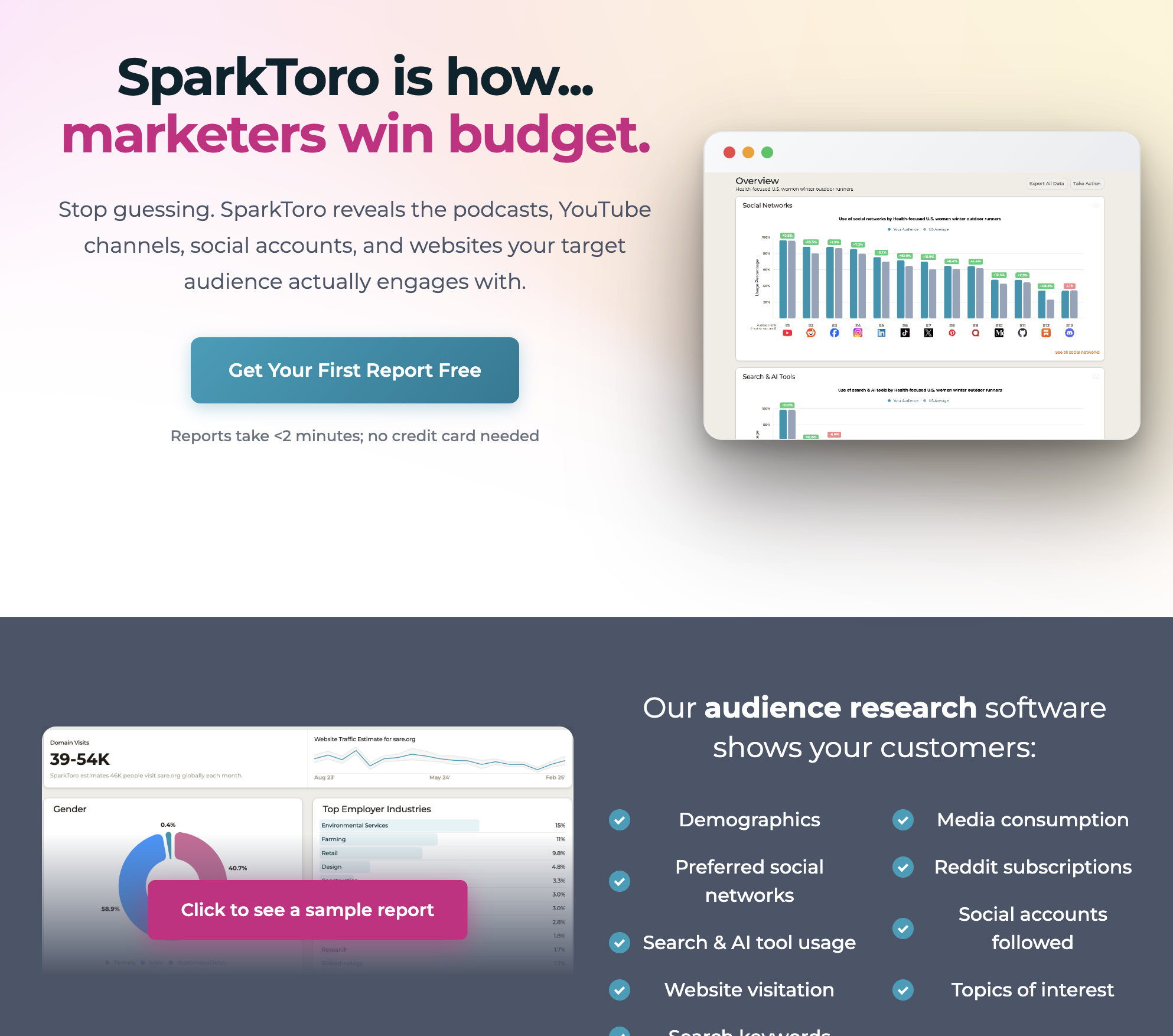
What it does: SparkToro answers the question most market research tools ignore: where does your target audience actually spend time online? By analyzing 200M+ social and web profiles, SparkToro identifies the websites, podcasts, YouTube channels, social accounts, and publications that influence your target customers. This is audience intelligence -- understanding who your buyers pay attention to, not just what they search for.
Why it matters for market research: Traditional market research tools focus on competitors and keywords. SparkToro focuses on customers. Knowing that "35% of startup CTOs who follow AI news regularly read The Pragmatic Engineer and listen to the Lenny's Podcast" is the kind of insight that transforms content strategy, partnership decisions, and advertising spend allocation. It fills a gap that no other tool on this list covers.
Key capabilities:
Real example: When researching the audience for AI sales tools, SparkToro revealed that 42% of people who discuss "AI sales automation" also follow specific SaaS podcasts and tech newsletters. This directly informed our content distribution strategy and guest post outreach targets.
Pricing: Free tier (5 searches/month). Standard $50/mo. Pro $150/mo. Agency plans available.
Best for: Content marketers, brand strategists, PR teams, and anyone making decisions about where to reach their target audience. Particularly valuable for startups entering new markets where audience behavior is unknown.
Limitations: Limited to English-language web and social data. Does not provide competitive intelligence or market sizing data. Audience insights are directional (based on public social behavior), not precise demographic data from panel studies.
What it does: Perplexity AI is a conversational research assistant that searches the web in real time and delivers answers with inline citations. For market research, it functions as a fast secondary research tool -- ask it a question about market sizing, competitor history, industry trends, or regulatory developments, and it synthesizes information from multiple sources with direct links to verify each claim.
Why it matters for market research: Secondary research (reviewing existing data, reports, and publications) consumes 40-60% of total market research time (Greenbook, 2025). Perplexity compresses this phase by acting as a research librarian that reads hundreds of sources simultaneously and presents a synthesized answer. It does not replace primary research or specialized tools, but it dramatically accelerates the "get up to speed on this market" phase.
Key capabilities:
Real example: We asked Perplexity "What is the current market size of AI customer service tools and who are the top 5 vendors by revenue?" and received a comprehensive answer in 15 seconds with 8 cited sources, including recent analyst reports from Gartner and Forrester. Verifying the same information manually would have taken 2-3 hours of searching and reading.
Pricing: Free tier (limited Pro searches). Pro $20/mo with unlimited Pro Search and file upload.
Best for: Individual researchers, analysts, and consultants who need to quickly gather background intelligence on unfamiliar markets. Excellent as a starting point before diving into specialized tools. Also useful for fact-checking data found through other research methods.
Limitations: Dependent on publicly available web content -- cannot access paywalled reports, proprietary databases, or internal company data. Answers are synthesized summaries, not original analysis. Not designed for ongoing competitive monitoring or structured data collection.
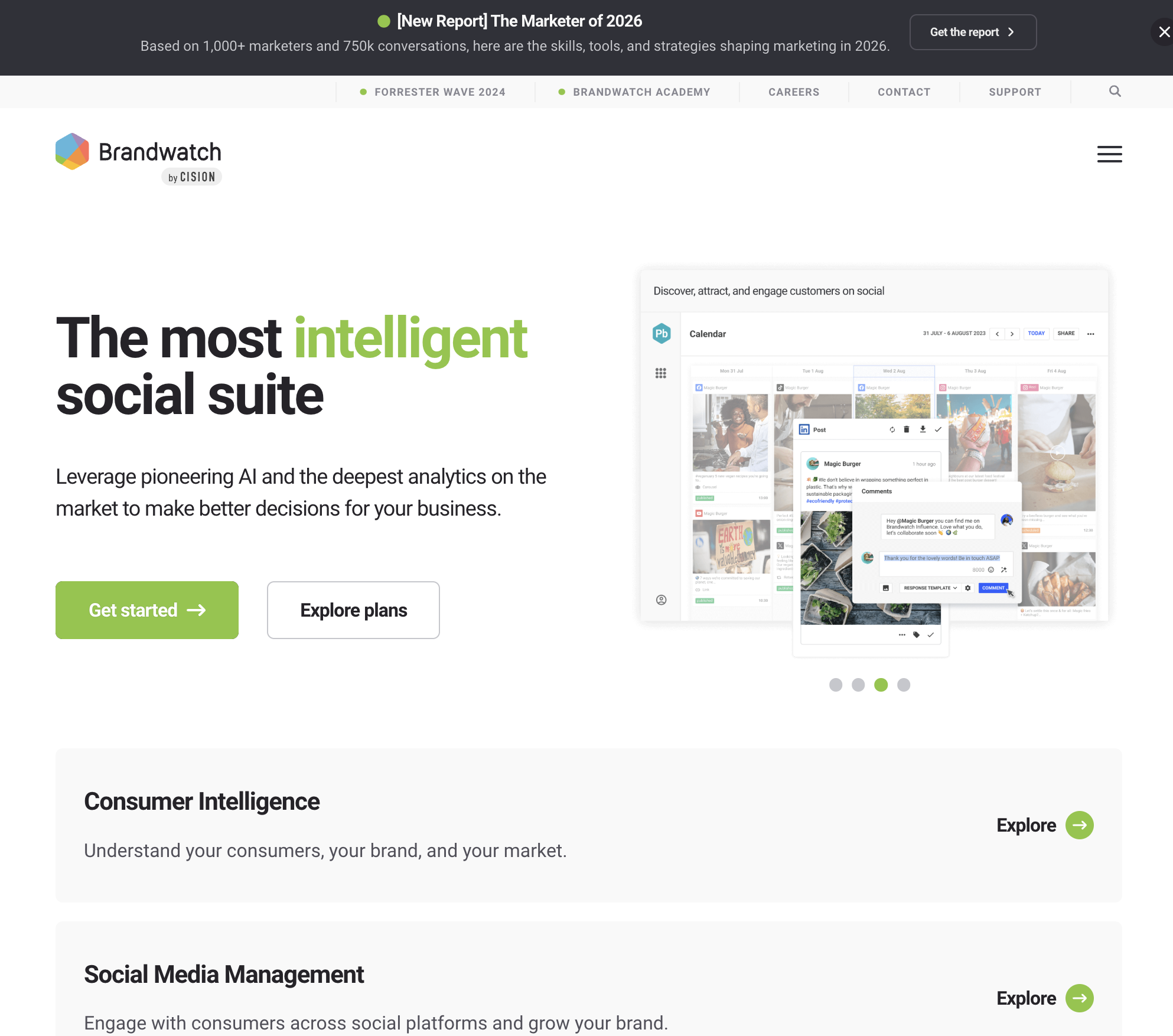
What it does: Brandwatch is an enterprise-grade social listening platform that monitors 100M+ online sources -- including social media, forums, blogs, news sites, and review platforms -- to track brand mentions, consumer sentiment, and emerging trends. With a historical database of 1.7 trillion conversations, it provides both real-time monitoring and longitudinal trend analysis.
Why it matters for market research: Consumer conversations contain market signals that traditional research tools miss entirely. Product complaints on Reddit reveal unmet needs. Discussion spikes on Twitter signal emerging trends. Review sentiment patterns across G2 and Capterra expose competitive weaknesses. Brandwatch transforms this unstructured data into structured market intelligence.
Key capabilities:
Real example: Monitoring social conversations around "AI customer service" over 90 days, Brandwatch identified a growing negative sentiment trend around chatbot-only support (conversation volume up 180%), and a corresponding positive trend around "AI-assisted human agents" -- a market positioning insight that search data alone would not reveal.
Pricing: Custom pricing (typically $800-$3,000+/month depending on volume and features). Consumer Research and Social Media Management are separate products. No free tier.
Best for: Brand managers, consumer insights teams, and market researchers at mid-market to enterprise companies. Particularly valuable for B2C brands, CPG companies, and any organization where consumer sentiment directly impacts product and marketing strategy.
Limitations: Enterprise pricing excludes smaller teams. Primarily focused on social and web conversations -- does not cover search data, website traffic, or financial market signals. Setup and query configuration require expertise to get meaningful results.
What it does: Statista is the world's largest curated statistics and market data platform, aggregating 1.5M+ statistics from 22,500+ sources across 80,000+ topics. It covers market forecasts, industry reports, consumer surveys, company data, and infographics, organized into a searchable database with standardized citations and downloadable charts.
Why it matters for market research: Every market research report, business plan, and investor deck needs credible data points. Finding reliable, properly sourced statistics is one of the most time-consuming parts of research. Statista aggregates data from Gartner, Forrester, IDC, Euromonitor, and thousands of other sources into a single searchable platform, eliminating the need to subscribe to multiple individual research firms.
Key capabilities:
Real example: Searching for "AI customer service market size" on Statista returned 23 relevant statistics from sources including Grand View Research, MarketsandMarkets, and Mordor Intelligence -- with market sizing data ranging from 2020 to 2030 projections. Each statistic included the exact source, methodology notes, and publication date. Compiling equivalent data through individual source subscriptions would cost $15,000+.
Pricing: Basic $199/mo. Professional and Enterprise tiers with additional features. Limited free access (some statistics visible without subscription).
Best for: Business analysts, consultants, academic researchers, and anyone who regularly needs credible data points for reports and presentations. Essential for market sizing exercises and industry benchmarking.
Limitations: Aggregates existing research rather than producing original analysis. Some statistics are sourced from older reports and may not reflect current conditions. Full access to all data requires Professional or Enterprise plans. Not designed for real-time competitive monitoring or automated research workflows.