

Oops! Something went wrong while submitting the form.


.svg)
If you manage clients, students, or subscribers, your Google Sheets contact list quietly runs your day. When those names are jumbled by first name, it is harder to match records, find people quickly, or line up reports with tools that expect last-name order. Sorting by surname sounds trivial, but at scale it is the difference between hunting through rows and instantly seeing who is who. Clean, consistently ordered data gives every downstream workflow a smoother path: gradebooks, CRM exports, event check-ins, payroll, even simple mail merges all benefit.
This is exactly where an AI computer agent shines. Instead of you repeating the same sequence of clicks and formulas in Google Sheets, the agent learns the pattern once and then applies it every time: opening the right sheet, extracting last names, running the sort, and saving or exporting results. You get the reliability of a documented process with the convenience of never touching the mouse for it again.
You would not ask your top salesperson to spend an afternoon alphabetizing a spreadsheet by hand. Yet that is exactly what happens when name lists in Google Sheets are messy.
Let’s walk through the best manual methods first, then see how an AI agent can take the entire workflow off your plate.
If first and last names are already separated, this is the fastest option.

If your sheet has full names like "Alex Rivera" in a single column:
=SPLIT(A2, " ")
=CONCATENATE(C2, " ", B2)
=TEXTJOIN(" ", TRUE, C2, B2)
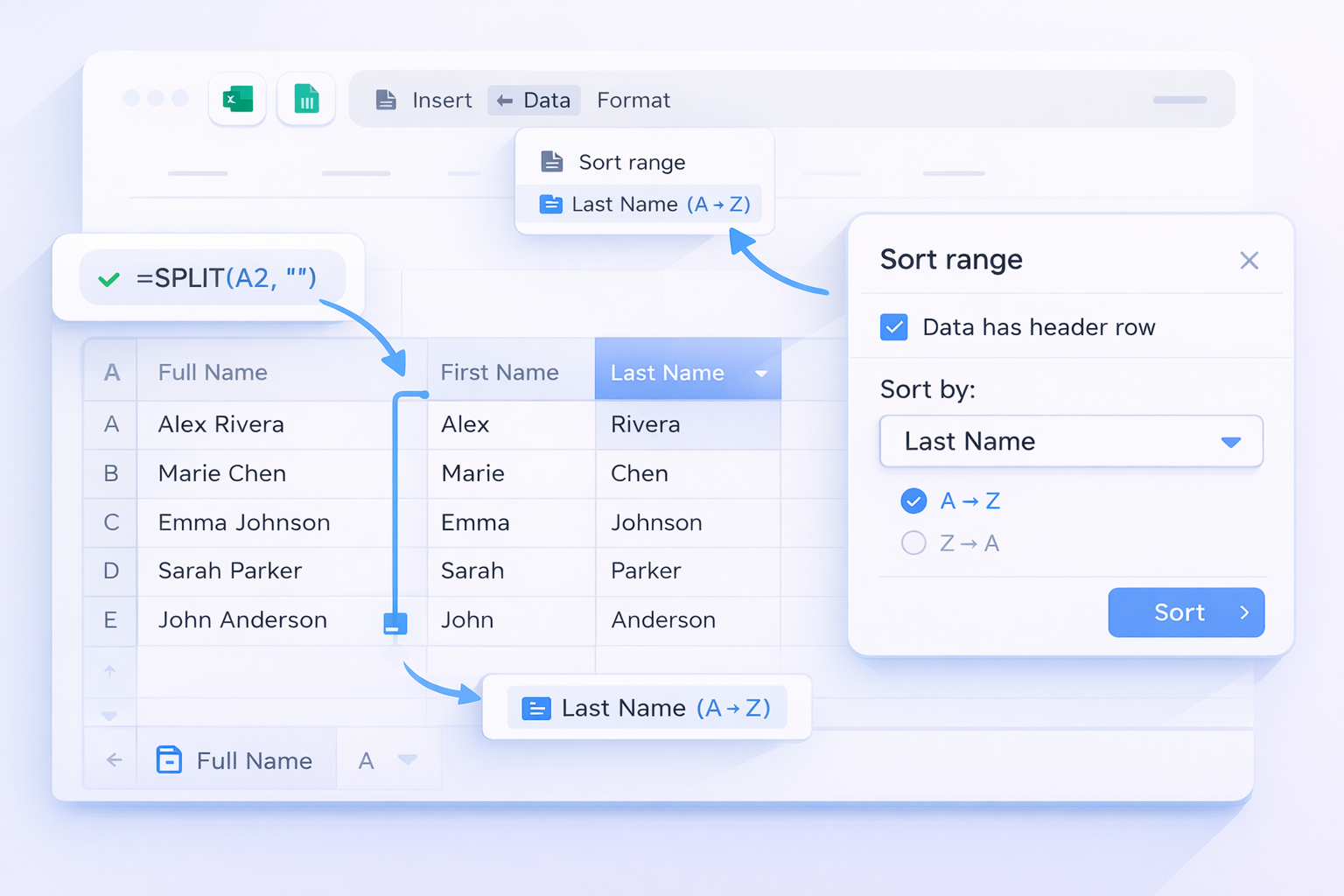
For messy names with middle names or initials, pull only the final word from the cell.
TRIM + RIGHT + SUBSTITUTE pattern).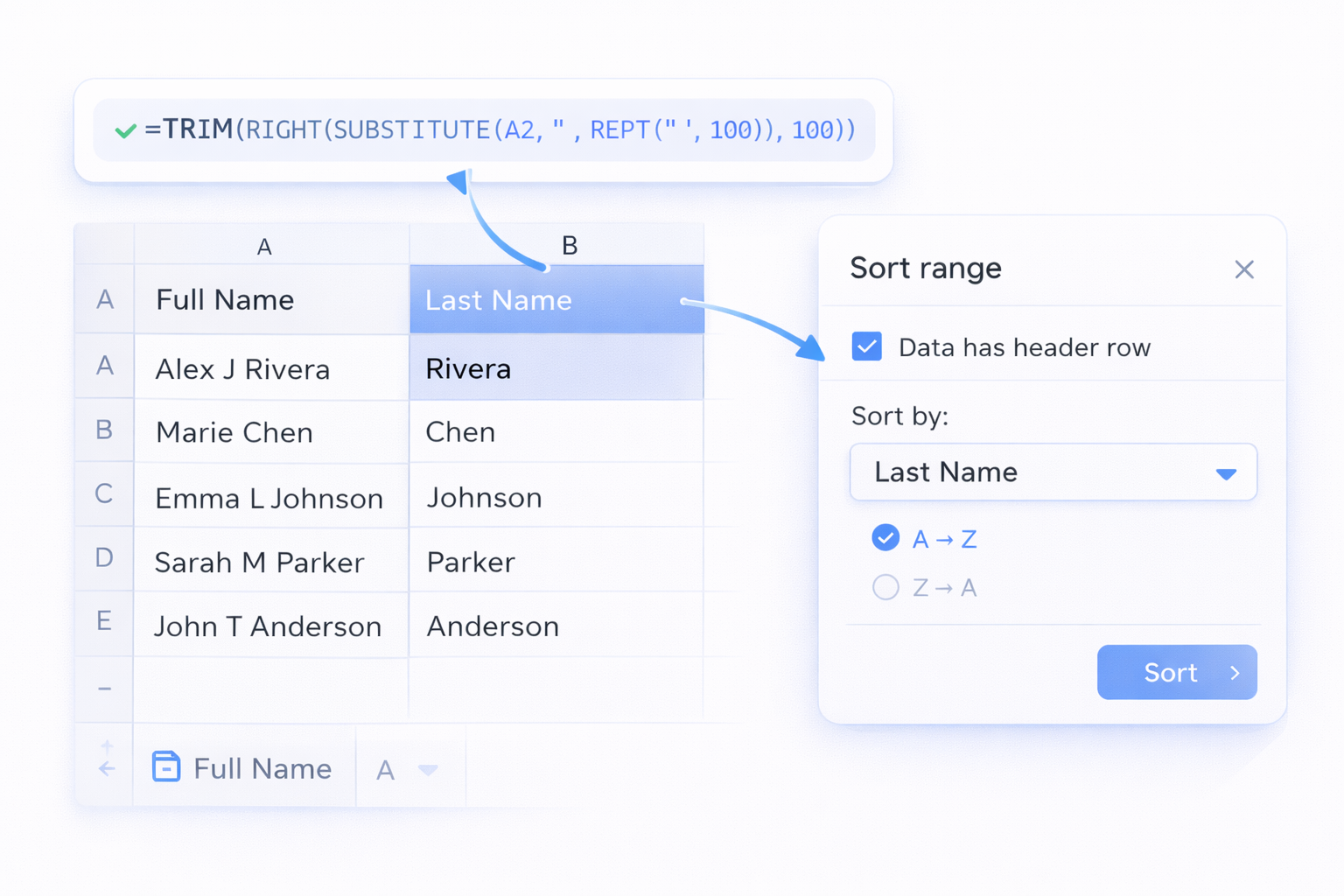
If you run an agency, school, or membership business, you’re not sorting ten names — you’re sorting thousands of records across dozens of Google Sheets tabs.
Every export from a CRM or classroom tool means you have to:

Multiply that by your whole team, and you can lose hours every week on what is essentially glorified alphabetizing.
One way to automate is with Apps Script.
Instead of embedding logic into one sheet, let a Simular AI computer agent handle the workflow like a human — without the tedium.

For a one-off cleanup, manual sorting is perfectly fine.
But when sorting by last name in Google Sheets becomes a recurring task across clients or departments, it’s a clear candidate for automation.
Start by nailing the logic with helper columns and sorts — then promote that logic into a Simular AI agent that runs the steps for you at scale. You keep control over the rules. The agent takes over the repetition.

