If you manage clients, students, or subscribers, your Google Sheets contact list quietly runs your day. When those names are jumbled by first name, it is harder to match records, find people quickly, or line up reports with tools that expect last-name order. Sorting by surname sounds trivial, but at scale it is the difference between hunting through rows and instantly seeing who is who. Clean, consistently ordered data gives every downstream workflow a smoother path: gradebooks, CRM exports, event check-ins, payroll, even simple mail merges all benefit.This is exactly where an AI computer agent shines. Instead of you repeating the same sequence of clicks and formulas in Google Sheets, the agent learns the pattern once and then applies it every time: opening the right sheet, extracting last names, running the sort, and saving or exporting results. You get the reliability of a documented process with the convenience of never touching the mouse for it again.
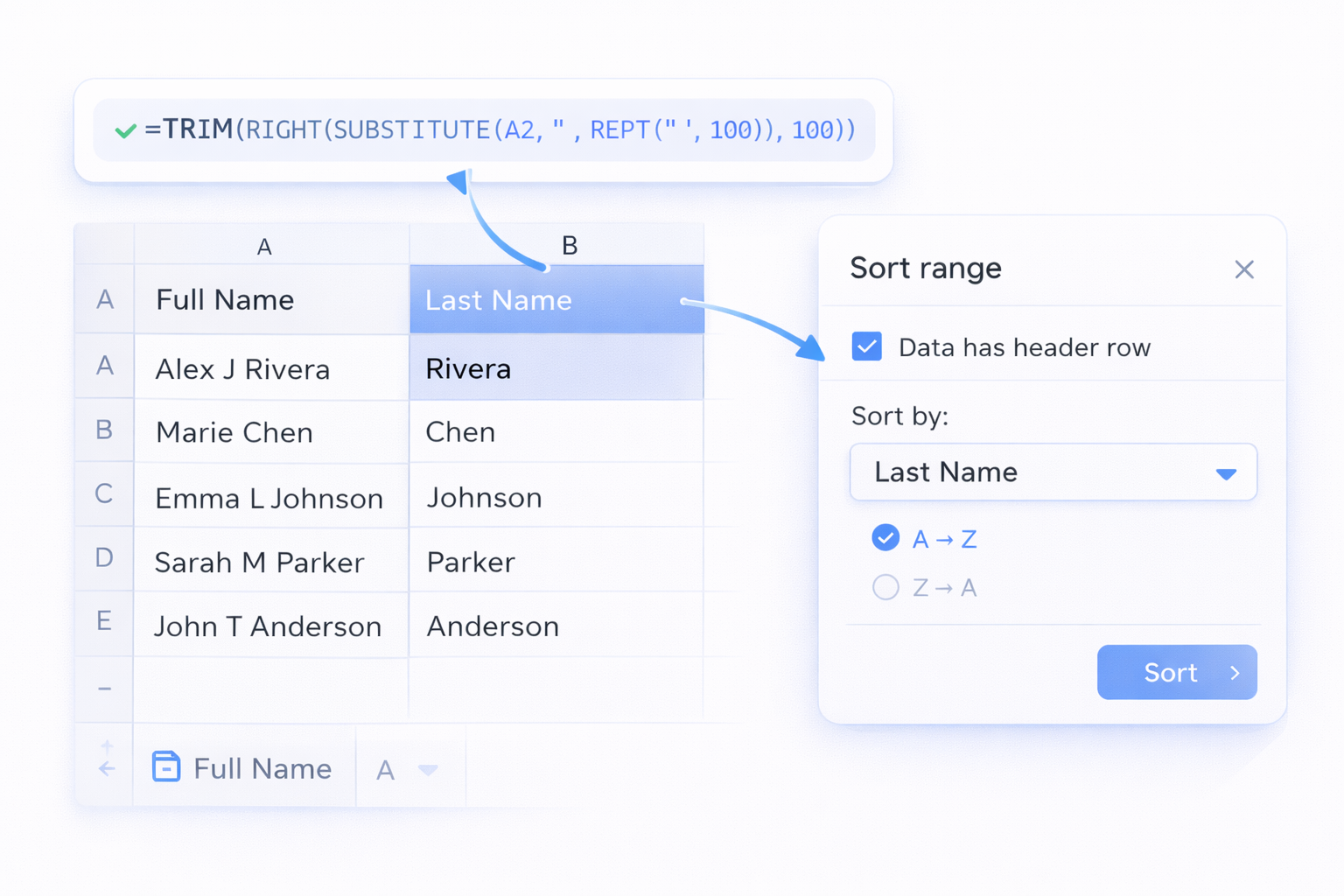
You would not ask your top salesperson to spend an afternoon alphabetizing a spreadsheet by hand. Yet that is exactly what happens when name lists in Google Sheets are messy. Let us walk through the best manual methods first, then see how an AI agent can take the entire workflow off your plate.MANUAL METHOD 1 – QUICK SORT WHEN LAST NAMES ARE IN THEIR OWN COLUMN1. Put first names in one column and last names in another, for example Column A = First Name, Column B = Last Name.2. Select the full range of data, including any extra columns that should stay attached to each person.3. In the menu, choose Data, then Sort range.4. If you have a header row, tick Data has header row.5. In the Sort by dropdown, pick the Last Name column and choose A to Z.Pros: Very fast, built into Sheets, no formulas required.Cons: Only works cleanly if last names already live in their own column.MANUAL METHOD 2 – SPLIT FULL NAMES, THEN SORTIf your sheet has full names like "Alex Rivera" in a single column:1. Insert two empty columns to the right of the full name column.2. In the first empty column, use SPLIT to break the name: =SPLIT(A2, " ") This pushes the first word into one column and the second into the next.3. Drag the formula down to fill for all rows.4. Now sort the range by the new last-name column using Data, Sort range.5. Optionally, use a formula like =CONCATENATE(C2, " ", B2) or TEXTJOIN to recombine if you still want a single full-name column.Pros: Simple and transparent, easy to debug.Cons: Struggles with middle names, suffixes, or multi-word last names; needs repeating every time you update data.MANUAL METHOD 3 – ROBUST LAST-NAME FORMULAFor messy names with middle names or initials, you can pull only the final word:1. Add a helper column called Last Name.2. In the helper column, use a formula that always takes the last word from the cell, such as a TRIM plus RIGHT and SUBSTITUTE pattern.3. Copy the formula down the column.4. Sort the entire range by this helper column.Pros: Handles middle names more reliably; updates if you edit a name.Cons: Still a manual process to set up, and you must remember not to delete the helper column if other sheets reference it.WHY MANUAL BREAKS DOWN AT SCALEIf you run an agency, school, or membership business, you are not sorting ten names. You are sorting thousands of records across dozens of Google Sheets tabs: separate lists for campaigns, cohorts, territories, and events. Every time you export from a CRM or classroom tool, you have to:- Clean up the full names- Rebuild helper columns- Reapply the sort- Double-check that nothing broke formulas or filtersMultiply that by your whole team and you can lose hours each week on what is essentially glorified alphabetizing.AUTOMATED METHOD 1 – SCRIPTING INSIDE GOOGLE SHEETSOne way to automate is with Apps Script:1. Open Extensions, Apps Script from your sheet.2. Write a script that, when run, reads the full-name column, computes last names, writes them to a helper column, and calls sort on the range.3. Attach the script to a custom menu item or a button.Pros: Once written, one click can re-sort any time; lives directly in Sheets.Cons: Requires coding comfort, breaks if column layout changes, and still depends on someone remembering to run it.AUTOMATED METHOD 2 – HAND IT TO A SIMULAR AI COMPUTER AGENTInstead of embedding logic in one sheet, you can let a Simular AI computer agent handle the entire workflow the way a human would, but without the tedium.Here is what that looks like:1. You describe the process once: which Google Sheets document to open, which tab holds full names, and how you like them sorted.2. The agent opens the browser, navigates to Google Drive, launches the sheet, and applies the name-splitting and sorting steps just like you would.3. It can repeat this across multiple files, export cleaned CSVs for your CRM, or update downstream dashboards.Pros:- Works across many sheets and accounts, not just one file.- Production-grade reliability: the Simular agent can run workflows with thousands of steps without drifting.- Transparent execution: every step is visible, so you can inspect how it split and sorted names.Cons:- Best for teams that are ready to formalize their process once, instead of improvising in every sheet.PUTTING IT ALL TOGETHERFor a one-off cleanup on a tiny list, manual sort is perfectly fine. But as soon as sorting by last name in Google Sheets becomes a recurring task across clients or departments, it is a clear candidate for automation. Start by nailing the logic with helper columns and sorts, then promote that logic into a Simular AI agent that runs the steps for you at scale. You keep control over the rules; the agent takes over the repetition.
Yes. Add a helper column next to your full-name column. Use a formula that extracts the last word in each cell, then fill it down. Next, select the entire data range, including the helper column, and go to Data, Sort range. Choose the helper column as the sort key, A to Z. Your rows will reorder by last name while keeping all related columns attached.
Before sorting, always select the full rectangular range of your table, not just the name column. That means clicking and dragging across all columns that belong to each person. Then use Data, Sort range and choose the last-name or helper column as the sort key. Sorting the full range ensures every row stays intact so emails, IDs, and notes still match the correct person.
Use a formula that pulls the final word from the cell instead of simply splitting on the first space. Create a helper column, enter a last-word formula in the first row that targets your full-name cell, and copy it down. This picks up the true surname even if there is a middle name or initial. Then sort your entire data range by that helper column from A to Z.
For dynamic sorting, combine a helper column with an array formula or QUERY. Use an array formula to extract last names for an entire range, then wrap your data in a QUERY that orders by that helper column. Alternatively, set up an AI computer agent with Simular to open Google Sheets, refresh helper columns, and apply the sort whenever new rows are added or files are imported.
Use Apps Script if you are comfortable coding and your sorting logic will live in a single, stable Google Sheet. Choose an AI agent like Simular when the task spans many sheets, accounts, or connected tools. The agent can drive the browser, open any file, recompute last names, sort ranges, and export results, all with transparent, inspectable steps and without you maintaining script code.