Oops! Something went wrong while submitting the form.
How to Write SMART Goals: Examples, Worksheets, and Templates
Learn how to write SMART goals that actually stick — with 30+ ready-to-use examples for work, fitness, nursing, students, and business, plus a free worksheet template and an AI tool that generates them for you.
Paste a vague intention — "I want to get healthier" or "grow our revenue" — and Sai rewrites it into a fully structured SMART goal with specific metrics, realistic timelines, and measurable milestones. It generates 5 variations across different ambition levels so you pick the one that fits.
Auto-Generated Worksheets and Tracking Sheets
Sai builds a complete SMART goals worksheet in Google Sheets with columns for each SMART dimension (Specific, Measurable, Achievable, Relevant, Time-bound), progress checkpoints, status badges, and a visual completion tracker — ready to use without touching a template.
Scheduled Check-Ins and Progress Monitoring
Set a cadence — weekly, biweekly, monthly — and Sai pings you with a progress review. It pulls your current status from the tracking sheet, flags goals that are falling behind schedule, and drafts adjusted milestones when timelines slip — keeping accountability on autopilot.
What is a SMART goal?
A SMART goal is a goal that passes five tests: it's Specific, Measurable, Achievable, Relevant, and Time-bound. If it fails any one of those, it's a wish, not a goal.
The framework was first published by George T. Doran in a 1981 issue of Management Review. He argued that most corporate objectives failed because they were too vague — "improve profitability" or "become a market leader" — with no way to know if you'd achieved them or not.
Four decades later, SMART goals are used everywhere: performance reviews, nursing care plans, fitness programs, student advising, startup planning, and personal New Year's resolutions. The concept hasn't changed because vagueness is still the number-one reason goals fail.
Vague Goal
SMART Goal
What Changed
Get in shape
Run a 5K in under 30 minutes by September 1
Added specific activity, measurable target, deadline
Improve sales
Increase monthly recurring revenue by 15% from $80K to $92K by Q3 end
Added baseline, target number, timeframe
Learn a language
Complete Pimsleur Spanish Level 1–3 (90 lessons) by May 31
Named the program, counted lessons, set deadline
Be a better nurse
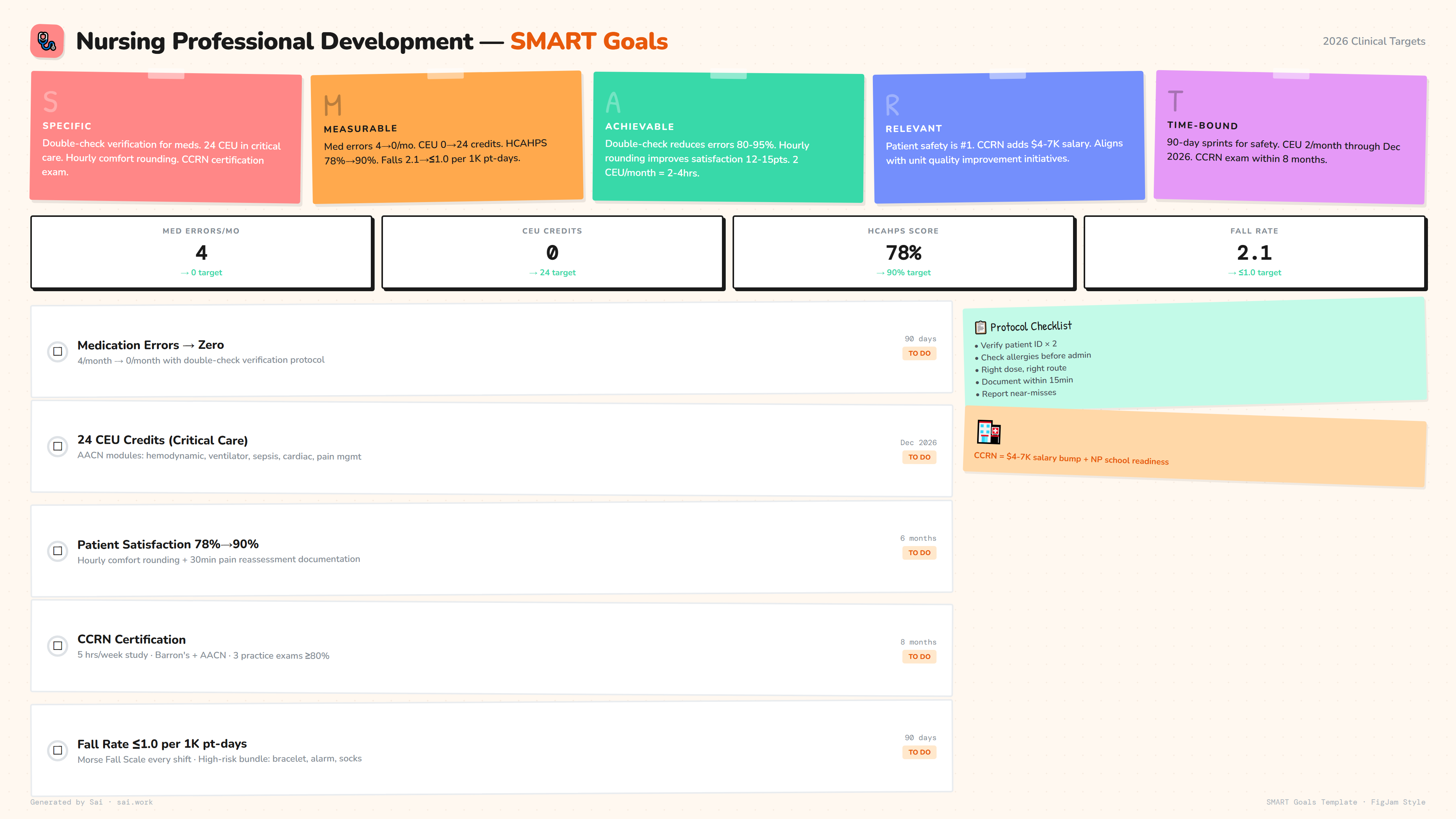
Reduce patient fall rate from 3.2 to below 1.5 per 1,000 patient days within 90 days
Named the metric, set baseline → target, added time
Save more money
Save $6,000 in 12 months by auto-depositing $500/month into a HYSA
Named the amount, method, and timeline
Do better in school
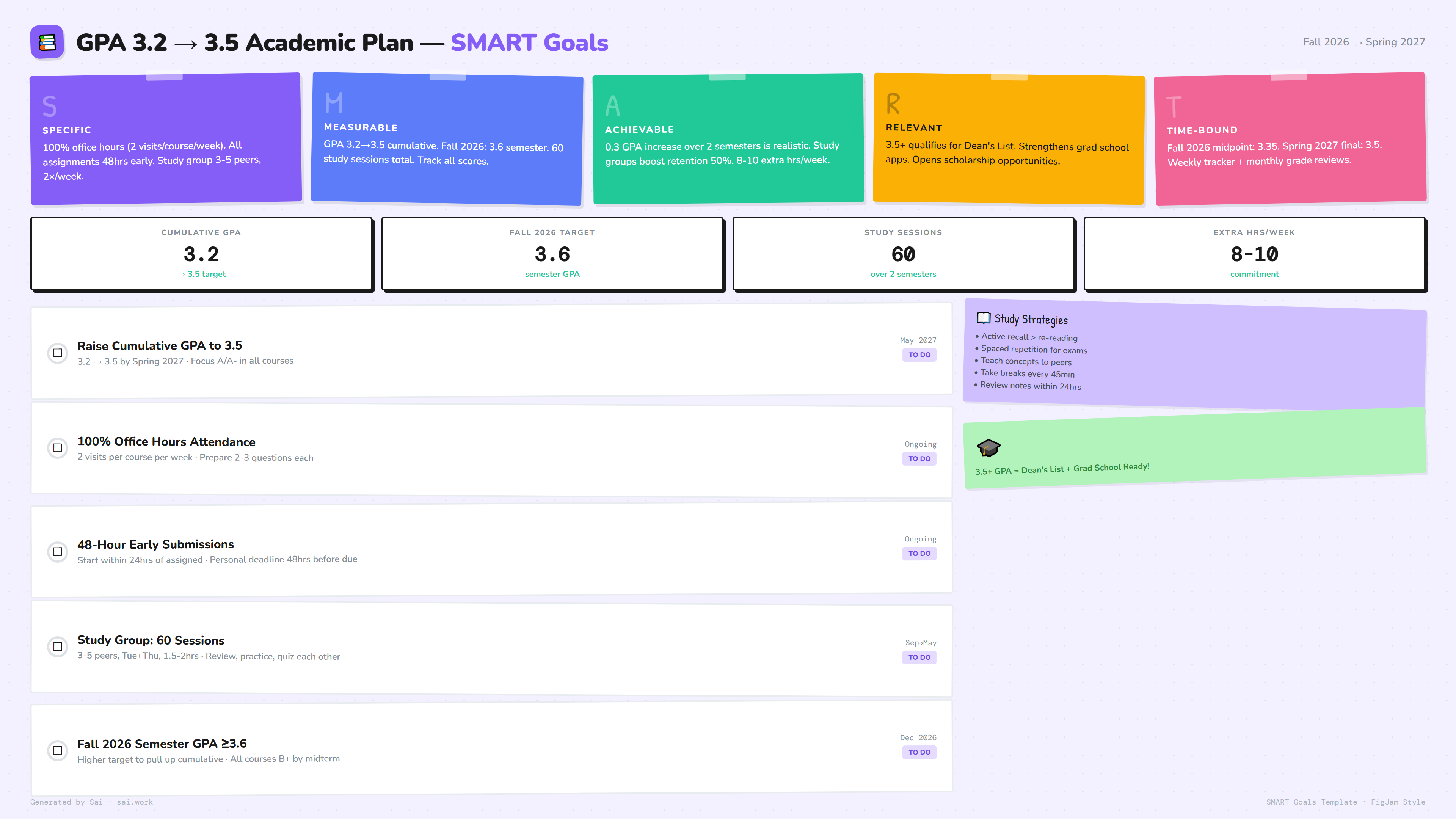
Raise GPA from 2.8 to 3.2 by end of spring semester using weekly study groups
Added GPA numbers, semester deadline, method
How to write a SMART goal (5-step framework)
The framework is straightforward — five filters, applied in order. If a goal can't pass all five, it needs rewriting.
Step 1: Make it Specific
A specific goal answers: What exactly am I doing, and where?
❌ "Exercise more"
✅ "Run 3 miles around Green Lake every Monday, Wednesday, and Friday morning"
The test: Could someone else read your goal and know exactly what to do? If not, it's not specific enough.
Step 2: Make it Measurable
A measurable goal has a number attached — a quantity, percentage, frequency, or score.
❌ "Read more books"
✅ "Read 2 books per month (24 total this year)"
The test: Will you know, objectively, whether you've achieved it? No subjective judgment required.
Step 3: Make it Achievable
Achievable doesn't mean easy. It means you have the resources, skills, and time to get it done — or a clear plan to acquire them.
❌ "Become fluent in Mandarin in 30 days" (unrealistic for most adults)
✅ "Complete HSK Level 2 (300 vocabulary words) in 6 months using 30 minutes of daily Anki review"
The test: Can you list the specific steps, tools, or resources that make this possible? If not, it might be aspirational rather than achievable.
Step 4: Make it Relevant
A relevant goal connects to a larger purpose — your career, health, relationships, or business strategy. Goals that exist in isolation get abandoned first.
❌ "Learn to play guitar" (if your actual priority is career advancement)
✅ "Complete AWS Solutions Architect certification to qualify for the $15K/year raise tied to the cloud infrastructure lead role"
The test: If someone asked "why this goal, why now?" — do you have a clear answer?
Step 5: Make it Time-bound
Every SMART goal needs a deadline. Without one, there's no urgency and no way to measure pace.
❌ "Eventually publish a book"
✅ "Complete a 50,000-word first draft by March 31 by writing 500 words per day"
The test: Is there a specific date (not "soon" or "eventually") when you'll evaluate success or failure?
These are the SMART goals you'd write for annual performance reviews, quarterly OKRs, or professional development plans.
SMART Goal
S
M
A
R
T
Close 12 new enterprise deals worth $50K+ each by end of fiscal year
Enterprise sales
12 deals × $50K+
Currently closing 8/year; new SDR hired
Revenue target for promotion
By fiscal year end
Reduce average customer support response time from 4 hours to under 1 hour
Support response time
4h → <1h average
Deploying chatbot + hiring 2 agents
CSAT score dropped 15 points
Within 90 days
Complete PMP certification by passing the exam on the first attempt
PMP certification
Pass/fail on first attempt
Study 1h/day for 12 weeks using PMI Authorized Training
Required for Senior PM role
By March 31
Publish 20 SEO blog posts that generate 10,000 organic visits per month
SEO content program
20 posts → 10K visits/mo
Writer hired; keyword research done; CMS ready
Organic is cheapest acquisition channel
Within 6 months
Reduce code deployment bugs by 40% by implementing automated testing in CI/CD pipeline
Automated testing in CI/CD
40% fewer post-deploy bugs
Jest + Cypress setup; 2 sprint allocation
Bug fixes consuming 30% of sprint capacity
By end of Q2
Mentor 2 junior designers through their first solo project from brief to delivery
Junior designer mentorship
2 mentees × 1 solo project each
Weekly 1:1s + async feedback on Figma
Team growth + manager track requirement
By end of quarter
Nursing smart goals examples
Nursing SMART goals are tied to patient outcomes, clinical competency, and professional development. These are commonly required in nursing care plans, BSN programs, and annual performance evaluations.
SMART Goal
S
M
A
R
T
Reduce patient fall rate on the med-surg unit from 3.2 to below 1.5 per 1,000 patient days
Fall rate on med-surg unit
3.2 → below 1.5 per 1,000 patient days
Implement hourly rounding + bed alarm protocol
Falls are #1 preventable injury
Within 90 days
Complete ACLS recertification and precept 3 new grad orientees
Fitness goals fail more than any other category — usually because they're too vague ("lose weight") or too aggressive ("run a marathon next month"). Here are fitness goals that pass the SMART test.
SMART Goal
S
M
A
R
T
Run a 5K in under 30 minutes at the Lincoln Park race
5K race at Lincoln Park
Sub-30 min finish time
Following Couch to 5K (C25K) 9-week plan
Doctor recommended cardio for blood pressure
By September 1
Deadlift 1.5× bodyweight (270 lbs at 180 lbs BW)
Barbell deadlift
270 lbs (1.5× BW)
Currently at 225 lbs; running 5/3/1 program
Strength foundation for sports performance
By June 30
Lose 12 pounds of body fat while maintaining lean mass
Fat loss (DEXA-verified)
12 lbs fat loss; lean mass ±2 lbs
500 cal/day deficit; high protein (1g/lb); 3× lifting
Pre-diabetic A1C at 5.8
16 weeks (1 lb/week + 4 wk buffer)
Walk 10,000 steps every day for 30 consecutive days
Daily walking streak
10,000 steps × 30 days
Track via Apple Watch; walk during lunch + after dinner
Sedentary desk job; averaging 3,200 steps
30-day streak starting Monday
Complete a full unassisted pull-up set of 10 reps
Pull-ups (unassisted)
10 consecutive reps
Currently at 3 reps; band-assisted progression plan
Functional upper body strength
Within 12 weeks
Hold a 3-minute plank with proper form
Plank hold (strict form)
3 minutes continuous
Current: 75 seconds; adding 10 sec/week
Core strength for lower back pain relief
By end of month 3
Smart goals examples for students
Student SMART goals span academics, career prep, and personal development. These are useful for advising sessions, scholarship applications, and semester planning.
SMART Goal
S
M
A
R
T
Raise cumulative GPA from 2.8 to 3.2 by end of spring semester
GPA improvement
2.8 → 3.2 cumulative
Attend weekly study groups + office hours for 2 hardest courses
Minimum 3.0 required for major
By end of spring semester
Complete 3 summer internship applications per week for 6 weeks
Internship applications
3/week × 6 weeks = 18 total
Resume reviewed by career center; LinkedIn updated
Need internship for graduation requirement
6-week sprint starting Jan 15
Score 160+ on GRE quantitative section by taking 2 full practice tests per week
GRE quant prep
160+ on quant (current: 148)
Using Magoosh + ETS official guide; 2 practice tests/week
Target grad schools require 155+
By test date (March 15)
Write and submit thesis draft of at least 8,000 words to advisor
Thesis first draft
8,000+ words submitted
Write 500 words/day, 5 days/week
Graduation requirement
By April 1
Build a portfolio website with 5 project case studies to showcase before career fair
Portfolio website
1 site + 5 case studies
Use free GitHub Pages + template
Differentiate from other applicants
2 weeks before career fair
Smart goals examples for business
Business SMART goals connect individual or team actions to revenue, growth, or operational metrics. These are the goals that show up in OKRs, quarterly planning, and investor updates.
SMART Goal
S
M
A
R
T
Grow monthly recurring revenue from $80K to $120K
MRR growth
$80K → $120K (50% increase)
Launch 2 pricing tiers + upsell campaign
Runway extension to 18 months
By end of fiscal year
Reduce customer churn rate from 8% to under 4% monthly
Monthly churn rate
8% → below 4%
Add onboarding sequence + CSM check-ins
Churn is #1 growth limiter
Within 2 quarters
Launch MVP of mobile app with 1,000 beta users signed up
Mobile app MVP launch
1,000 beta signups
2 devs assigned; React Native codebase ready
60% of users request mobile
By July 15
Increase NPS score from 32 to 50+ across all customer segments
Net Promoter Score
32 → 50+
Fix top 5 feature requests + improve docs
NPS correlates with expansion revenue
By next quarterly survey
Generate 500 qualified leads per month from organic search
Organic lead generation
500 MQLs/month from SEO
Publish 12 blog posts + 6 landing pages
Reduce CAC from $120 to $45
Within 6 months
How to create a SMART goals worksheet
1. Generate it automatically with an AI agent
Here's where the workflow-style approach kicks in. Instead of building the worksheet yourself, you tell an AI computer agent what you want to achieve — in plain language — and it generates the entire SMART goals worksheet in Google Sheets.
Step 1: Rewrites your vague goals into SMART format. Sai analyzes your input, identifies implied goals, and rewrites each one to pass all five SMART criteria. "Get healthier" becomes "Walk 10,000 steps daily for 30 consecutive days, tracked via Apple Health, starting Monday." "Advance my career" becomes "Complete AWS Solutions Architect certification by passing the exam on first attempt within 90 days."
Step 2: Creates a Google Sheets worksheet. Sai builds a new spreadsheet with three sheets:
SMART Goals Worksheet — Each goal in its own row with S/M/A/R/T breakdown, status, and % complete
Progress Tracker — Weekly columns for each goal with color-coded status (green/yellow/red)
Milestones — Specific target dates, actual completion dates, and auto-calculated days ahead/behind schedule
All with conditional formatting, data validation dropdowns, and frozen headers — ready to use immediately.
Step 3: Sets up automated check-in reminders. Sai can schedule weekly reminders to review your goals. Every Monday morning, it checks your progress tracker and sends a summary: which goals are on track, which are behind, and what needs attention this week.
Why Google Sheets instead of Notion or Asana?
Same reasoning as the kanban board:
Zero new tools: Everyone already has Google Sheets
Full data ownership: Not locked into a SaaS product
Customizable: Add charts, pivot tables, or connect to other sheets
Exportable: Download as Excel, PDF, or CSV
Free: No per-seat pricing
Time required: Under 60 seconds. You type one sentence; Sai does the rest.
Add data validation for the Status column (Not Started / In Progress / On Track / Behind / Completed)
Apply conditional formatting: green background for "Completed" and "On Track," yellow for "In Progress," red for "Behind"
Add a second sheet called "Progress Tracker" with weekly columns
Add a third sheet called "Milestones" with Target Date and Actual Date columns
Time required: 20–30 minutes.
3. Use a template from Notion, Asana, or Monday.com
Most project management tools have SMART goal templates built in:
Notion: Search the template gallery for "SMART Goals" — several free community templates available. Notion's database properties map well to the S-M-A-R-T breakdown.
Asana: Use the "Goal Tracking" project template. Each goal becomes a task with custom fields for Measurable, Time-bound, and Status.
Monday.com: The "Goals & Strategy" template includes progress tracking, owner assignment, and timeline visualization.
Google Sheets templates: Search "SMART goals template" in Google Sheets' Template Gallery for pre-formatted options.
Time required: 5–10 minutes to customize a template. But you're locked into that tool's structure.
Stop doing repetitive tasks. Let Sai handle them for you.
Sai is your AI computer use agent — it operates your apps, automates your workflows, and gets work done while you focus on what matters.

.svg)


.svg)