
Oops! Something went wrong while submitting the form.
The moment it really hits you isn't when you hear about AI at a conference. It's at 11:47 p.m., when you're duplicating the same nurture flow for the fourth time this quarter and silently wondering if this is really what marketing leadership is supposed to feel like. That's the night most founders, agency leads, and solo marketers decide they're done clicking buttons for a living.
That's where the current wave of AI marketing automation platforms comes in: tools that don't just schedule emails, but actually learn from your data, predict what your audience will do next, and handle the busywork while you get back to strategy. Modern AI marketing automation software uses behavioral signals to choose channels, personalize content, and optimize timing automatically -- far beyond what old-school, rules-based workflows could manage. Platforms like ZoomInfo's recommended stacks for 2026, university-backed guides from Northwestern Medill, and consultant reviews from Kanerika all point to the same thing: AI is no longer a nice-to-have layer -- it's the operating system for high-performing marketing teams.
In this guide, we compare seven AI marketing automation tools built for small businesses, agencies, and lean revenue teams -- and, more importantly, how they differ when you need real agents that can operate across your entire stack, not just inside a single platform.
This shift is also driving demand for specialized AI agent development services that go beyond deploying off-the-shelf automation tools. Organizations with complex marketing operations often need AI agents that can securely interact with CRMs, marketing automation platforms, analytics dashboards, content management systems, and collaboration tools within a single workflow. Custom AI agents can autonomously qualify leads, generate campaign briefs, coordinate multichannel execution, monitor performance, and recommend optimizations based on live business data—helping marketing teams automate entire processes instead of isolated tasks.
If you're ready to delegate whole workflows instead of isolated tasks, these are the platforms worth shortlisting.
TL;DR -- Pick the tool that matches your biggest bottleneck:
We evaluated each tool by running the same three marketing workflows a small business actually needs:
Workflow 1: Lead nurture sequence. A new subscriber signs up on a landing page. We set up a 5-email welcome sequence with conditional branching -- different follow-ups based on whether the subscriber opened email 2 or clicked a product link. We measured setup time, template quality, and how much manual work was needed after launch.
Workflow 2: Campaign performance report. After running a two-week email campaign, we asked each tool to generate a performance summary -- open rates, click rates, revenue attribution, and segment-level breakdowns. We checked whether the report was usable as-is or required manual spreadsheet work.
Workflow 3: Cross-platform marketing task. Research three competitor blog posts, draft a response article outline, schedule social media posts promoting it, and update a tracking spreadsheet. This tests whether the tool stays inside its own walled garden or can work across the apps a small business actually uses -- Google Docs, Sheets, social platforms, and CMS tools.
For each workflow, we scored on four dimensions: setup time (how long to get running), AI quality (did the AI-generated content need heavy editing), integration depth (did it connect to other tools or create more manual work), and cost at SMB scale (pricing for a 2,000-5,000 contact list with one marketer).
Every tool was tested on its SMB-tier plan -- not enterprise pricing. Features locked behind enterprise tiers are noted but did not affect scoring.
Pricing: Free CRM; Marketing Hub Starter $20/month; Professional $890/month Best for: SMBs that want CRM, email, landing pages, and automation in one platform
HubSpot is the default recommendation for small businesses that want a single platform for marketing, sales, and customer management. The free CRM is genuinely useful, and the Marketing Hub adds email automation, landing pages, forms, and basic AI content tools on top of it.
The AI features include an email writer, blog post generator, and campaign assistant that drafts ad copy, social posts, and landing page text. For a one-person marketing team, having AI content generation inside the same tool that manages contacts and tracks analytics saves significant context-switching.
What it does well:
Where it falls short:
HubSpot is the best choice for SMBs that want everything in one place and are willing to grow into the platform. Start with the free CRM and Starter plan. If you need advanced automation, be prepared for the jump to Professional pricing.
Pricing: Free Trial Available Best for: SMB marketers who work across multiple tools and need automation beyond email
Every other tool on this list automates within its own platform. HubSpot automates HubSpot workflows. Mailchimp automates Mailchimp emails. Jasper generates Jasper content. The moment your marketing workflow crosses platform boundaries -- research competitors on the web, draft content in Google Docs, schedule posts on social media, update a tracking spreadsheet, send a follow-up email -- you are back to manual work.
Sai works differently. It is an AI agent that operates across any software, automating the full workflow rather than individual steps within a single tool. Describe what you need in plain English, and Sai researches, writes, schedules, and tracks across whatever platforms your marketing stack includes.
What it does well:
Where it falls short:
Scaling marketing workflows across small businesses and growth teams:
Traditional marketing automation platforms excel at sending scheduled emails, but small business marketing teams spend most of their hours on the unglamorous manual work around those campaigns—scraping competitor ad creatives, pulling weekly analytics into executive slide decks, and enriching lead lists across external directories. For lean commercial teams, Sai for SMBs acts as an autonomous marketing operations desk that bridges your isolated tools without costly custom API integrations. Growth, demand generation, and brand teams deploy Sai for Marketing to automate recurring competitor audits, draft SEO-grounded content briefs directly into Google Docs, and compile cross-channel performance sheets on a schedule. When scaling across multi-seat departments with shared marketing SOPs and enterprise data controls, explore Sai Enterprise.
Best for: Marketing leaders and small business operators who work across fragmented stacks and need end-to-end execution beyond simple email drips. To eliminate cross-platform marketing busywork for your team, explore Sai for Marketing Operations, or get started with Try Sai Free.

Pricing: Starter from $15/month; Plus $49/month; Pro $79/month Best for: B2B small businesses focused on email nurture sequences and lead scoring
ActiveCampaign is the specialist in email marketing automation. Its visual workflow builder is more powerful than HubSpot's at comparable price points, with deeper conditional logic, lead scoring, and CRM integration built into every plan.
The AI features focus on predictive sending (optimizing send times per subscriber), predictive content (choosing email variants by recipient), and an AI-powered email content generator. ActiveCampaign also offers a machine-learning-based "win probability" score for deals in its CRM.
What it does well:
Where it falls short:
ActiveCampaign is the best value for SMBs that prioritize sophisticated email automation over an all-in-one suite. If email is your primary marketing channel, it outperforms HubSpot at a fraction of the cost.
Pricing: Free (500 contacts); Essentials $13/month; Standard $20/month Best for: Solo founders and very small teams launching their first email campaigns
Mailchimp is the most recognizable email marketing platform and the easiest to start with. The free plan supports up to 500 contacts with basic email campaigns, signup forms, and a landing page builder. For a founder sending their first newsletter, Mailchimp removes every barrier to getting started.
Mailchimp's AI features include a content optimizer that scores your email copy, a creative assistant that generates design variations, and a send time optimizer. The Standard plan adds predictive segmentation -- automatically grouping contacts by purchase likelihood.
What it does well:
Where it falls short:
Mailchimp is the best starting point for solo founders and tiny teams that need to send professional emails without a learning curve. Once your automation needs grow beyond basic sequences, you will likely outgrow it.
Pricing: Free (300 emails/day); Starter $9/month; Business $18/month Best for: Budget-conscious SMBs that need email, SMS, and chat in one affordable platform
Brevo offers the most generous pricing model for small businesses. Instead of charging per contact (like most competitors), Brevo charges per email sent. This means you can have a large contact list without paying more -- you only pay when you actually send campaigns.
The platform includes email marketing, SMS campaigns, WhatsApp messages, a live chat widget, and a basic CRM -- all in one platform. AI features include a writing assistant for email content and send time optimization.
What it does well:
Where it falls short:
Brevo is the best choice for price-sensitive SMBs that need multi-channel marketing (email + SMS + chat) without paying enterprise prices. The per-email pricing model is uniquely advantageous for businesses with large contact lists and moderate send volume.
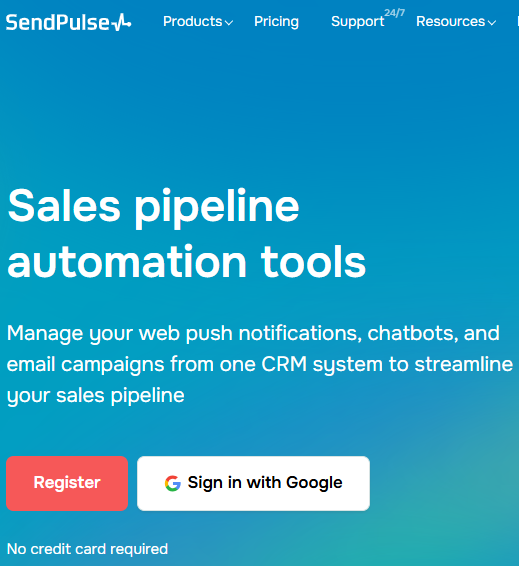
Pricing: Free (500 contacts, 15,000 emails/month); Standard $9.60/month; Pro $11.52/month
Best for: SMBs that want email, SMS, and chatbot automation unified under one CRM without enterprise pricing
SendPulse takes the opposite approach from ActiveCampaign's email-first specialization — instead of going deep on one channel, it unifies email, SMS and chatbots (WhatsApp,Instagram, TikTok) under one Automation 360 workflow builder, with a free CRM tracking every interaction across channels from a single contact record. The AI layer can generate a complete flow from a plain-text prompt rather than just tuning send times or subject lines.
What it does well:
Where it falls short:
SendPulse is the best pick for SMBs whose customers are spread across email, WhatsApp, and SMS and who want that reach without paying for a dedicated CRM platform like ActiveCampaign or HubSpot.
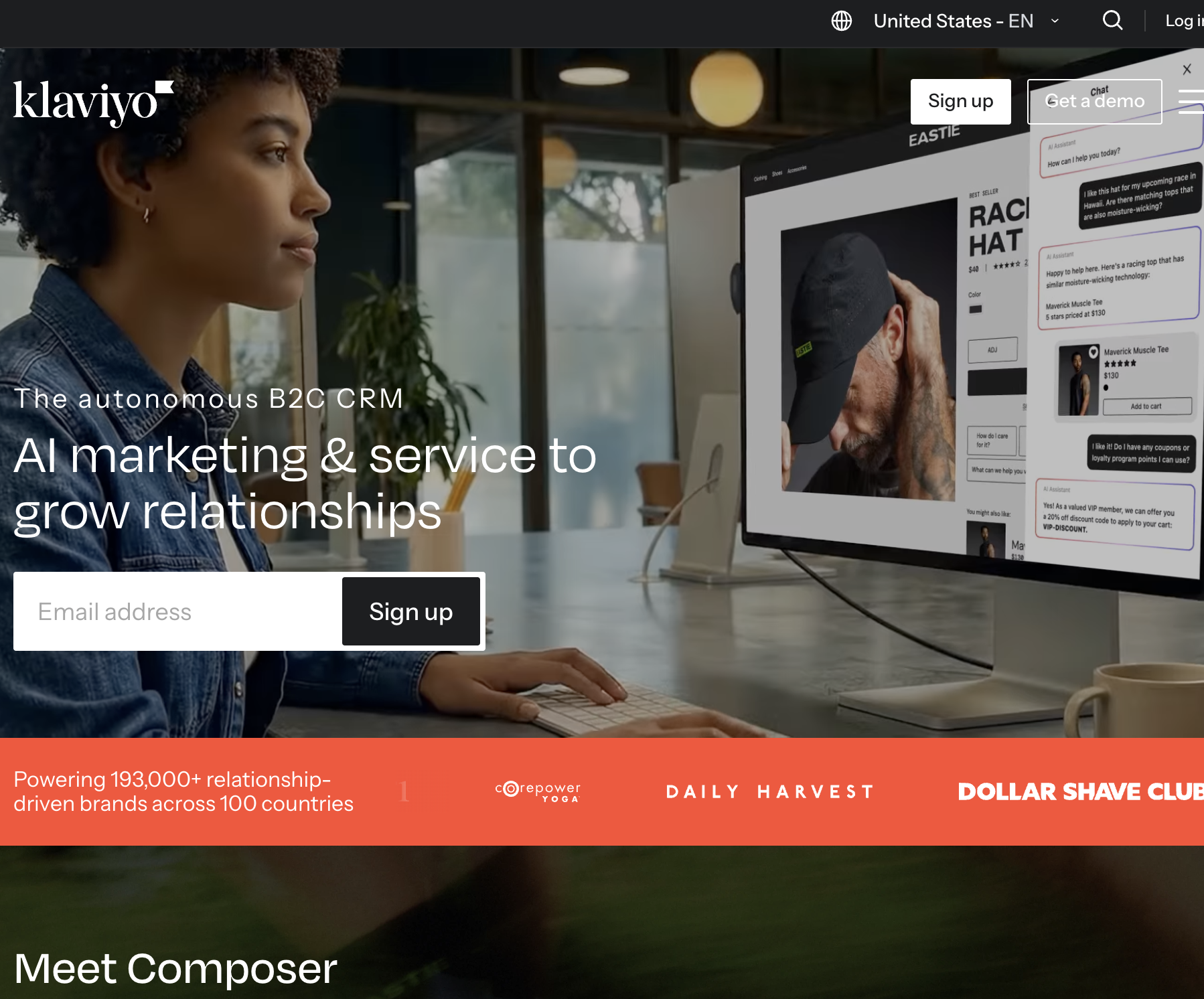
Pricing: Free (250 contacts); Email $20/month; Email + SMS $35/month Best for: Online stores that need revenue-driven email and SMS automation
Klaviyo is built specifically for e-commerce. It integrates deeply with Shopify, WooCommerce, and BigCommerce to trigger automated campaigns based on shopping behavior -- abandoned carts, browse abandonment, post-purchase upsells, win-back sequences, and more.
Where general marketing platforms treat e-commerce as one use case among many, Klaviyo makes it the entire focus. Every feature is designed to connect marketing actions to revenue. The AI features include predictive analytics for customer lifetime value, churn risk scoring, and AI-generated subject lines and email copy.
What it does well:
Where it falls short:
Klaviyo is the best marketing automation tool for online stores. If your revenue comes from e-commerce and you want automation that ties directly to shopping behavior and revenue data, nothing else on this list matches it.
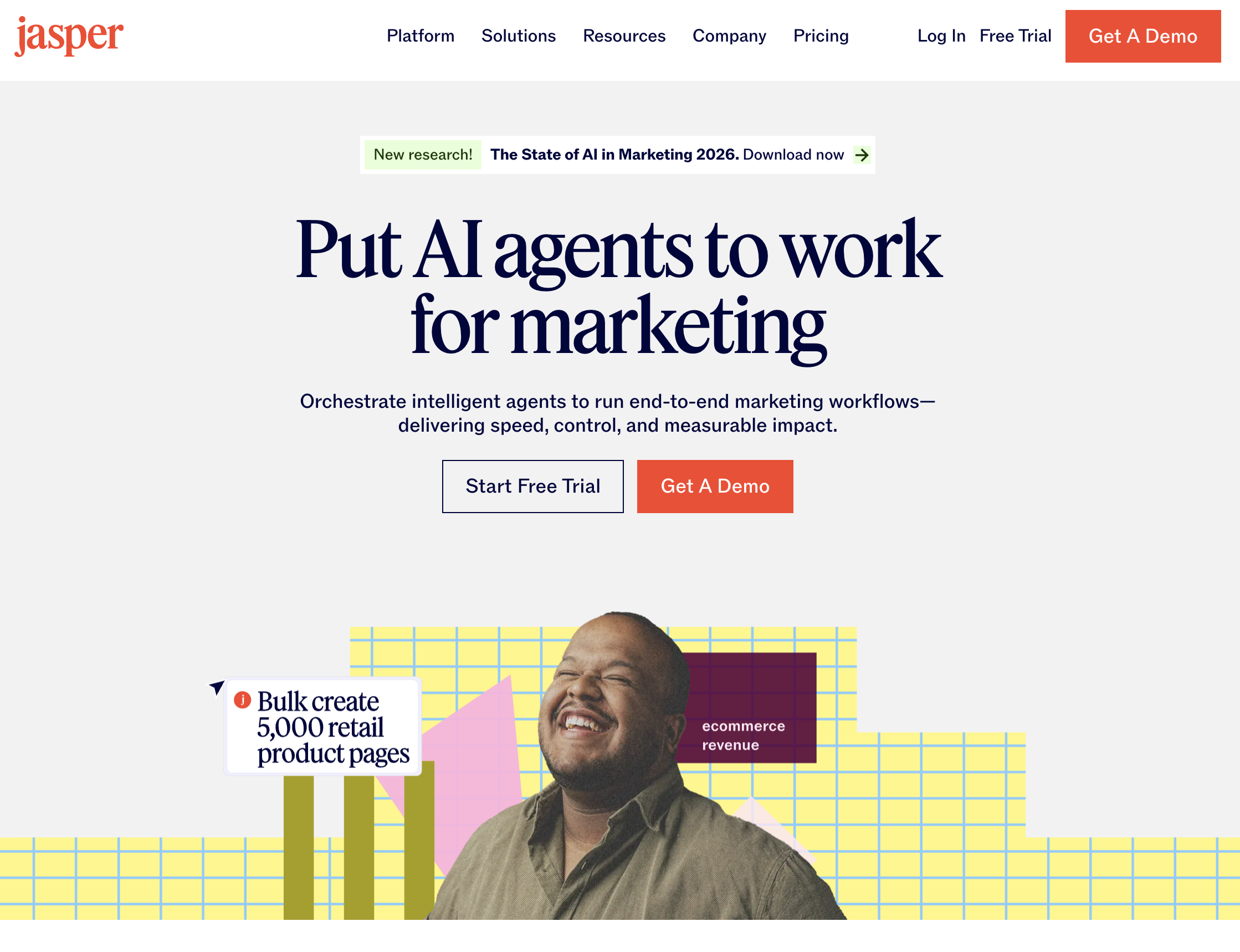
Pricing: Creator $49/month; Pro $69/month; Business custom Best for: Marketing teams that need high-volume content production with brand consistency
Jasper focuses on the content creation side of marketing automation. It generates blog posts, ad copy, social media content, email campaigns, landing page copy, and product descriptions using AI -- all trained on your brand voice, style guide, and knowledge base.
Unlike the AI writing features built into HubSpot or Mailchimp (which generate generic content), Jasper's AI is designed to learn and maintain a consistent brand voice across every piece of content. For SMBs that produce a lot of marketing content, this saves significant editing time.
What it does well:
Where it falls short:
Jasper is the best choice for marketing teams that spend most of their time creating content. It does not replace your email platform or CRM -- it accelerates the content production that feeds into them.