Oops! Something went wrong while submitting the form.
Scores applications against the job description and records each candidate in a Google Sheet with strengths, gaps and stage. For teams hiring occasionally, where an ATS subscription is not yet justified.



The recording is a real session. The sheet on the right is what it produced.
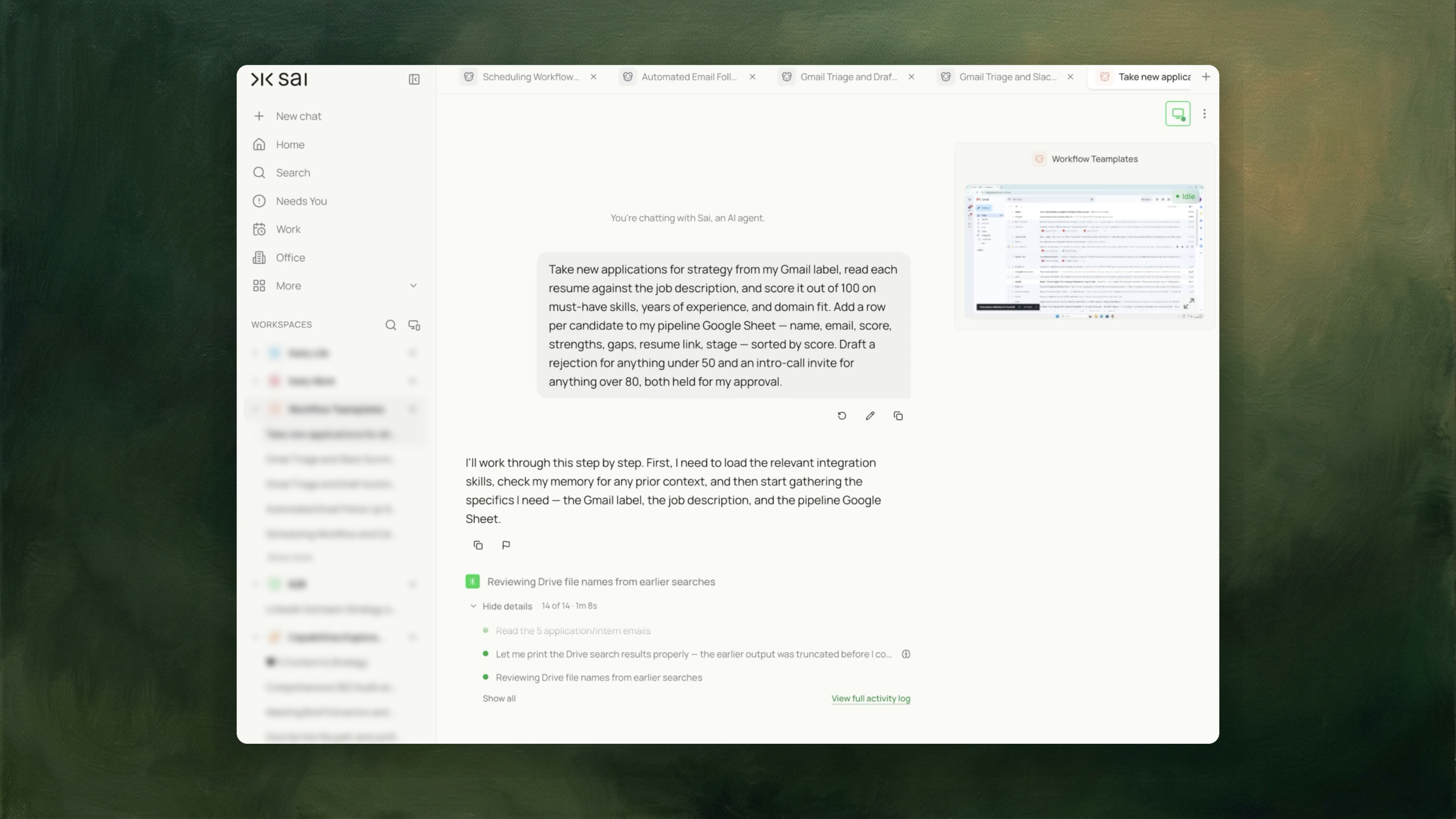
Sai opens each profile, pulls the signal, and writes the row, live, in a real browser.
Eight columns, sorted by score, with a source link behind every claim.
A Gmail label or Drive folder holding the applications The job description for the role A Google Sheet to serve as the pipeline Score thresholds for the two draft types
One row per candidate: name, email, score, strengths, gaps, resume link, stage Rows sorted by score A drafted rejection below the lower threshold A drafted interview invite above the upper threshold Every draft held unsent
Run it each morning while a role is open, then stop when it closes.
An applicant tracking system is software that manages hiring as a repeatable process: it publishes job postings, collects applications into a single database, moves candidates through defined stages, collects structured feedback from multiple interviewers, and reports on the pipeline.
The defining feature is that it is a system of record shared by several people. A hiring manager, a recruiter and three interviewers all work from the same candidate record, and the system enforces that they see the same stages, use the same scorecards, and leave feedback in the same place.
Common systems include Greenhouse, Lever, Ashby, Workable, BambooHR, Recruit CRM, Manatal and Zoho Recruit. They differ in depth, integrations and pricing model, but the core function is the same: coordination across people and roles over time.
That is the problem an ATS solves. Whether a given business has that problem depends on how many people are involved in hiring and how often it happens.
Pricing is the question small businesses ask first and the one product comparisons tend to answer least precisely.
Two published figures give the range. Workable's lowest tier, Standard, is listed at $299 per month, or $3,588 billed annually, for organisations of 1 to 20 employees. Zoho Recruit publishes a Forever Free tier at US$0, alongside paid tiers.
The spread between those two numbers is the decision. An ATS at the upper end costs roughly what a small company might spend on a single recruiter's fee for one placement — spent annually, whether or not any hiring happens that year.
Two structural details matter when comparing plans. Some vendors price by active job slots rather than by user, so cost scales with how many roles are open at once rather than with team size. And free tiers are generally capped, on active jobs, users, or candidate records; a free plan that fits one open role may not fit three.
The threshold is not headcount. It is whether hiring is a coordination problem.
An ATS earns its cost when several of the following are true:
Where most of those hold, a spreadsheet fails in a specific way: it does not enforce anything. Two interviewers record feedback differently, a candidate is contacted twice or not at all, and no one can say what stage anyone is at without asking.
Where few of them hold — one role open, one or two people involved, hiring twice a year — the coordination problem does not exist yet. The problem that does exist is narrower: applications arriving in an inbox, being read unevenly, and leaving no record of what was assessed.
Those are different problems, and the second one does not require a subscription to solve.
Two columns are worth reading together. On posting and multi-interviewer scorecards, every ATS row scores better than the last row, and that gap does not close — those are the functions an ATS exists to provide. On screening and scoring applications, the picture inverts: an ATS collects and organises applications, but reading each one against the job description is generally either a manual step inside it or a paid add-on.
A small business with a coordination problem should buy an ATS. The last row is for the case where the coordination problem has not arrived yet.
Companies of five to twenty people hiring their next one or two roles. Hiring is occasional. Two people are involved. An annual subscription is difficult to justify against two or three hires a year.
Founders running a search personally. There is no recruiter, applications land in a personal inbox, and the pipeline exists in the founder's head.
Businesses evaluating ATS options and unsure of the trigger. The question is whether now is the point, and the answer depends on how hiring is structured rather than on headcount.
Teams already on a free-tier ATS. The system stores candidates and moves them through stages. The reading of each application is still manual.
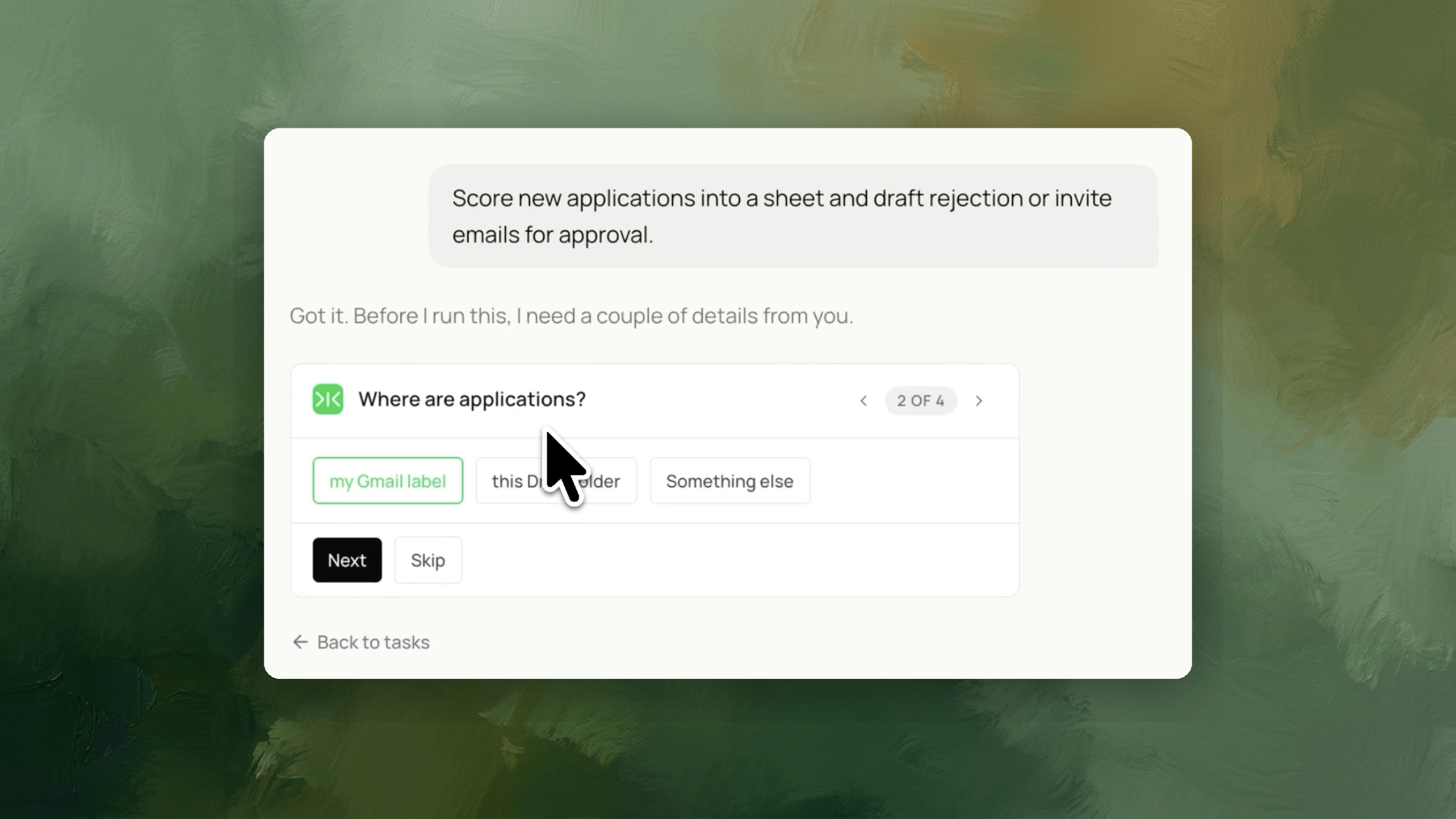
Sai reads the applications in the Gmail label or Drive folder you name, reads each resume against the job description, and scores it on the criteria you specify.
Each candidate becomes a row in your pipeline sheet: name, email, score, strengths, gaps, resume link and stage, sorted by score. The strengths and gaps columns hold the reasoning behind the score.
Below your lower threshold a rejection is drafted; above your upper threshold an interview invitation is drafted. Both are held unsent.
The sheet is the pipeline. It has stages, one row per candidate, and a record of what was assessed — which is the subset of ATS functionality that matters when one person is doing the hiring.