Oops! Something went wrong while submitting the form.
Most newsletter AI writes from what a model already knows, so you get fluent copy with no facts in it. Sai searches current reporting first, then writes sections around what it actually found — each one cited, each one with a plain-English note on why it matters.
The recording is a real session. The sheet on the right is what it produced.
Sai opens each profile, pulls the signal, and writes the row, live, in a real browser.
Eight columns, sorted by score, with a source link behind every claim.
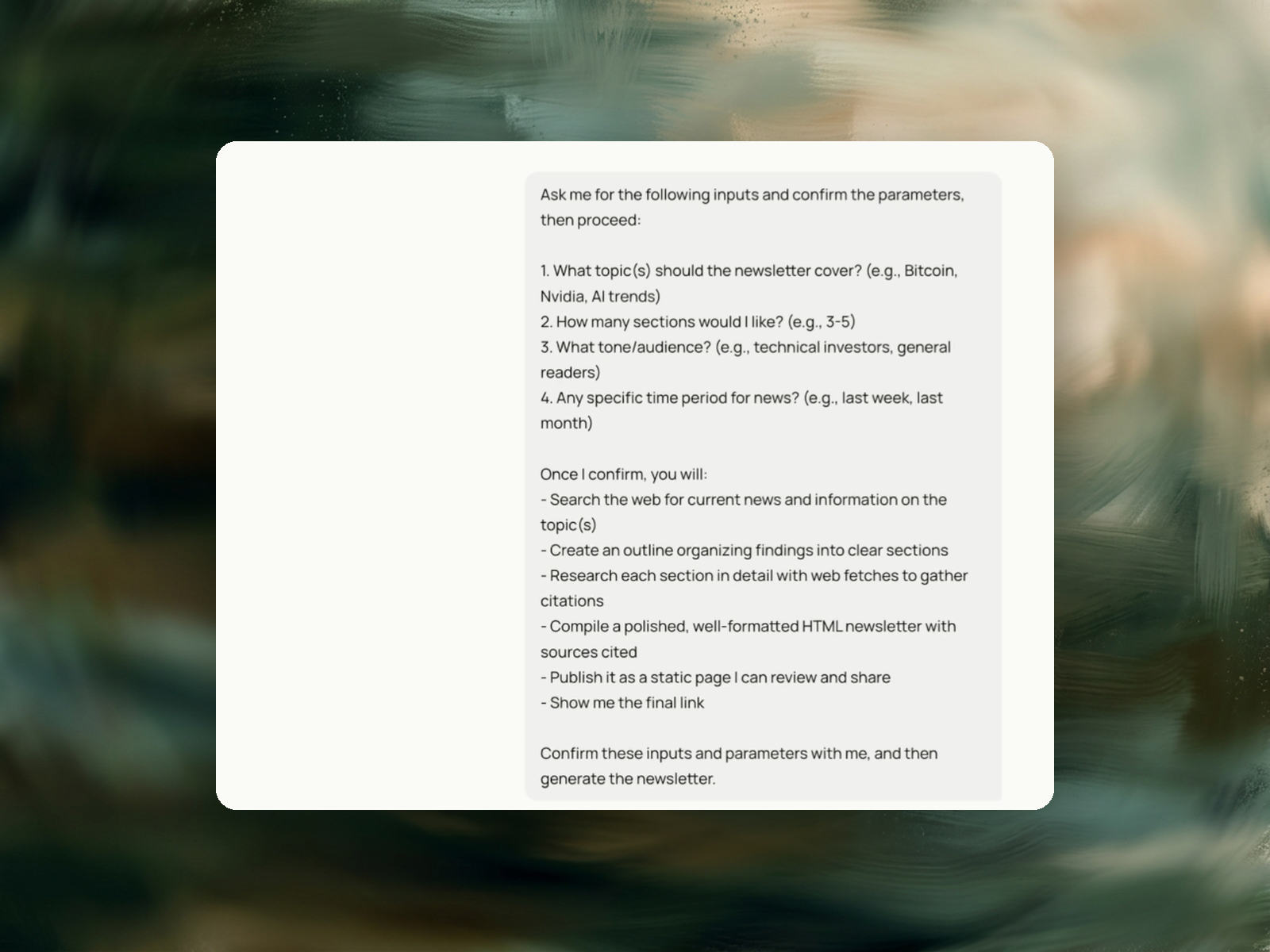
A topic, roughly how many sections you want, who it's for, and what time window the news should cover. Sai confirms all four before it starts.
A finished newsletter published as a shareable page — sections built from dated reporting, sources linked under each one, a "why it matters" note per section, and a one-line summary at the end.
One run covers searching, outlining, fetching each source, and publishing.
Set it to run every Friday on the same topic and you have a standing weekly issue — same structure, that week's news.
Usually text, not news. Most tools in this category work the same way: you type a topic, and a language model writes a few hundred words about it from what it already knows. The output reads well. It's structured, the tone is right, the paragraphs are the right length.
It also contains almost no facts. No dates, no named events, no numbers you could check, no links. Ask one for "this week in AI" and you'll get something that would have been equally true last March — because the model isn't looking at this week. It's writing from memory.
For most content that's a survivable weakness. For a newsletter it isn't, because timeliness and credibility are the entire product. A newsletter that could have been written any week is one nobody needs to open.
Because most of them aren't news tools. They're email tools with a writing assistant attached.
Mailchimp, Brevo, Beehiiv and Substack are subscriber platforms first. Their real product is list management, deliverability, and open rates — the infrastructure of actually sending email to thousands of people, which is genuinely hard and which they're genuinely good at. The AI feature is there to unblock you on the draft.
So the generator is scoped to drafting. It fills the template. It's not connected to a news source, and it doesn't claim to be.
That's a reasonable division of labour, and it leaves a gap: the research is still yours. You open twelve tabs, read the week, decide what matters, and then the AI helps you phrase it. The part that takes two hours is still the part you do.
The order is reversed. Search, then outline, then write.
Sai searches current reporting on your topic before writing anything, builds an outline from what it actually found, then fetches each source in detail to get the specifics right. Sections come out of the news, rather than the news being retrofitted into sections.
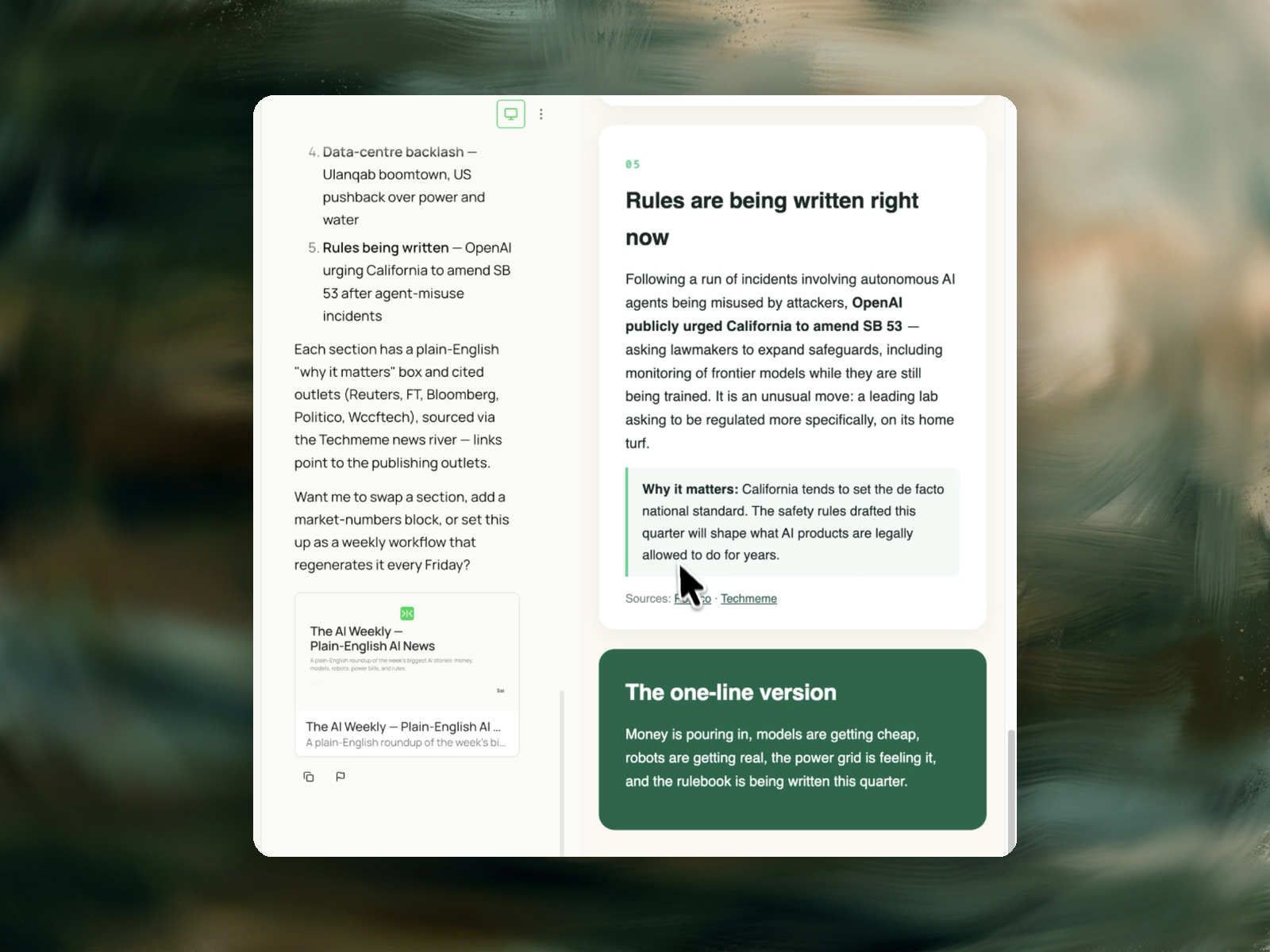
You can see this in the output. A generated section on AI regulation would say something like "regulation remains a key concern for the industry." A researched one says OpenAI publicly urged California to amend SB 53, notes that it's unusual for a leading lab to ask to be regulated more specifically on its home turf, and links to where that was reported.
The second one is checkable. That's the difference that matters — not that it's more detailed, but that a reader can verify it and therefore has a reason to trust the next issue.
Three things, and the second is the one people notice.
Every section covers a specific event with the details intact. Under it sits a short why it matters note in plain English — what the event changes, who it affects, why it's in this issue rather than being one more headline. Then the sources, named and linked to the publishing outlet.
At the end of the issue there's a one-line version: the whole thing compressed into a sentence. The example issue closes with "money is pouring in, models are getting cheap, robots are getting real, the power grid is feeling it, and the rulebook is being written this quarter." Five sections, one line, and a reader who only reads that line still got something.
That layer — a view about what the week added up to — is what separates a newsletter from a feed. Aggregators like Techmeme and Feedly give you an excellent list of links and deliberately no opinion. A generator gives you opinion with no links. The useful thing sits in between.
It gets published as a page with a link you can share.
That's an unusual answer for this category, and it cuts both ways, so here it is plainly.
The upside is that you don't need an audience to get value. There's no list to import, no domain to verify, no sending reputation to warm up. You get a finished issue at a URL, you read it, you send the link to whoever should see it. For an internal weekly digest, a client update, or a first issue you're not sure you'll continue, that's the whole job.
The limit is that Sai does not send email. No subscriber management, no deliverability, no open rates, no unsubscribe handling. If you are running a real subscription newsletter, you need an ESP, and Beehiiv or Substack will serve you better than we will.
The two aren't in conflict. Sai produces the issue; your ESP sends it. Paste the content into your platform of choice and you've kept the research and kept the deliverability.
Depends which half of the job is hurting.
If your problem is sending — growing a list, landing in inboxes, tracking who opened — that's a platform problem and this task doesn't solve it. Go to an ESP.
If your problem is that every issue costs you two hours of reading before you can write a word, that's the part this handles. And if you're writing an internal digest that goes to twenty people in Slack, you may not need an ESP at all.
Yes, and this is where the task changes character.
A one-off newsletter is convenient. A recurring one is a publication. Set it to run every Friday on the same topic and tone, and each week you get a fresh issue built from that week's reporting, in the same structure, ready to review.
The review step stays yours, and should. Sai handles the reading and the first draft; you decide whether the framing is right before anything goes out.
If you're using it for competitor or market coverage, our guide on AI for market research and competitive analysis covers the research side in more depth. And if the newsletter is one part of a broader publishing rhythm, automated content creation covers the rest of it.