Oops! Something went wrong while submitting the form.
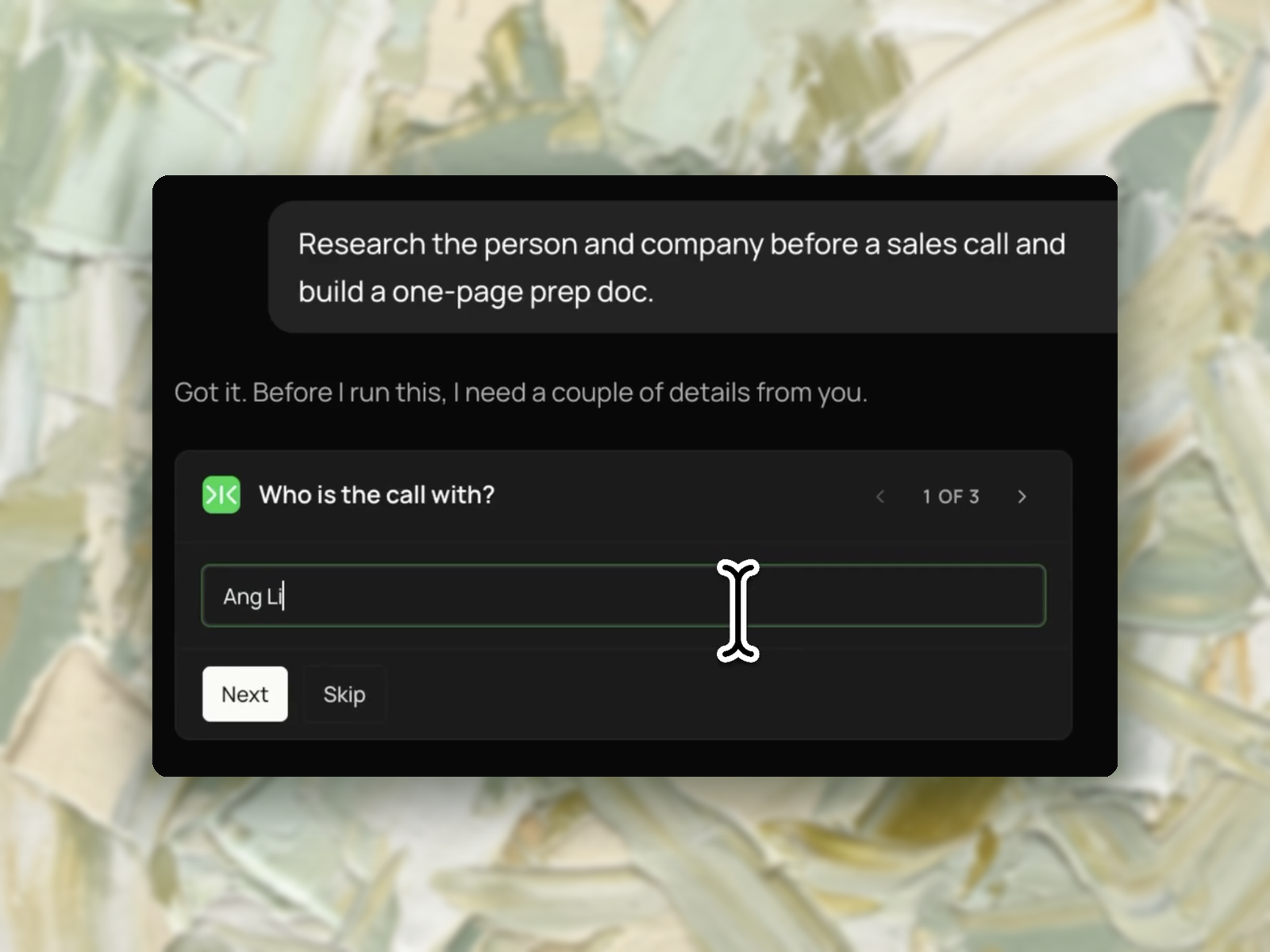
Meeting assistants prepare you from the last meeting's notes. A first call with a new account has none. Sai searches your Gmail and calendar for any prior contact, researches the person's LinkedIn and their company's news, funding and hiring, and returns a one-page prep doc — talking points, discovery questions, and likely objections.
The recording is a real session. The sheet on the right is what it produced.
Sai opens each profile, pulls the signal, and writes the row, live, in a real browser.
Eight columns, sorted by score, with a source link behind every claim.
The name of the person or company and the call topic. Gmail and calendar access; HubSpot if you use it.
A one-page prep doc: who they are, what they likely care about, prior contact from your side with dates and names, three talking points, five discovery questions, and two likely objections with responses. External facts are dated; inferences are marked.
Trigger it the morning of any call with an external company, so the doc is ready before the meeting starts.
Avoma, Fellow, Spinach, Read AI and Sembly attach to the calendar and prepare each meeting from its own record: an agenda, the previous meeting's notes, outstanding action items, and who said they would do what.
For recurring meetings this is the correct design. A weekly sync, a 1:1, a project review — each has a history, and the useful preparation is a summary of where the last one left off. Fellow's shared agendas go further, letting both sides add items before the meeting starts.
These tools also cover the meeting itself and the follow-up, so one product spans the whole cycle.
The preparation depends on the meeting having a record. A first call with a new account does not have one.
The calendar entry is a name, a company and a time. There are no previous notes, no outstanding items, no prior agenda. A tool that prepares you from the meeting history produces very little here, because the useful preparation is not "where we left off" — it is "who is this company".
That is a research question, and it is answered from sources outside the calendar.
Gong, Clari, ZoomInfo and LinkedIn Sales Navigator answer the research question. Gong retrieves what was said on previous recorded calls, including objections and competitor mentions. ZoomInfo supplies technographics and org charts. Sales Navigator uses LinkedIn's own first-party signals.
Each reads its own system. A CRM brief contains what someone entered into the CRM; a Gong brief contains what was recorded.
Contact that happened outside those systems is in neither. A colleague answered a pricing question by email eight months ago. A founder followed up after a conference. Support handled a question from someone at the same company. None of it was logged, and none of it appears in the brief.
The failure shows up on the call: opening as a first contact with someone who remembers a previous conversation. What the prospect concludes is not that the CRM was incomplete.
This task searches Gmail and the calendar before any external research.
From the recorded run:
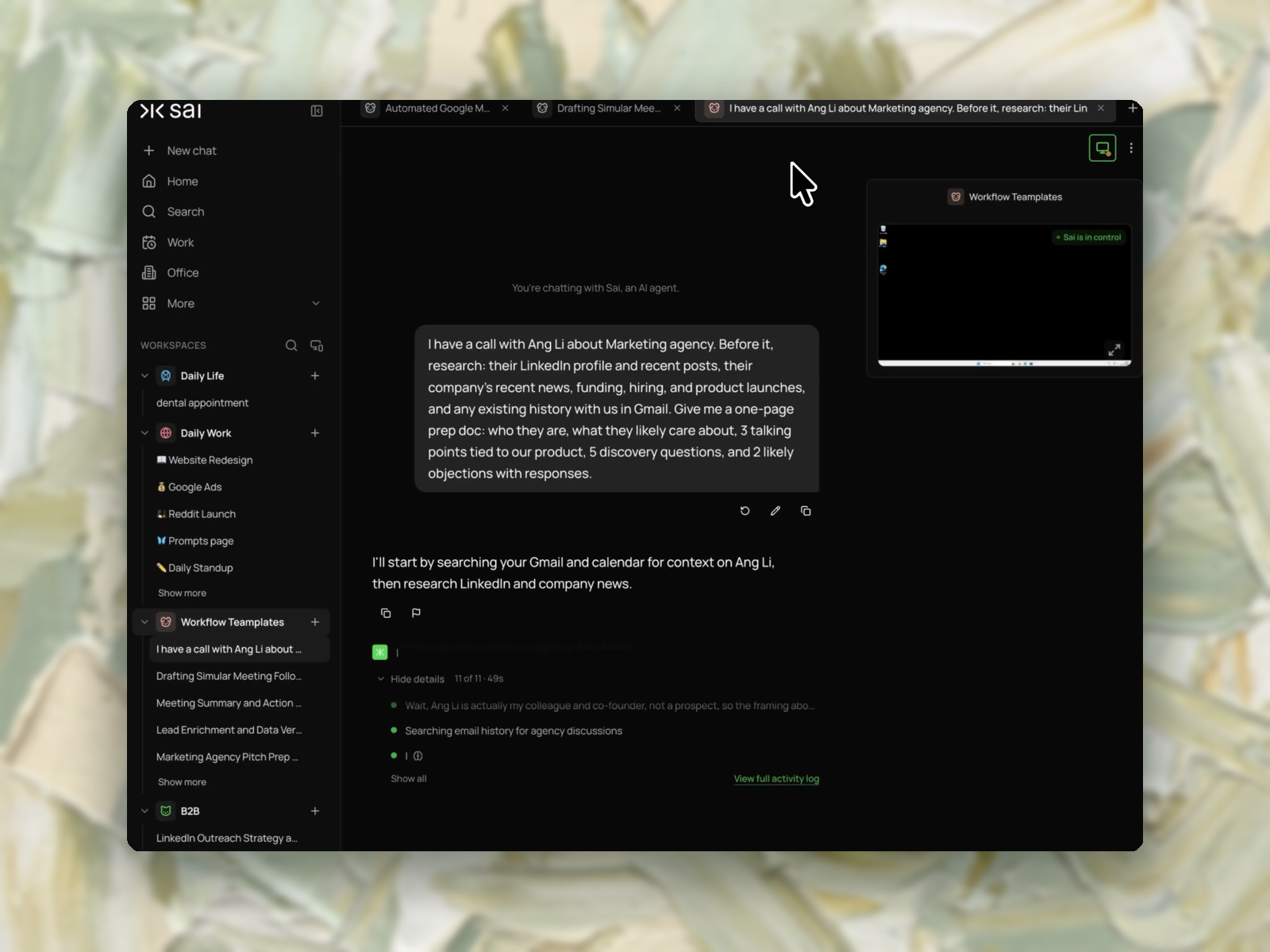
"I'll start by searching your Gmail and calendar for context on Ang Li, then research LinkedIn and company news."
And from the activity log:
"Searching email history for agency discussions"
The order is deliberate. Whether prior contact exists sets the frame for the whole document — a first-touch discovery call and a re-engagement after a stalled thread need different talking points and different questions.
Where nothing is found, the doc states that no prior contact exists. Otherwise "we checked and there is none" and "we did not check" leave the same blank.
Both categories of tool take the calendar entry at face value. Neither asks whether the person on it is a prospect.
The recorded run asked. From the activity log:
"Wait, Ang Li is actually my colleague and co-founder, not a prospect, so the framing abo…"
Partway through, the research identified the named person as a co-founder of the user's own company. The run stopped and said so rather than continuing to produce talking points and objection handling for an internal colleague.
The document that would otherwise have been produced is the harder failure to catch. It would have been complete, well-structured and correctly formatted, and none of those properties indicate that the premise underneath it is wrong.
The same check covers existing customers, former customers, investors and partners — all of whom appear on calendars and none of whom should receive a cold discovery framing.
A prep doc contains two kinds of statement. "They posted about hiring three SDRs last month" has a source. "They likely care about ramp time for new reps" is inferred from it.
Both belong in the document. Presented identically, the second carries into the call with the weight of the first, and a discovery question built on a wrong inference is audible to the person answering it.
Inferences are marked. External facts carry dates, since a funding round from two years ago and one from last month support different openings.
This task covers the hour before a call with no history behind it.
Afterwards, two separate documents come out of the same conversation. The follow-up email from call notes drafts the recap that goes to the attendees, quoting their own phrasing. The meeting follow-up action brief produces the internal version — your action items, decisions, and what you are blocked on.
Further upstream, lead list enrichment covers verifying a whole list before deciding which accounts are worth a call at all.
Trigger it on the morning of any external call so the doc is ready beforehand.
Because prior contact is reported with dates and names, a run against an account someone has already spoken to identifies the colleague to check with first — frequently more useful than anything in the external research.