Oops! Something went wrong while submitting the form.
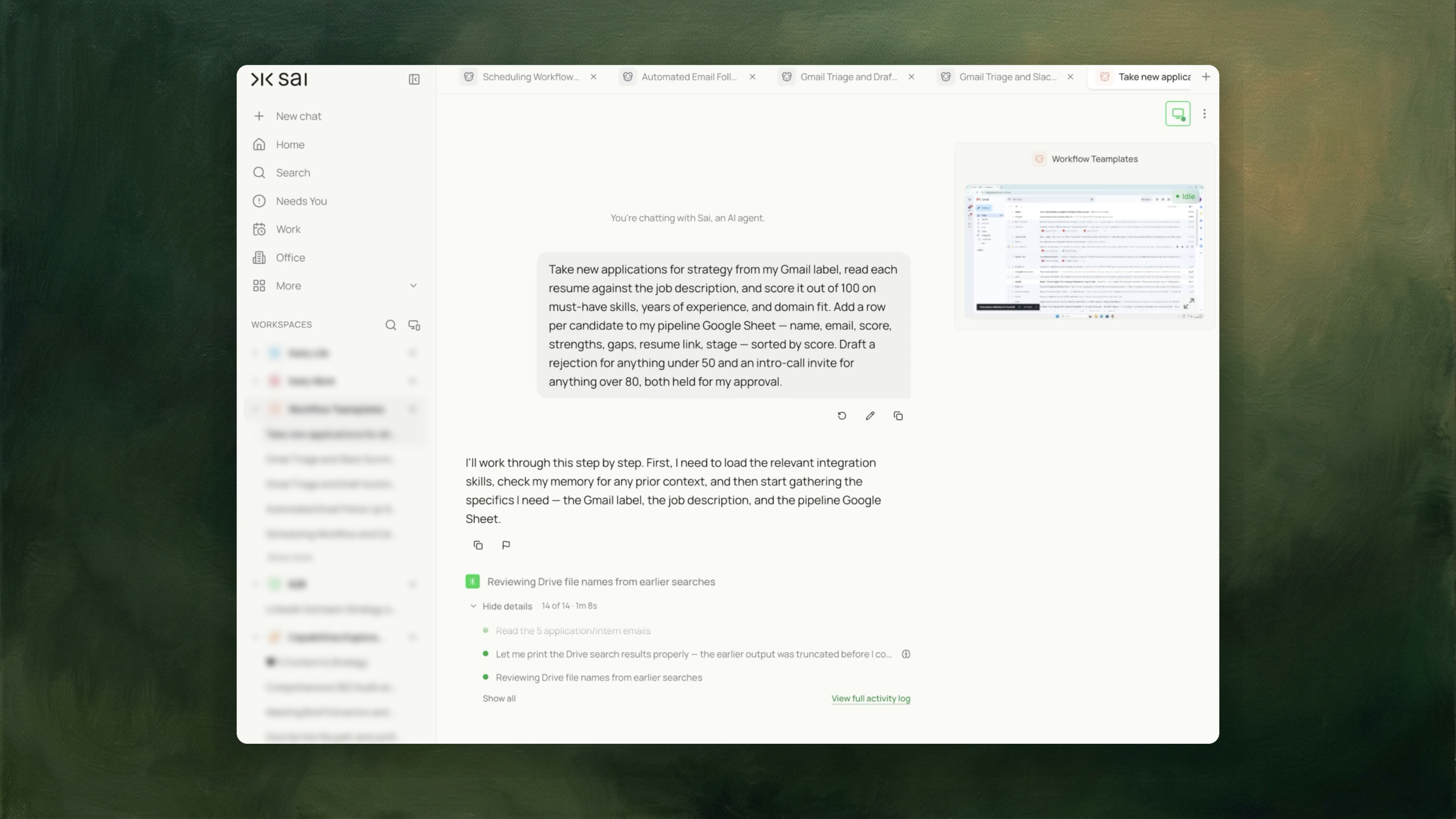
Reads each application against the job description, scores it, and writes a row per candidate with the reasoning behind the number. Candidate emails are drafted and held for approval.



The recording is a real session. The sheet on the right is what it produced.
Sai opens each profile, pulls the signal, and writes the row, live, in a real browser.
Eight columns, sorted by score, with a source link behind every claim.
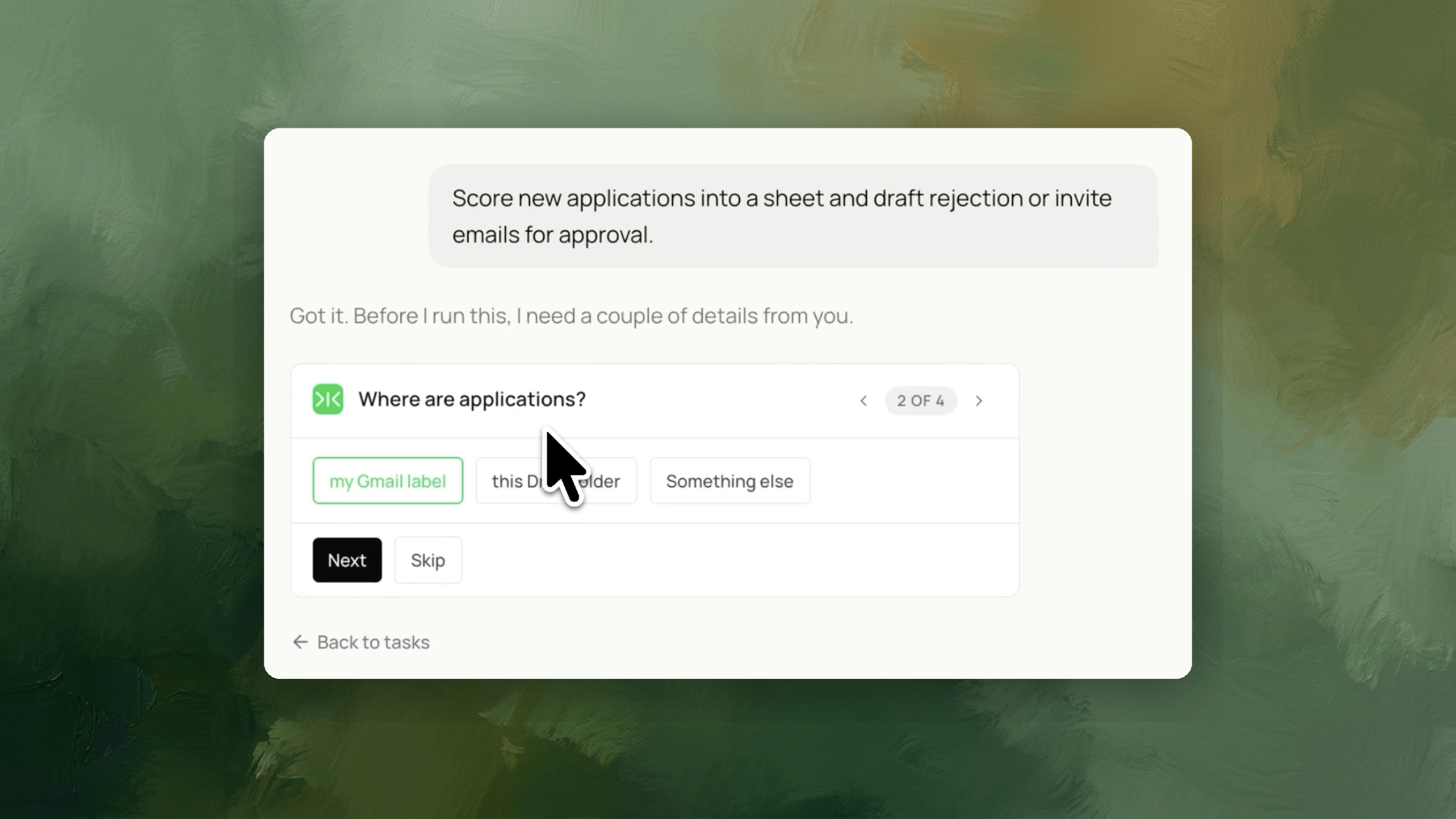
A Gmail label or Drive folder holding the applications The job description for the role A Google Sheet to serve as the pipeline Score thresholds for the two draft types
One row per candidate: name, email, score, strengths, gaps, resume link, stage Rows sorted by score A drafted rejection below the lower threshold A drafted interview invite above the upper threshold Every draft held unsent
Run it each morning so overnight applications are scored and recorded before the day starts.
AI for recruiting is the use of machine learning at specific points in the hiring process: finding candidates who have not applied, reading and parsing resumes, ranking applicants against a role, scheduling interviews, and conducting structured screening conversations.
It is not a single capability. Sourcing tools search for people outside the applicant pool. Parsing tools convert documents into fields. Ranking tools score applicants against a description. Scheduling tools handle the back-and-forth of finding a time. Assessment tools evaluate candidates through exercises. A company using AI in recruiting is usually using several of these, supplied by different vendors, at different stages.
What they share is that each one operates on a stage where the work is repetitive and volume-dependent. None of them operates on the stage where a hiring decision is made, though several produce outputs that strongly influence one.
That distinction — between performing a step and determining an outcome — is where the regulation sits, and where most of the practical questions about AI in recruiting turn out to be.
It replaces a portion of the reading, and the portion is bounded.
Hiring consists of stages with different characteristics. Some are high-volume and repetitive: opening a hundred attachments, extracting the same eight facts from each, checking each against a list of requirements, and writing the same rejection a hundred times with the name changed. These are the stages where consistency degrades with volume — the hundredth resume does not receive the attention the first one did, and that is a property of human attention rather than a failure of diligence.
Other stages are low-volume and judgement-heavy: deciding what the role actually requires as opposed to what the description says, evaluating an unusual career path, assessing whether a candidate will work well with a specific team, negotiating an offer, and deciding to take a chance on someone whose resume does not present well.
Automation applies to the first group. The second group is not bottlenecked by throughput and does not improve by being done faster.
The observable effect of introducing AI into recruiting is therefore a shift in where a recruiter's time goes, rather than a reduction in the need for one. The reading compresses; the deciding does not.
The two columns worth reading together are the third and fourth. Every stage suited to automation is a stage that does not determine an outcome on its own. Every stage that determines an outcome is either unsuited to automation or, in the case of screening and assessment, suited to it only as an input a person reads.
Founders and hiring managers evaluating whether to use AI at all. The question is not which vendor but whether introducing automated scoring into a small hiring process creates more exposure than it removes.
Recruiters at companies without a formal process. Applications arrive in an inbox, the pipeline is a spreadsheet, and nothing enforces that every applicant was assessed on the same criteria.
Hiring teams that already use AI screening and cannot explain its output. The score exists; the reasoning behind it does not, which becomes a problem the first time a hiring manager disagrees or a candidate asks.
Operations and HR staff responsible for records. They are the ones who need the assessment to still be legible six months later.
Sai reads the applications in the Gmail label or Drive folder you name, reads each resume against the job description, and scores it on the criteria you specify.
Each candidate becomes a row in your pipeline sheet: name, email, score, strengths, gaps, resume link and stage, sorted by score. The strengths and gaps columns hold the reasoning that produced the number.
Below your lower threshold a rejection is drafted. Above your upper threshold an intro-call invitation is drafted. Both are held unsent. Candidates between the thresholds get a row and no draft, because that band is where a person reads the resume.
Three things determine whether the output is worth keeping.
The job description does the work. Scores are relative to the description supplied. A description listing eight vague preferences produces scores that cannot be defended or explained. One listing specific requirements produces scores that can.
The criteria should be stated, not implied. Naming must-have skills, years of experience and domain fit in the instruction means each score is attributable to those criteria rather than to an unstated overall impression.
The thresholds should start wide. A narrow band between the rejection and invitation thresholds moves most candidates into automatic drafting, which shifts the arrangement toward automated decisions. A wide band keeps more candidates in the review range. The first run reveals how scores distribute for the role, and the thresholds can be tightened afterwards.
Applications arrive continuously and are usually reviewed in batches, which is why response times vary so widely within a single hiring process.
A morning run scores what arrived overnight and adds the rows before the day begins. Drafts wait for review rather than waiting to be written.
The review remains daily. That is the arrangement, not a limitation of it.
Free your hands from the computer.
Run this Task