
Apresentando SimuLang: Playwright para todo o Desktop
Palo Alto, California • Sep 16, 2026
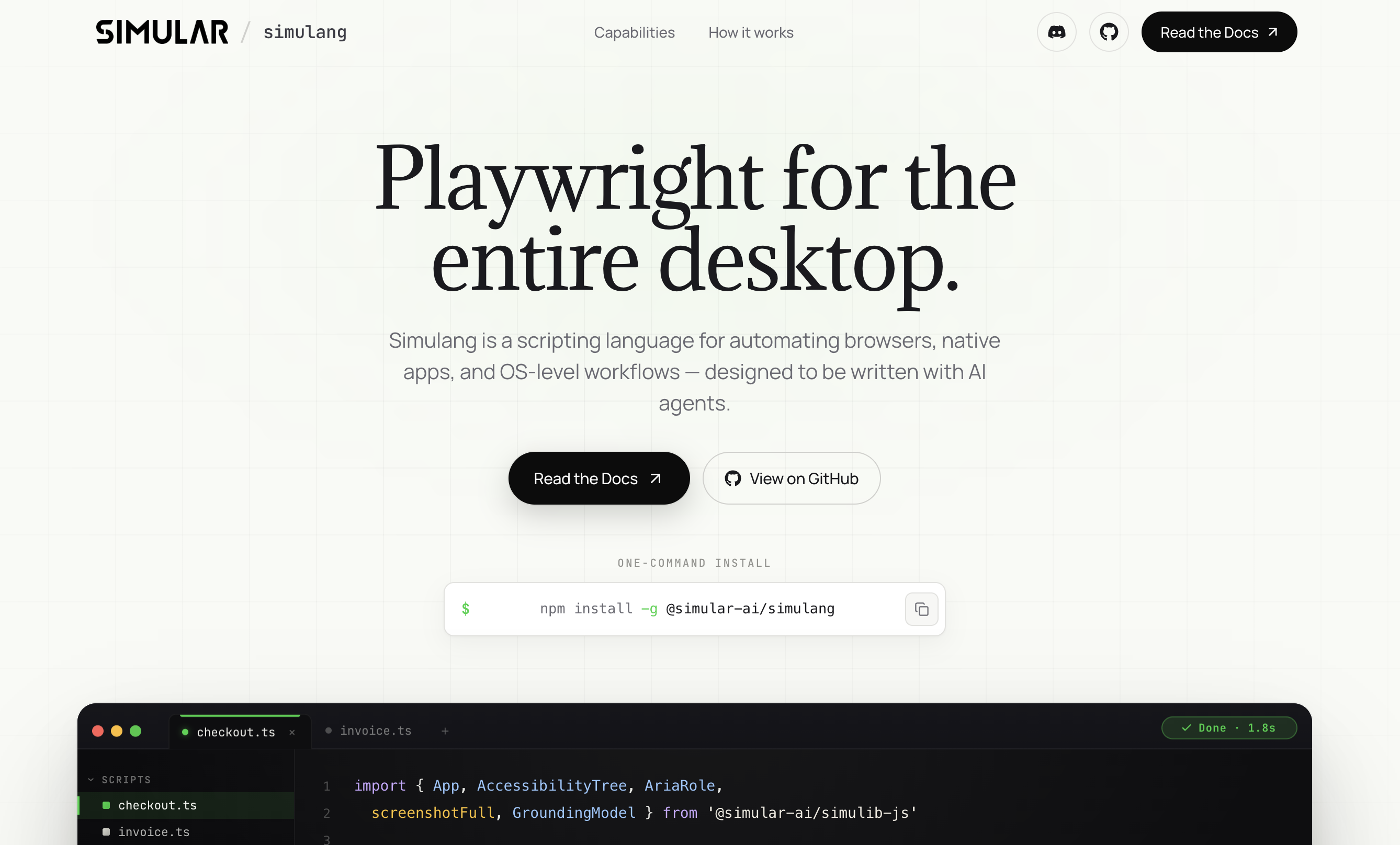
Sai orchestrates a fleet of autonomous computers to work on your repetitive desktop work
We've been on a long mission at Simular: to free people from digital labor by building autonomous computers.
Simular’s computer-use agent, Sai, becomes generally available today. You tell it what desktop work you want done; it wakes a fleet of autonomous computers, does the work, and texts you when it's finished. We call it a “robosecretary”, devoted to you 24/7, backed by OSWorld-topping computer-use technology.
Sai came from a simple observation. The average office worker spends more than five hours a day moving a mouse and tapping a keyboard — clicking through tabs, copying cells, retyping the same text into the same forms. We call this kind of repetitive work “digital labor”, and it’s costing our backs, attention, and capacity to be creative and strategic.
Human-computer interaction is overdue for a change. Hire Sai today to free yourself – and it’s free to start.
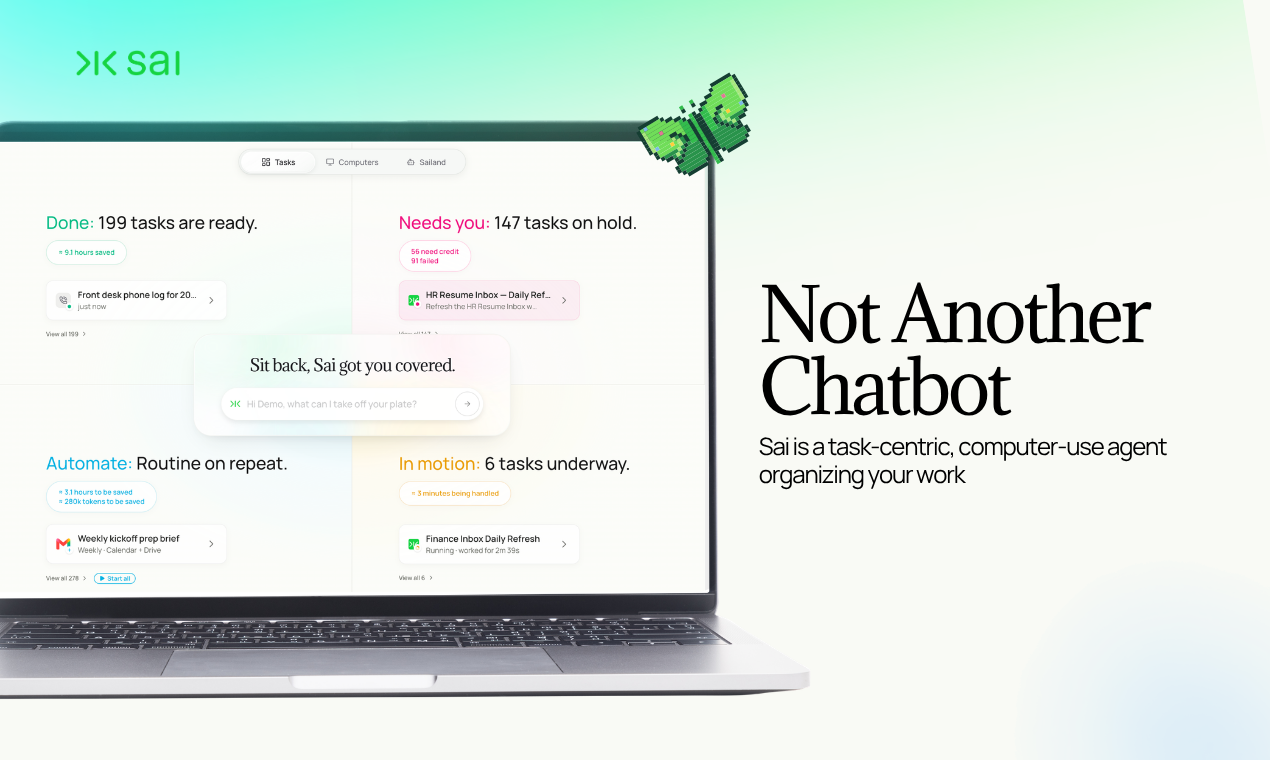
Not another chatbot
Meet your robosecretary (namely ‘Sai-cretary’) — the butterfly at the heart of our brand mark.
We believe an agent for managing work should look nothing like a chatbot, so we redesigned Sai around the four states work actually moves through: ready, needs your attention, in motion, and worth turning into a routine. You hand off a task and see everything at a glance. Sai runs your work on a computer – either a cloud-based virtual machine we provision you or your own device – and surfaces only the part that requires you — approve or reject.
We designed Sai this way so you can close the app and sink into the work that needs you, or close the laptop and step away from your desk entirely.
We also gave Sai users somewhere to go while the agent works: a pixel-art world for their computer fleet. Decorate the space or hatch an avatar, each representing a real autonomous computer out doing your work.
Democratizing: 90% token reduction
In recent months, AI companies have finally come to realize the current design of agents doesn't scale for users. Every time a task is repeated, the agent still pays the full price for reasoning from scratch. At Simular, we’re committed to making intelligence accessible to everyone, which is why we've spent years on the problem of making agents not just capable, but also accessible.
Sai saves at least 90% on tokens when performing long-horizon tasks. The chart shows a high token consumption initially, when Sai calls the LLM for reasoning, but the cost drops precipitously after Sai switches to the code mode, and only periodically rebounds when a changed state requires re-reasoning.
Sai excels in completing long-horizon computer work. For desktop tasks that repeat hundreds of times, for example, "upload my invoices to QuickBooks everyday", Sai saves at least 90% of tokens compared to LLM-driven agent wrappers. The driver behind this cost reduction is the neuro-symbolic approach that’s at the core of Simular’s research: call large language models for discovery and planning, then once the agent has worked out the procedure, compile it into code and replay it deterministically.
When Sai runs a task once, the reasoning cost is the same as other agents. But in rerunning the code, its margin cost is close to 0, whereas other agents incur the same reasoning cost every time. When the environment changes and the recipe breaks, Sai falls back to the model, works it out again, and returns to code for repetition.
Sai gains muscle memory the ways humans learn to ride a bike: learn it once and never again. It doesn’t just save tokens but leads to more reliable outcomes. Sai has the inventiveness of an LLM and the reliability of code — like a good assistant with an instinct for cost efficiency.
Your agent shouldn’t only talk to you
Sai runs 24/7 on autonomous computers in the cloud, for recurring and ad hoc work alike. It’s model-agnostic, and can run on your own device, on any OS.
While you might think you’ve got a fleet of robo-computer staff, and that's enough, your work in real life is mostly likely collaborative, so an agent that only talks to you is of limited use. Down the road, you'll be able to tag colleagues on Sai's deliverables, like tagging someone on an Excel sheet the computer-use agent spun up. More sharing features are on their way.
Agents have largely changed how people in tech work over the past two years, but “everyday users” have largely watched from afar. We believe that driving down token costs while keeping quality deliverables will draw more people towards computer-use agents — fewer tokens also mean less compute, which means a lighter carbon footprint for work that repeats every day.
AI is here to take the dreadful, repetitive parts of your work — not your judgment or creativity. We don’t want a world with less human work, but one where the hours a day you spend on navigating software tabs returns to you.
We're eager to see what digital labor you hand off to your first Sai-cretary.
Construir computadores autônomos não significa substituir humanos. Isso significa cooperação.
Liberte suas mãos do computador. Baixe o Simular hoje gratuitamente.
