
SimuLang을 소개합니다: 데스크톱 전체를 위한 Playwright
Palo Alto, California • Sep , 2026

What is a robosecretary?
Sai from Simular is the world’s first robosecretary. It’s a computer-use agent that operates not just one machine -- but an entire fleet, autonomously. It uses the computer the way a person does -- clicking buttons, filling forms, reading screens, and moving between applications. Sai takes an instruction, works inside the software you already use, and hands back the finished task instead of instructions for doing it.
Two distinct capabilities define the category. Unlike most AI agents, a robosecretary interacts with the software you already use, rather than producing text instructions for a person to execute. And unlike robotic process automation (RPA), it needs no pre-recorded script or human maintenance: it perceives the screen, decides the next action, and recovers when the interface changes.
The Evolution of "Secretary"
- 1300s–1400s (The Secret-Keeper): A loyal confidant entrusted with the private secrets of kings, popes, and nobles.
- 1500s–1600s (The Royal Advisor): Personal secret-keepers gained political power, becoming top government ministers in Great Britain.
- 1789 (The Government Title): The U.S. adopted "Secretary" for cabinet heads (like Secretary of State) to avoid royal-sounding titles.
- Late 1800s (The Office Assistant): The typewriter and corporate boom turned the job into a female-dominated role focused on typing and filing.
- 1970s (The Administrative Professional): The title faded in favor of "Administrative Assistant" to better reflect professional workplace skills.
- 2020s+ (The Robosecretary): AI agents take over routine digital tasks, shifting humans back into high-level strategic partnerships.
Robosecretary vs. general AI agents vs. RPA
The tech industry has long tried to tackle desktop software automation. RPA (UiPath, Automation Anywhere) is precise and cheap to run once built, and breaks when an interface moves. General AI agents reason well and operate a screen, but pay a model call for every click and are bounded by whichever environments their vendor ships. A robosecretary is built to hold both properties at once: GUI-native reach with deterministic, repeatable execution.
The practical distinction is coverage. An API-based workflow tool cannot touch software that has no API, and RPA cannot touch software that changes. A robosecretary works against the same interface a human uses, which is the one interface every application is guaranteed to have. That argument is developed further in the case for GUI agents.
How good are computer-use agent Sai in 2026? The OSWorld benchmar
OSWorld is the standard open benchmark for computer use agents: real applications in a real operating system, scored on whether the task was actually completed.
On OSWorld 2.0 -- a 108-task benchmark released in June 2026 by the XLANG Lab at the University of Hong Kong, built from tasks that take skilled humans more than an hour -- Sai scored a 73.0% partial score at $15.70 per task, ahead of Claude Opus 5 Max Thinking (70.6% at $23.70/task) and GPT-5.6 Sol Max (62.6% at $26.62/task).
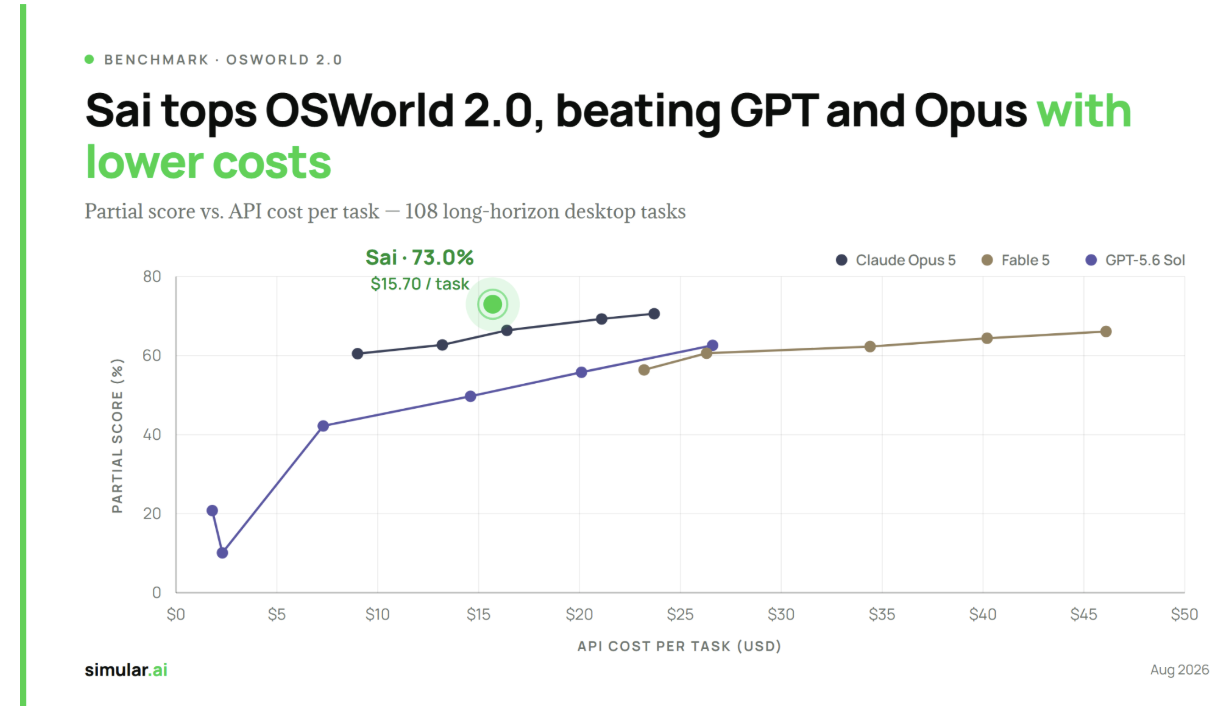
One thing about benchmark reading is worth stating plainly: OSWorld 1.0 and OSWorld 2.0 measure different things, and their numbers are not comparable. OSWorld 1.0 is a set of one-off, self-contained tasks — change a setting, edit a file, run a query — that a capable agent finishes in a handful of steps. OSWorld 2.0 is long-horizon work: tasks that run past 100 steps, span several applications, and mirror the shape of an actual workflow rather than a single request. An agent can be excellent at the first and fail the second, because holding state across a hundred steps is a different problem from executing one correctly. A score means little without the benchmark version attached to it.
Sai excels in completing long-horizon computer work. For desktop tasks that repeat hundreds of times, for example, "upload my invoices to QuickBooks everyday", Sai saves at least 90% of tokens compared to LLM-driven agent wrappers. The driver behind this cost reduction is the neuro-symbolic approach that’s at the core of Simular’s research: call large language models for discovery and planning, then once the agent has worked out the procedure, compile it into code and replay it deterministically.
When Sai runs a task once, the reasoning cost is the same as other agents. But in rerunning the code, its margin cost is close to 0, whereas other agents incur the same reasoning cost every time. When the environment changes and the recipe breaks, Sai falls back to the model, works it out again, and returns to code for repetition.
What makes a robosecretary usable day to day
Benchmark scores decide whether the category works. Four product properties decide whether a person keeps using one.
Live visibility: you always see what it is doing
Sai runs a persistent VM View — a window showing the virtual machine the agent is working in, in real time, while it works. When a step does not involve computer use (an API call, a code execution, a file transform), the same window shows the current workflow and where the run has got to.
The reason this matters is supervision cost. A computer use agent that reports only at the end forces a full audit of its output; one you can glance at is one you can interrupt at the step that went wrong. Visibility is what makes an autonomous run reviewable rather than a leap of faith.
Model agnostic: any model, even open ones
A robosecretary should not be a wrapper on one vendor’s model. Sai orchestrates a mixture of frontier and specialist models and can be pointed at different ones — your own key, an open-weight model, or a model running on-premises — rather than binding the workflow to a single provider’s pricing and availability.
Cost efficiency comes from neuro-symbolic planning, not from a cheaper model
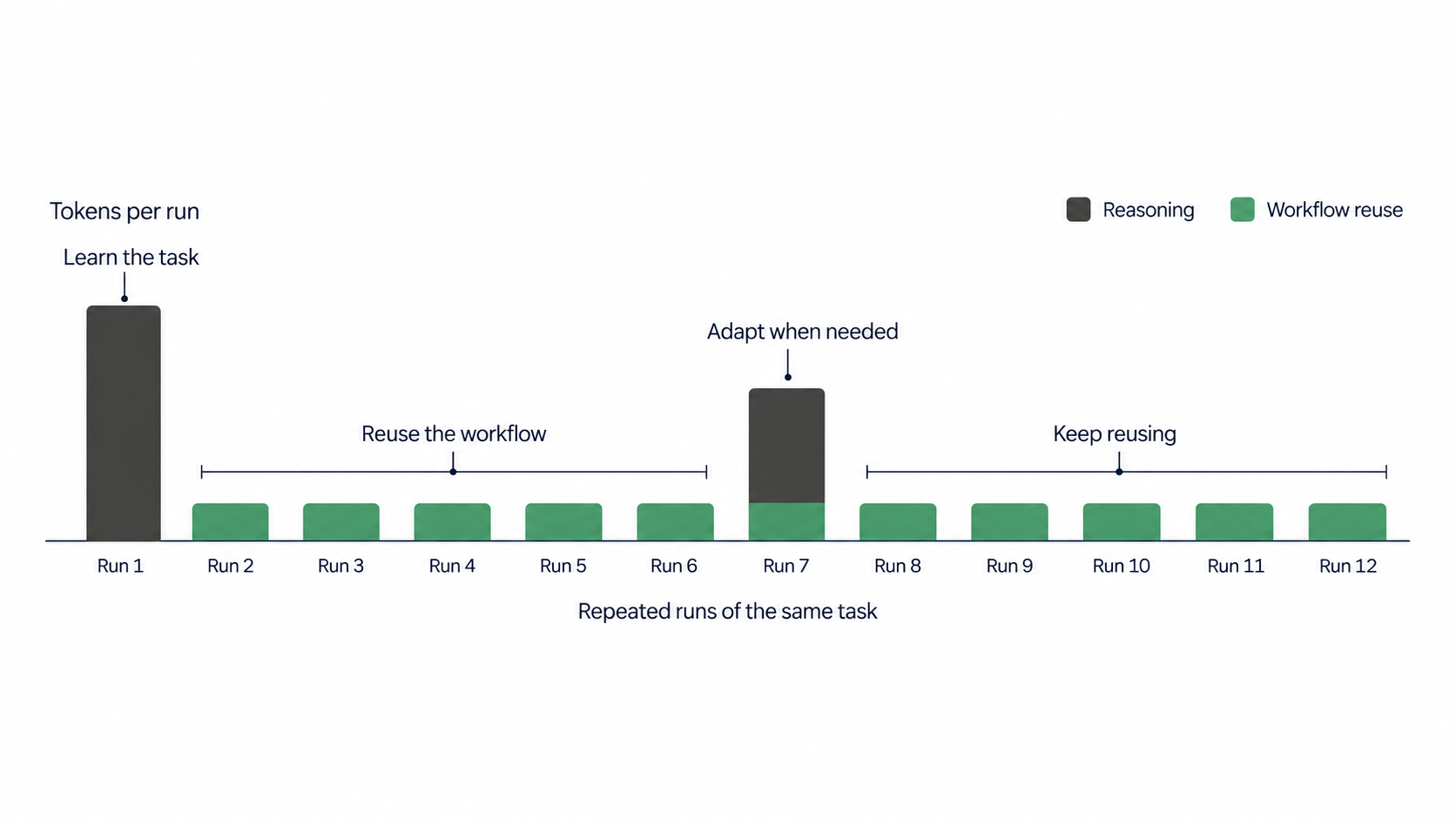
The cost gap on OSWorld 2.0 is not the result of swapping in a discount model. It comes from planning in code. The computer use agent Sai writes and runs code for longer subtasks instead of paying for a model call per click. Simular reports Sai uses roughly 1.5× fewer model calls than pure models by taking more actions per turn, and at least 90% fewer tokens on long-horizon tasks, with adaptive summarization and a constant prompt prefix keeping input size bounded.The underlying observation is that the power law of practice is absent from agents. A human doing the same task for the hundredth time is faster than on the first; a purely model-driven agent pays the same reasoning cost every time. Symbolic plans give an agent that missing curve: once a task is solved, the working recipe is code, and repetition costs almost nothing. When the environment changes and the recipe breaks, the agent falls back to the model, works it out again, and returns to code.
Windows and BYOD: the agent works beside you, not instead of you
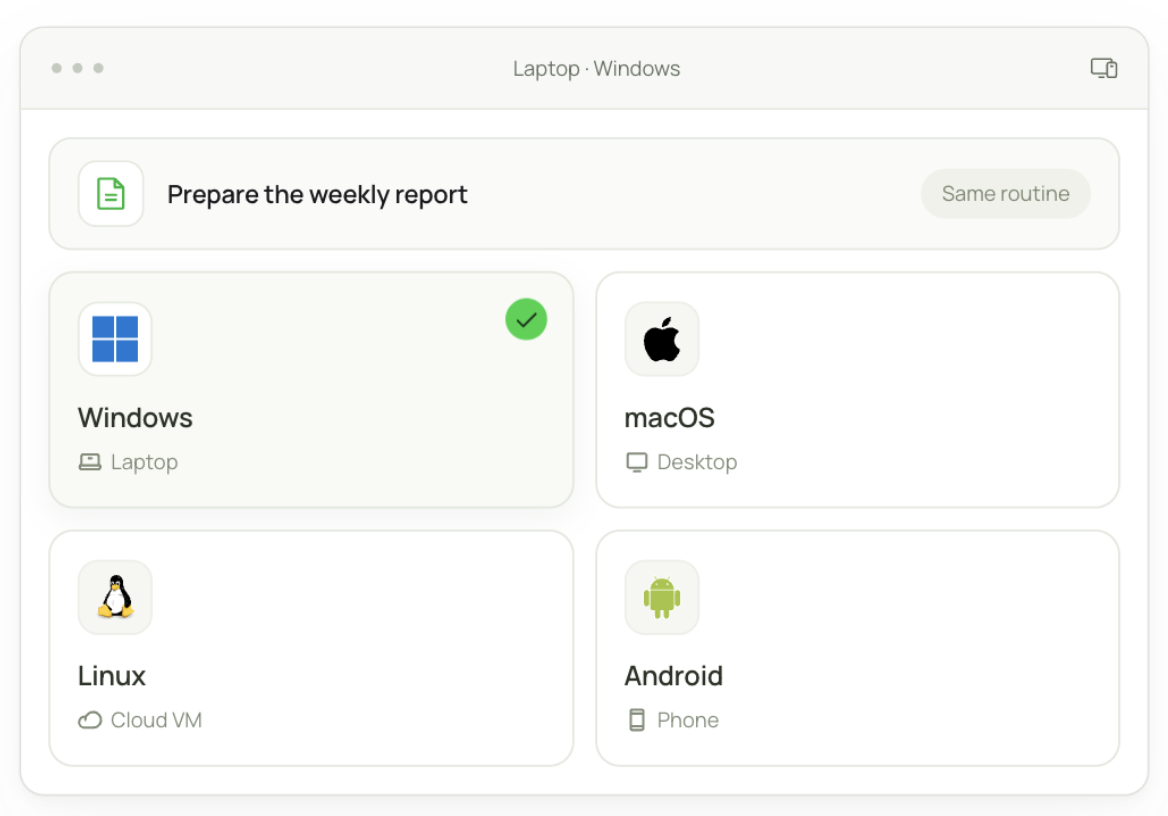
Sai runs on Windows on your own machine, not only in a remote VM. The constraint that makes desktop agents unpleasant is exclusivity — an agent driving your mouse means you stop working. Sai’s Picture-in-Picture mode puts the session in a small always-on-top window, so it can work through a desktop application while you stay in the foreground writing the document. Bring-your-own-device operation also keeps data on the machine that already holds it, which is the deciding factor where files cannot leave the endpoint.
Multi-VM: what if we gave you 100 of them?
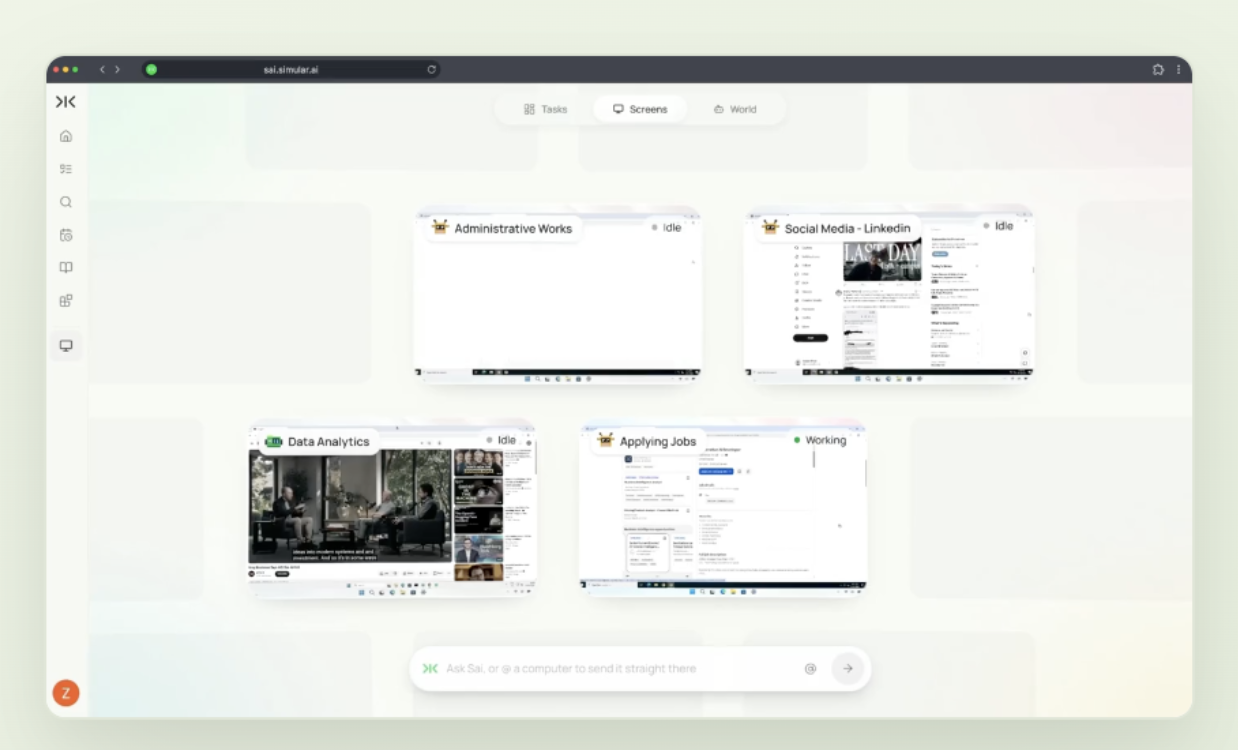
A single cloud computer is a tool you open. A fleet is something you wake up. Sai can run many virtual machines in parallel on the same class of task — the same form filled across fifty portals, the same report pulled from twenty dashboards — so throughput scales with machines rather than with the length of one queue. The unit of work stops being “a task” and becomes “a batch”, and the bottleneck moves from execution speed to how clearly the work is specified.
Parallel computer use also holds up in adversarial, real-time conditions: Simular’s work on extending computer use to real-time gameplay tests the same perception-action loop against environments that do not wait for the agent to think.
Who should be looking at a robosecretary
The common pattern across the roles below is software with no API, a task repeated with small variations, and a person currently doing it by hand.
- Office and knowledge workers spend the day moving information between applications that were never designed to talk to each other — a figure from an email into a spreadsheet, a spreadsheet into a slide, a slide into a shared drive. A computer use agent covers the gaps between the tools rather than replacing any one of them.
- Sales and business development teams run the same sequence against every account: enrich the record, check the last touchpoint, draft the follow-up, log the activity in the CRM. The sequence is stable; only the account changes, which is the shape multi-VM parallel execution is built for.
- Entrepreneurs and solo operators have no one to delegate to. A robosecretary is the first hire that costs less than a contractor and works on the tools already installed — invoicing, supplier portals, filings, inbox triage.
- Marketing and advertising teams pull performance data out of platforms that each have their own export ritual, then reconcile it into one report on a weekly cadence. The work is a scheduled batch, not a creative decision.
- E-commerce operators manage listings, prices and stock across marketplaces and seller consoles — Amazon Seller Central, Shopify, regional marketplaces — most of which expose only partial APIs and all of which change their interface without notice.
- Finance and accounting teams process invoices, reimbursements, bank reconciliations and month-end reports through ERP screens where every field has to be typed. This is the highest-volume, lowest-variance desk work in most companies.
- HR and recruiting teams screen résumés, post the same job to several boards, generate offer letters, and complete onboarding checklists across an ATS, a payroll system and an identity provider.
- Investment analysts and researchers collect the same fields from many filings, dashboards or databases, then reconcile them. Gathering is the cost; analysis is the part that cannot be delegated.
- IT management teams handle account provisioning, license audits, device checks and ticket triage across admin consoles — high-frequency, well-specified, and rarely worth building an integration for.
- Developers and QA use computer use agents for UI regression, form validation and cross-browser checks without maintaining test scripts against selectors that move.
- Customer support teams answer from a knowledge base, update the ticket, and touch two or three internal systems per case. The reply is the visible part; the system updates are the work.
