
SimuLang을 소개합니다: 데스크톱 전체를 위한 Playwright
캘리포니아주 팔로알토 • 2026년 8월 28일 • 작성: Simular 팀

Computer-use agents are limited by the interfaces humans give them. An agent may type a spreadsheet cell by cell when a single line of code would do, or overwrite a file with a script while the application still holds unsaved edits.
Both the interfaces and the knowledge of when to use each are built by hand, which cannot keep pace with new applications, workflows and models.
결과
순수 모델의 경우 성공률이 높을수록 비용도 증가합니다. Sai는 이러한 곡선을 깨뜨렸습니다. 차트에서 가장 높은 점수를 기록하면서도 경쟁 모델 대비 3분의 2 미만의 비용으로 운영됩니다.
How it works
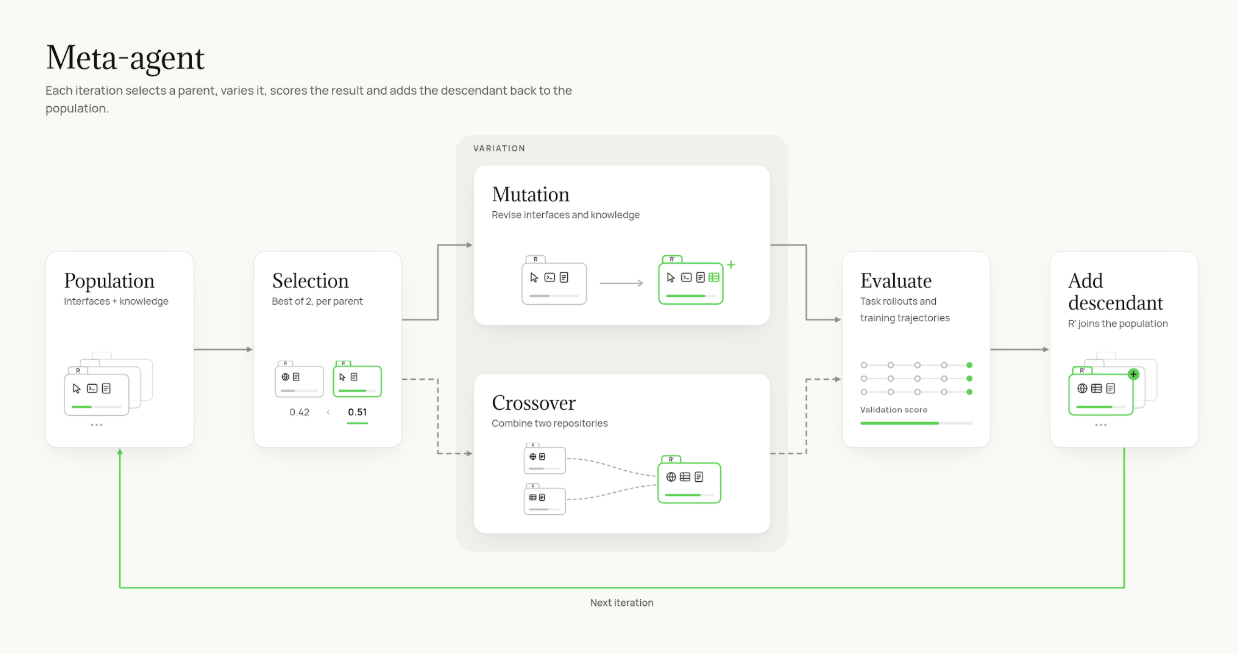
- Examine. A meta-agent examines task agents' trajectories on synthetic training tasks, without success labels.
- Write. It writes new interfaces and usage knowledge into a repository.
- Select. Population-based evolution selects which repositories to develop further by their performance on held-out tasks the meta-agent never sees. This favors changes that generalize beyond the seen tasks.
Interfaces no one specified
The evolved repositories contain interfaces no one specified, such as:
- a single request that batches dozens of GUI actions.
- observations that condense PDFs and archives into compact text.
Results on OSWorld V2
Agent S4 with Qwen3.8-27B performs on par with Claude Opus 4.8 with batched actions, at approximately 1.5% of the cost.
"We created a computer-use scientist: it runs experiments to discover new software for any other computer agent to complete tasks more efficiently," said Ang Li, CEO and co-founder of Simular.
감사의 글
These results suggest that interfaces are an axis of improvement complementary to the model, one that can keep evolving as models and harnesses change.
Read the paper: http://arxiv.org/abs/2610.28601
