
SimuLangのご紹介:デスクトップ全体のためのPlaywright
Palo Alto, California • Aug 28, 2026• by Simular Team

Simulangは、ブラウザ、ネイティブアプリ、OSレベルのワークフローを自動化するためのスクリプト言語で、AIエージェントによって記述されるように設計されています。Simulangをオープンソース化しました。今すぐ単一のコマンドでインストールできます。
Sai, a computer agent built by Simular, has achieved a 73% success rate on OSWorld 2.0, a 108-task benchmark measuring long professional and everyday tasks that take skilled humans more than 1 hour to complete.
The state-of-the-art performance places Sai ahead of GPT-5.6 Sol at 62.57%, as reported by OpenAI, and Opus 5 at 70.57%, as reported by Anthropic – and Sai reaches the highest score at about two-thirds the cost of either.
Sai is a computer agent that operates desktop applications and webpages, calls APIs, and writes code - just like a human. It orchestrates a mixture of frontier and specialist models, perceives and acts on the computer with dedicated interfaces, and runs on both Simular's fleet of remote machines and personal computers. The OSWorld 2.0 milestone reflects Sai's ability to execute complex, real-world tasks at an accessible cost for individuals with routine tasks and for businesses with scalable deployment needs.
The OSWorld 2.0 benchmark, released in June by the XLANG Lab at the University of Hong Kong, represents long-horizon real-world tasks in a controlled Linux environment. Unlike the OSWorld 1.0 benchmark, OSWorld 2.0 tasks are measured in hours instead of minutes. They pose real-life challenges such as finding and reasoning across multiple data sources (e.g. receipts scattered across email and expense reports), responding to dynamic environment changes (e.g. a message arriving midway through the task), precisely following tutorials (e.g. reimbursement guidelines), and troubleshooting information discrepancies (e.g. contradictory data). As such, the Simular team believes it is the most robust open benchmark in the industry currently that best reflects real-world tasks.
Results
For pure models, higher success rate comes at a higher cost. Sai breaks that curve: the highest score on the chart, at less than two-thirds the cost of the models it beats.
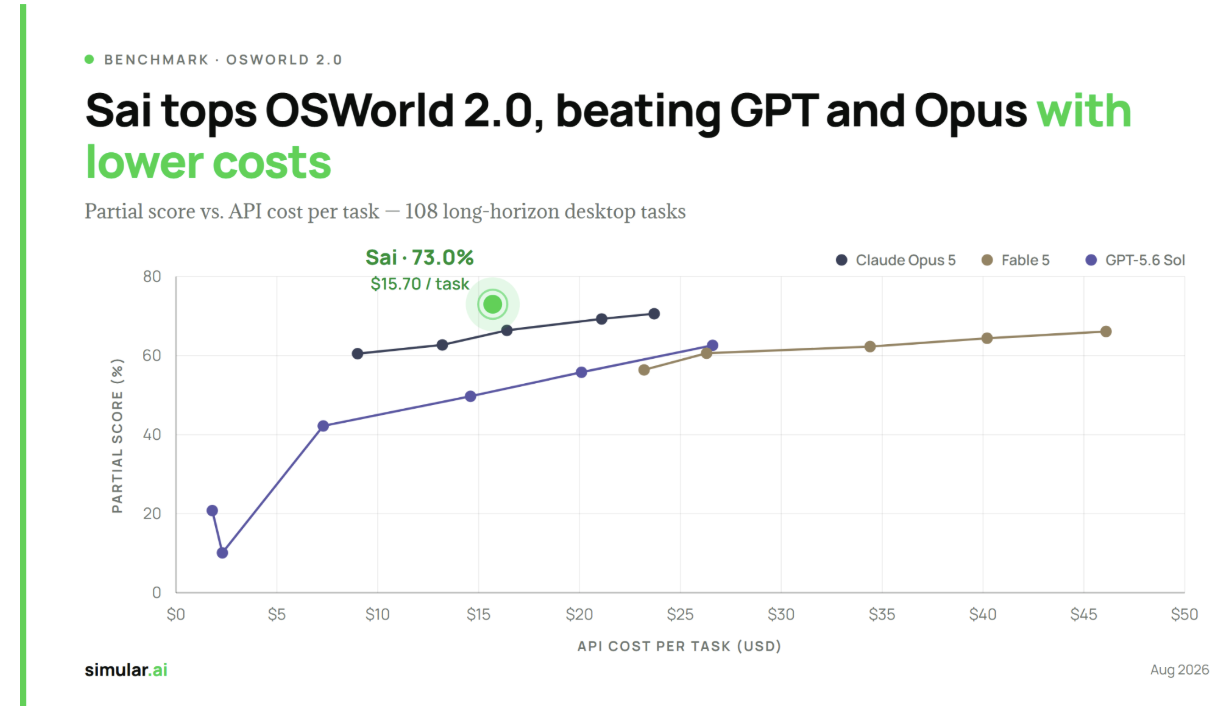
Partial score and API cost per task on OSWorld 2.0. Sai achieves a 73.0% partial score at $15.70/task, outperforming Claude Opus 5 Max Thinking (70.6% at $23.70/task) and GPT-5.6 Sol Max (62.6% at $26.62/task) while costing substantially less.
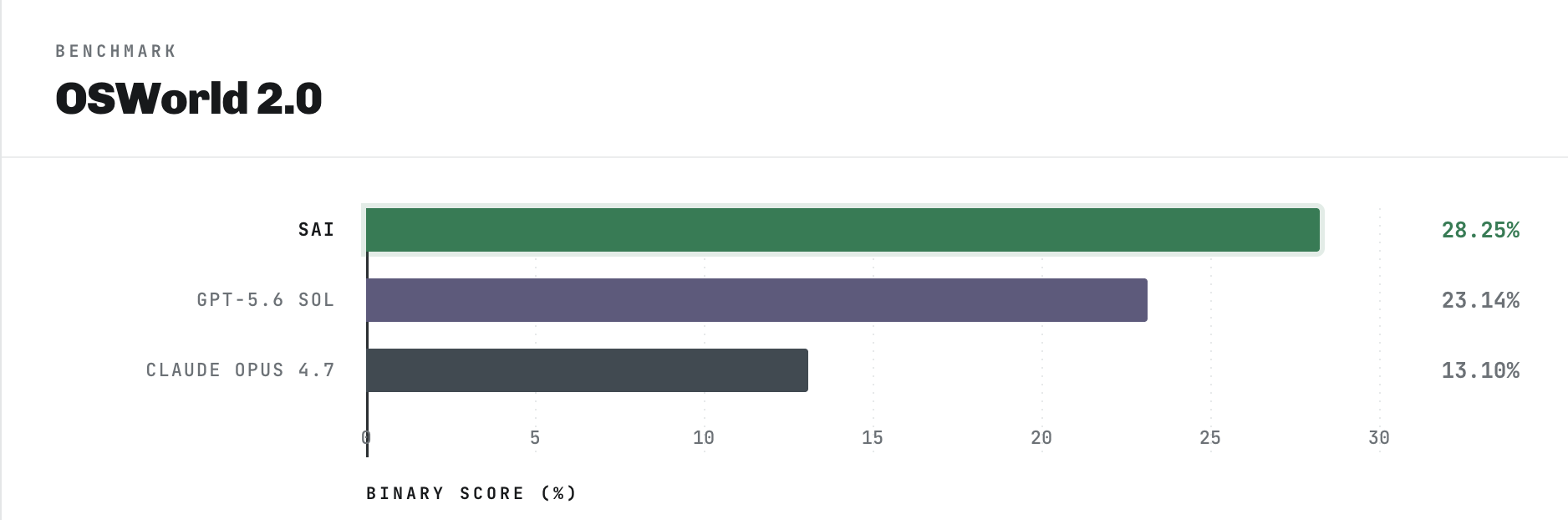
Binary success rate on OSWorld 2.0. Sai scores 28.25%, compared with 23.14% for GPT-5.6 Sol and 13.10% for Claude Opus 4.7.
Sai achieves this better outcome-cost tradeoff by:
- Neuro-symbolic planning: Sai uses ~1.5x fewer model calls on average than pure models by taking more actions per turn, using Simulang code as a powerful symbolic language for planning and executing longer subtasks.
- Efficient caching and memory: Sai keeps the input size bounded by adaptive summarization and maintains a constant prompt prefix for as long as possible before summarization. Planning in code lets Sai maintain and access critical task information in runtime memory across the full run of a task.
- Model orchestration: Sai invokes specialist models and interfaces for localizing UI elements, pure reasoning, and verification, thereby avoiding expensive models for steps where the full task context is unnecessary.
See it work: Where the score comes from
Two tasks showing Sai, GPT 5.6 Sol and Opus side by side, measured for reliability and efficiency.
1. Task 68: Chrome Dino Game
The agent has to play Chrome Dino, a repetitive real-time game, and clear a score target on a live page. Scoring is pass/fail on the final score, and all three agents scored 1.0, so what actually separates them is the cost of getting there. Sai finished in 23 model turns, Sol needed 46, and Opus 4.7 took 201.
Sai treated a repetitive real-time game as a programming problem instead of a clicking problem. Sai measured the ground line, the obstacle speed, and its own input latency from raw pixels, then wrote a control loop that captures the screen, detects obstacles, and jumps, and ran that loop on the VM inside a single execute call. Four versions of the code and 23 turns produced a 93-second run with 96 clean jumps and a final score of 768, nearly six times the target, and Sai read the score back off the page before it called the task done.
By contrast, Sol reached the same idea and then typed its bot into a terminal keystroke by keystroke through pyautogui.typewrite, spending five full rewrites on it. Opus 4.7 gave up on playing entirely, opened DevTools, set the game's score variable to 150 by hand, and sent it to the server. That score was written, not earned. The older evaluator passed it, but the current one zeroes any run that touches DevTools.
2. Task 28: Vaccine booking
Task 28 involves getting an email about required immunizations, a scanned vaccination record on the desktop, and a booking site with price, distance and date constraints. The requirements also state a Hepatitis B dose-spacing rule: dose 3 must come at least 16 weeks after dose 1 and at least 8 weeks after dose 2. The record shows three doses given 70 and 40 days apart, so a fourth booking is due. Sai scored 1.0, Opus 4.7 scored 0.4, and Sol scored 0.0.
Sai extracted rather than transcribed. Sai ran pdftotext on both PDFs and re-rendered the scanned record at 300 dpi to read the handwritten entries, then held the patient's details as data (BUYER = { name: "Jeniffer", … }) and typed that variable into every form. Sol read the same PDF visually in Document Viewer and re-typed "Jennifer" from memory four times, and the site accepted it silently.
Sai also read the requirements as rules, not as a checklist. The dose-interval condition is a computation over dates, and Sai treated it as one. Opus 4.7 counted three doses, wrote "Hepatitis B: ✓ Complete," and quietly dropped a quarter of the task. Before declaring done, Sai re-read all four booking JSONs from ~/Downloads and printed vaccine, clinic, date, time and price to confirm each one matched. Sol's own confirmation page read "Booking Successful — Name: Jennifer" and it never compared that back to the source. Opus 4.7 dumped its JSONs too, but only three existed, and it still wrote a summary claiming everything was booked.
Sai is for everyone, not just a lab result
Since 2023, Simular has been researching and pushing the frontier of Computer Use Agents (CUA). In December 2025, Agent S, Simular’s open-source CUA, became the first to reach human-level performance on OSWorld 1.0, scoring 72.6% against a human baseline at 72.36%.
Our research team builds and open-sources the Agent S family of frameworks, and our product team ships Sai, a computer agent that runs on its own cloud desktop and does real jobs for real customers. That combination keeps our research grounded in economically valuable work instead of demos. It also means we understand the entire stack of a computer agent: the models, the planning and grounding, the scripting layer, the virtual machines the agent runs on, and the user interface.
Today, there’s a gap between benchmark performance and real-world production needs. Simular and others have surpassed the human success rate on OSWorld 1.0, and now Sai leads OSWorld 2.0 – yet human-level speed, cost, and reliability remain our north star to be achieved. Benchmarks report pass@k, or success across independent attempts; but real work demands consistent success every time, even on the hundredth run. That gap is the problem our neuro-symbolic approach is built for.
Most work is repetition. Sai's strength is carrying out routine tasks reliably and cheaply: summarizing your inbox every morning, filing a month's worth of invoices. Our neurosymbolic method pairs the exploratory power of neural networks with the precision of symbolic code, resulting in reliability and cost saving. Once Sai completes a new task once, the solution exists as robust code that replays the same way every time, so processing the hundredth invoice does not cost what the first one did.
We founded Simular to liberate humans from digital labor – the repetitive clicking, typing, and moving the cursor. Liberating people from digital labor takes an agent that is not just capable, but reliable and cost-efficient too. That is the standard we are building toward.
Acknowledgements
This work is the product of the entire Simular team. The research behind Sai, the product engineering, the evaluation infrastructure, and this write-up came from many hands, so we credit it the way it was built: together. Additional thanks to Darrow Hartman, who ran the full OSWorld 2 evaluation behind these results.
自律型コンピュータを構築しても、人間が置き換えられるわけではありません。それは協力を意味する。
コンピューターから手を離してください。Simular を今すぐ無料でダウンロードしてください。
