
Oops! Something went wrong while submitting the form.

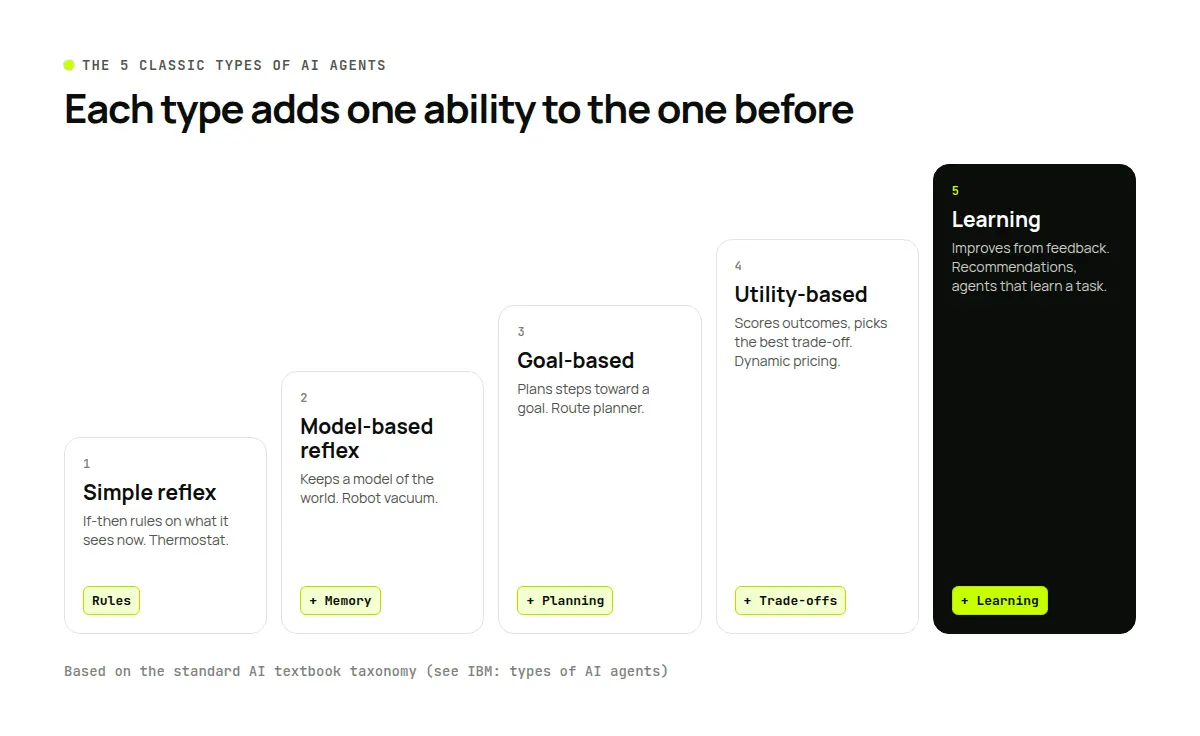
There are five classic types of AI agents: simple reflex agents, model-based reflex agents, goal-based agents, utility-based agents and learning agents. They're sorted by how much an agent remembers, plans and improves, and each type adds one ability to the one before it. Today's AI agents, the ones that run on large language models, are also grouped by what they work on: chat assistants, API and workflow agents, browser agents, computer-use agents, coding agents and multi-agent systems. Most modern agents combine several classic types at once.
This guide draws on IBM's overview of AI agent types, the OSWorld benchmark and Simular's own published results and product pages; each source is linked at the end.
We explain the types of AI agents through:
| Type | How it decides | Memory | Plans ahead | Learns | Everyday example |
|---|---|---|---|---|---|
| Simple reflex | Fixed if-then rules on what it sees now | None | No | No | Thermostat |
| Model-based reflex | Rules plus an internal model of the world | Tracks past state | No | No | Robot vacuum that maps rooms |
| Goal-based | Searches for actions that reach a goal | Yes | Yes | No | Route planner |
| Utility-based | Scores outcomes and picks the best trade-off | Yes | Yes | No | Dynamic pricing, ride matching |
| Learning | Improves its behavior from feedback | Yes, and it updates | Yes | Yes | Recommendation system, agents that learn a task |
An AI agent is a system that perceives its environment, decides what to do, and acts to reach a goal. The environment can be a room (a robot), a road (a self-driving car), a market (a trading system), a website or a whole computer (a software agent).
Every agent, simple or advanced, has the same basic parts:
The five classic types differ in that decision rule: whether it looks only at the present, keeps track of the past, plans toward a goal, weighs trade-offs, or learns from experience.
A simple reflex agent follows condition-action rules: if this, then that. It looks only at what it senses right now and ignores everything that happened before. There's no memory, no model of the world and no plan; just a lookup from situation to action.
How it works. The agent reads its sensors, finds the first rule whose condition matches, and does the action. A thermostat's whole "mind" is two rules: if the room is below the set temperature, turn the heat on; if it's above, turn it off.
Strengths. Simple reflex agents are fast, cheap, easy to test and completely predictable. When the environment is fully visible and stable, they're often the right answer, and they're still everywhere in software and hardware.
Limits. With no memory, they can't handle situations where the right action depends on history, and they repeat the same mistake forever if their rules don't fit a new case. A simple reflex robot that bumps into a wall and always turns left can get stuck in a corner.
Common use cases:
A model-based reflex agent still acts on rules, but it keeps an internal model of the world: a record of what it has seen and how the world tends to change. That lets it act sensibly even when it can't see everything at once.
How it works. Each time it senses something, the agent updates its internal state ("the kitchen is already clean," "there's a chair at this spot"), then applies its rules to that state rather than to the raw reading. The model answers two questions: how does the world change on its own, and how do my actions change it?
Strengths. It handles partly observable environments, where the current reading alone isn't enough. It avoids redoing work and can react to things it saw earlier but can't see now.
Limits. It still reacts rather than plans. It doesn't think several steps ahead or choose between competing goals, and its behavior is only as good as its model; if the model is wrong, it confidently does the wrong thing.
Common use cases:
A goal-based agent chooses actions by asking: will this get me closer to the goal? Instead of reacting one step at a time, it considers sequences of actions and picks a sequence that reaches the goal. This is where planning and search come in.
How it works. The agent has a description of the goal state ("arrive at the airport," "all receipts entered"), a model of what each action does, and a search or planning method to find a path from here to there. If something changes along the way, it re-plans.
Strengths. Foresight. Goal-based agents handle multi-step tasks, and you can change their behavior by changing the goal rather than rewriting rules. Most "do this task for me" AI agents are goal-based at heart.
Limits. Goals are binary: reached or not. A goal-based agent has no built-in sense that one route is faster, cheaper or safer than another, so it may take a valid but poor path. Planning can also be slow when there are many possible actions.
Common use cases:
A utility-based agent scores possible outcomes with a utility function (a measure of how good each outcome is) and chooses the action with the best expected result. It doesn't just ask "does this reach the goal?" but "which way of reaching it is best, given everything I care about?"
How it works. The agent predicts the outcomes of different actions, scores each outcome on the factors that matter (time, cost, risk, comfort, revenue), weighs those factors, and picks the highest-scoring option. When outcomes are uncertain, it weighs them by how likely they are.
Strengths. Good decisions when there are competing goals or trade-offs, and when nothing is perfect. It can choose a slightly slower route that's much cheaper, or decline a sale that would hurt more than it helps.
Limits. A good utility function is hard to design. If the score leaves out something that matters (fairness, safety, a customer's trust), the agent will optimize the wrong thing very efficiently. Scoring many options can also be expensive.
Common use cases:
A learning agent gets better with experience. Instead of relying only on rules or a fixed model written in advance, it observes how well its actions worked and changes its future behavior.
How it works. A learning agent has four parts:
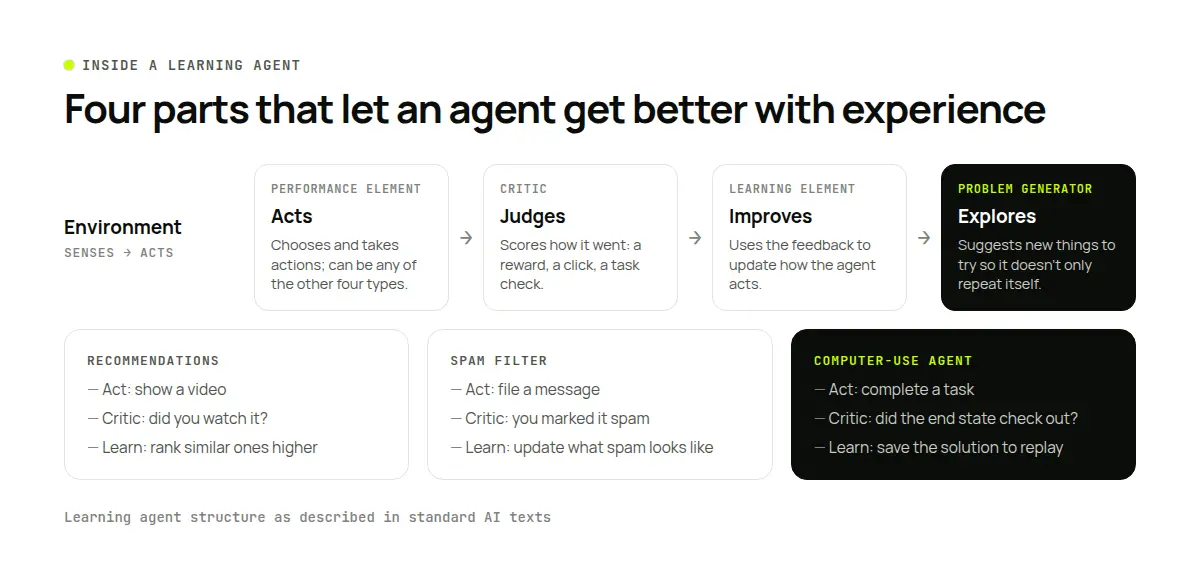
Strengths. Learning agents adapt to new and changing situations, and they can reach a level of skill nobody could hand-code. Over time they can also become cheaper to run, because they stop re-solving problems they've already solved.
Limits. They need feedback and time to improve, they can learn the wrong lesson from bad feedback, and what they learned can be harder to explain.
Common use cases:
| Type | Best when… | Use cases |
|---|---|---|
| Simple reflex | The situation is fully visible and the right response never changes | Thermostats, email rules, safety cut-offs, keyword bots |
| Model-based reflex | You can't see everything at once, but rules still work | Robot vacuums, smart home, network monitoring |
| Goal-based | The job has several steps and a clear end state | Route planning, warehouse robots, multi-step task agents |
| Utility-based | There are trade-offs between speed, cost, risk and quality | Pricing, dispatch, ad bidding, self-driving decisions |
| Learning | The environment changes or the task repeats often | Recommendations, fraud detection, agents that learn a workflow |
Complex jobs are often split across several agents, each doing what it's best at.
Common use cases include supply-chain planning, traffic-light coordination across a city, research-write-review pipelines for reports, and coding setups where one agent writes a change and another reviews it.
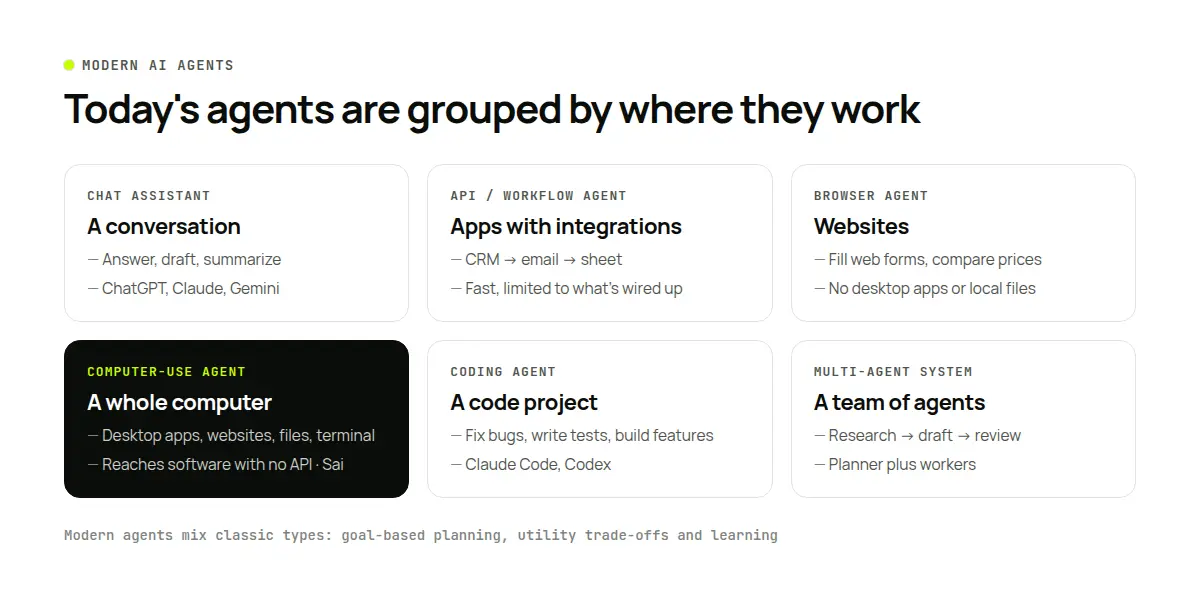
Large language models changed what agents can do: they read instructions in plain English, reason through steps, write code and decide which tool to use. Today's agents are usually grouped by where they work.
| Modern type | What it works on | Example jobs |
|---|---|---|
| Chat assistant | A conversation, sometimes with search or files | Answer, draft, summarize, explain |
| API and workflow agent | Apps with integrations | Move data between CRM, email and sheets |
| Browser agent | Websites | Fill a web form, compare prices |
| Computer-use agent | A whole computer: desktop apps, websites, files, terminal | Invoices across vendor portals, data entry in legacy apps |
| Coding agent | A code project and terminal | Fix a bug, write tests, build a feature |
| Multi-agent system | Several agents with roles | Research, then draft, then review |
Chat assistants like ChatGPT, Claude and Gemini are the starting point. On their own they answer and draft; with tools (search, files, connectors) they start to act like goal-based agents.
API and workflow agents connect apps that have integrations. They're fast and dependable for "when this happens there, do that here," but they stop at the edge of what's been integrated.
Browser agents operate websites the way a person would: reading pages, clicking, typing. They reach the long tail of the web but not desktop apps or local files.
Computer-use agents operate a whole computer through its graphical interface: desktop apps, websites, files and the terminal. They're the most general kind and can reach software with no API, which is why reliability (benchmarks like OSWorld) matters so much for them.
Coding agents such as Claude Code and Codex read a codebase, make changes, run tests and fix what fails.
Multi-agent systems combine several of these, for example a research agent, a writing agent and a reviewing agent passing work along.
Modern agents mix the classic types. A computer-use agent is goal-based (it plans toward the task), model-based (it keeps track of what's on screen and what it has done), utility-based (it weighs speed, cost and risk, and asks before risky steps) and, at its best, a learning agent (it gets better at tasks it has done before).
Sai, Simular's autonomous agent, is a computer-use agent that also behaves like a classic learning agent.

Sai has a free plan with daily credits; Pay as you go is $50/month and Sai Unlimited is $500/month (pricing). If you'd rather keep ChatGPT or Claude as the brain and just give it a computer, see Simular Box.
Several agents working together, often with a higher-level agent planning and others carrying out specific steps.
Thermostats (simple reflex), robot vacuums (model-based), route planners (goal-based), dynamic pricing (utility-based), recommendation systems and Sai (learning).
Checked Nov 25, 2026: IBM: types of AI agents, Sai, Sai pricing, Sai tops OSWorld 2.1, Simular Box.