Oops! Something went wrong while submitting the form.
Best Meta Muse Alternatives in 2026: 7 Screen-Action & Autonomous Computer-Use Agents Tested
When evaluating Meta Muse alternatives, the central question for modern enterprise operations and high-growth teams is no longer whether a multi-modal model can recognize a button on a display. In 2026, teams are testing whether an autonomous computer-use agent can reliably execute complex, multi-application workflows—navigating local operating systems, ERPs, SaaS dashboards, and terminal environments—without drifting, hallucinating actions, or creating massive infrastructure overhead.
Meta’s unveiling of Muse (and its vision-grounded OS actuation architecture) represented a massive leap forward for foundational multimodal models interacting with graphical user interfaces (GUIs). By translating screen perception directly into $(x, y)$ coordinate clicks, keyboard strokes, and shell commands, Meta Muse validated the category of general-purpose computer use.
However, as B2B teams and operations leaders move from experimental research to production deployment, clear operational trade-offs emerge:
Foundational Model vs. End-to-End Enterprise Product: Meta Muse provides a powerful base research architecture, but enterprise operations require turnkey workflow persistence, fine-grained access control, remote multi-channel delegation, and unified human-in-the-loop governance.
The Dual-Engine Imperative: Running pure pixel-based vision models for every step is computationally expensive and slow. Production workloads demand an architecture that decouples fast background code/file execution from GUI manipulation.
Deterministic Replays vs. Stochastic Exploration: When an operational workflow runs on a recurring schedule (e.g., daily financial reconciliation or CRM hygiene), teams need self-improving, replayable skills that execute with 99%+ reliability rather than re-exploring the interface from scratch every time.
Below is our comprehensive benchmark of the top seven Meta Muse alternatives in 2026, evaluated across benchmark reliability, execution runtime, enterprise security, and B2B readiness.
How we evaluated
Comparison Summary
Platform
Architecture & Runtime
Target Persona
Core Differentiator vs. Meta Muse
Starting Pricing
Sai (by Simular)
Dual-Engine (Isolated Linux Sandbox + Persistent Dedicated Workspace VM)
Operations Leads, RevOps, SMBs & Enterprise Teams
#1 on OSWorld Benchmark; Turnkey autonomous (robo)secretary; Self-healing replayable skills; Zero-trust isolated credential input; Multi-channel mobile delegation (SMS/Telegram)
Free tier available; Pro at $50/mo; Ultimate at $500/mo; Custom Enterprise
Anthropic Claude Computer Use
Raw Model API / Developer-Orchestrated Docker Containers
AI Engineers & Python Developers
Direct API-level integration with Claude 3.7 / 3.5 Sonnet reasoning; highly customizable prompt scaffolding
Pay-as-you-go per API token & screenshot
Adele (Adept / Amazon AGI)
Action Transformer Cloud Agent
Enterprise IT & Workflow Architects
Specialized action-transformer foundation model tuned specifically on enterprise SaaS navigation
Custom enterprise contracts
OpenAI Operator
Cloud Browser Sandbox (Web only)
Knowledge Workers & ChatGPT Pro Users
Tight native ChatGPT ecosystem integration; frictionless browser-based research and booking
Bundled in ChatGPT Pro ($200/mo)
UiPath Agentic Automation
Enterprise Client/Server RPA Orchestrator
Fortune 500 Enterprise Automation Centers of Excellence (CoE)
Decade-long legacy system connectors; strict compliance governance and deep IT policy management
Annual tiered enterprise contracts
Browserbase + Stagehand
Managed Headless Browser Cloud + SDK
Full-Stack Developers & Growth Engineers
High-concurrency cloud browser infrastructure with built-in CAPTCHA solving and session replays
Usage-based per browser hour
Manus AI
Sandboxed Ephemeral Cloud VM (Web & Code)
Prosumers & General Knowledge Workers
Wide-scope autonomous research synthesis with clean conversational task planning
Freemium / Credit-based tiers
The 7 Best Meta Muse Alternatives in 2026
1. Sai (by Simular) — Best Overall Autonomous (Robo)Secretary for B2B Operations
Best For: Operations managers, founders, revops teams, SMBs, and enterprise business units needing an autonomous computer-use agent that executes complex cross-app screen workflows with zero babysitting.
Saiis built by Simular as a dedicated autonomous computer-use agent designed specifically to take over repetitive screen and shell work. While Meta Muse demonstrates how foundational multi-modal models can control interfaces, Sai delivers a production-grade, end-to-end system engineered for day-to-day business execution.
Core Architectural Differentiators vs. Meta Muse:
OSWorld Benchmark Leader (#1 Globally): Rigorous academic benchmarks matter when delegating mission-critical work. Simular’s underlying computer-use architecture holds the #1 rank on the global OSWorld benchmark, proving unmatched reliability when handling complex OS navigation, multi-window switching, and realistic software operations.
Dual-Engine Architecture (Sandbox + Dedicated Workspace): Sai separates headless computational tasks from visual desktop actions. When a task involves data parsing, PDF text extraction, or batch shell scripts, Sai executes in an instant, lightweight Linux sandbox. When GUI navigation is required, Sai drives a persistent dedicated computer with full mouse, keyboard, and accessibility-tree precision.
Self-Healing Replayable Skills: Unlike purely exploratory agents that reinvent the wheel on every prompt, Sai compiles successful trajectories into reusable, parameterized skills. If an application updates its button layout, Sai automatically detects the shift and self-heals the execution path.
Zero-Trust Credential Security: Through an isolated client-side evaluation boundary, users can safely authorize passwords, two-factor OTPs, and API credentials into target forms without exposing sensitive plaintext to the LLM context.
Remote Mobile Delegation: Operations teams can trigger, monitor, and approve tasks directly through Telegram, SMS, or iMessage. When Sai finishes, deliverables are packaged into downloadable artifacts, structured charts, or synced to cloud storage.
B2B Team & Enterprise Solutions:
For organizations looking to deploy autonomous computer agents across departments:
Discover howSai for Teamsprovides collaborative delegation across shared operational workspaces.
Explore how Sai for Small Businesses automates administrative, invoicing, and operational overhead.
Learn how Sai for Enterprise delivers sovereign cloud isolation, SOC2/HIPAA compliance, and enterprise governance.
Free Tier: Free daily computer time to experience autonomous screen delegation.
Pro ($50/mo): Designed for individual operators running regular automated workflows.
Ultimate ($500/mo): High-performance tier with dedicated machine power for heavy operational workloads.
Enterprise: Custom dedicated clusters, private runner deployment, and enterprise SLAs.
2. Anthropic Claude Computer Use — Best for AI Engineers Building Custom Pipelines
Best For: Developers and machine learning engineers looking for raw API access to build custom containerized computer-use agents.
Anthropic’s Computer Use feature (available via the Claude 3.5 and 3.7 Sonnet API) provides low-level model primitives that analyze screen captures and emit coordinate-based mouse and keyboard commands.
Strengths:
Exceptional Reasoning: Industry-leading multimodal reasoning for diagnosing visual interface state.
Direct API Control: Developers can design custom screenshot sampling rates, coordinate scaling algorithms, and programmatic tool bridges.
Limitations
Heavy Development Burden: Anthropic provides the raw model API, leaving teams to build the surrounding execution infrastructure: VM orchestration, accessibility tree bridges, session persistence, and end-user interfaces.
Significant Token Costs: Continuously passing high-resolution screenshots into vision models across long-horizon tasks incurs substantial token costs without an integrated headless execution layer.
3. Adele (Adept / Amazon AGI) — Best for Specialized Enterprise SaaS Automation
Best For: Enterprise IT architects automating deep legacy SaaS workflows in Salesforce, Workday, and SAP.
Originally pioneered by Adept AI and continued under Amazon AGI, Adele focuses on Action Transformers—models explicitly pre-trained on software interface actuation rather than general conversational text.
Strengths:
SaaS-Specific Pre-training: Highly optimized for complex enterprise web applications with deeply nested menus and complex data tables.
Enterprise Security Mindset: Structured from the ground up for strict corporate data compliance.
Limitations:
Restricted Access: Primarily accessible via high-touch enterprise pilots and AWS partnerships, making it unavailable for fast-moving startups or self-serve operational teams.
4. OpenAI Operator — Best for Consumer Web Tasks & ChatGPT Subscribers
Best For: Individual knowledge workers needing ad-hoc web research, flight booking, and consumer transaction automation.
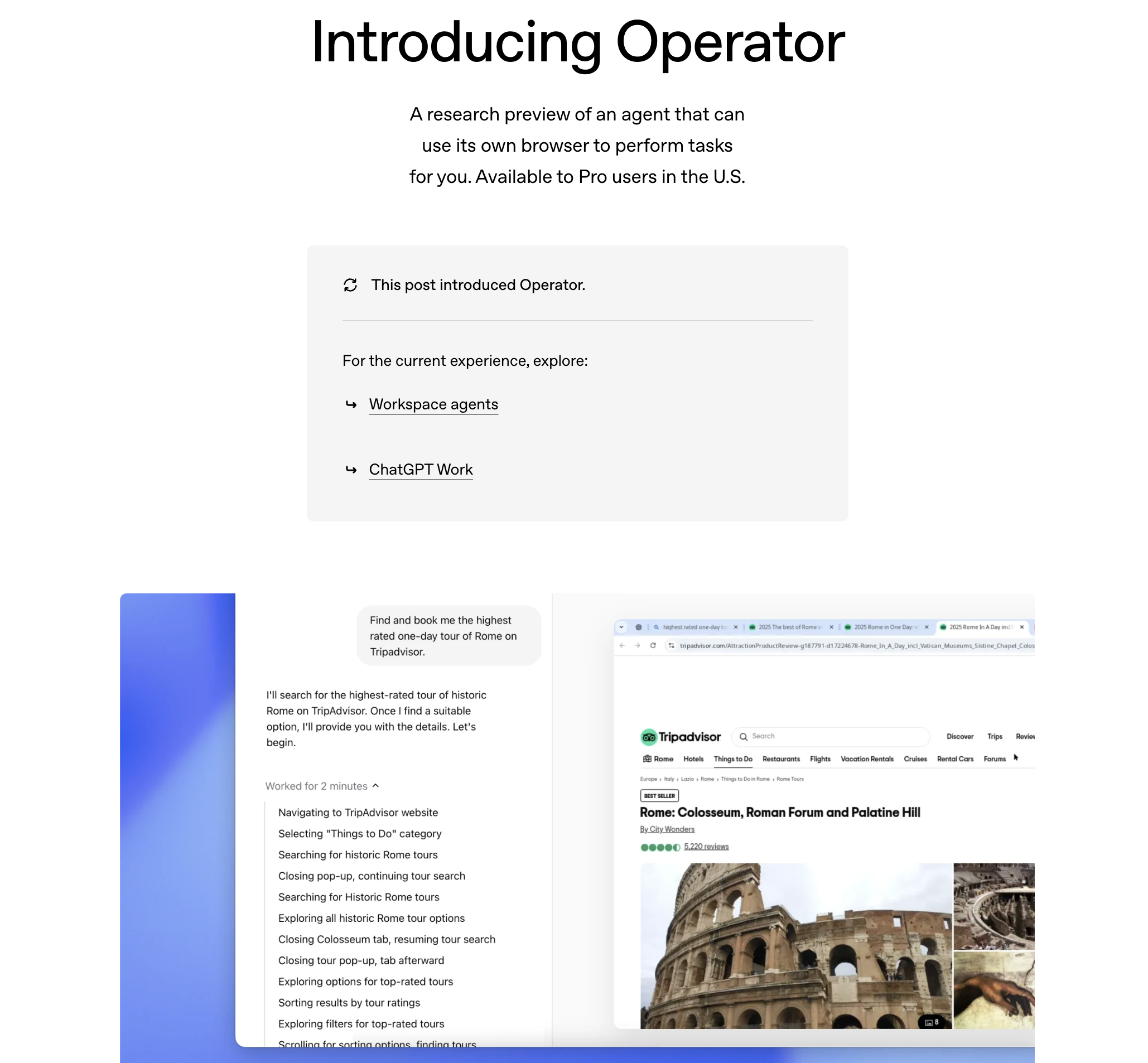
Integrated into ChatGPT Pro, OpenAI Operator uses a managed cloud browser to autonomously navigate the web, fill out travel booking forms, and compile product comparisons.
Strengths:
Turnkey Consumer Experience: Frictionless side-by-side browser view integrated directly into the ChatGPT interface.
Conversational Refinement: Easily steer tasks mid-execution through natural conversational feedback.
Limitations vs. Sai & Muse:
Web-Only Sandbox: Cannot interact with native desktop applications, local spreadsheets, developer terminals, or local file systems.
No Workflow Replays: Does not compile recurring tasks into deterministic, reusable skills.
5. UiPath Agentic Automation — Best for Fortune 500 RPA Modernization
Best For: Enterprise IT centers of excellence seeking to infuse traditional RPA bots with dynamic multi-modal reasoning.
UiPath bridges traditional rule-based enterprise RPA with modern generative AI agents, allowing companies with existing robot deployments to handle dynamic GUI exceptions.
Strengths:
Comprehensive Enterprise Governance: Deep role-based access control, SOC2/ISO audit logging, and battle-tested enterprise connectors.
Hybrid Determinism: Blends fast, cheap legacy RPA selectors with generative vision models when unexpected UI changes occur.
Limitations:
High Total Cost of Ownership: Requires certified RPA developers, complex server infrastructure, and substantial annual enterprise licensing.
6. Browserbase + Stagehand — Best for Headless Cloud Browser Infrastructure
Best For: Software engineers and growth hackers automating browser-only workflows at scale.
Browserbase provides managed, high-concurrency cloud browser instances with built-in CAPTCHA solving, while Stagehand is an open-source framework for automating web tasks via Playwright and LLMs.
Strengths:
Developer-First SDK: Seamlessly combines structured DOM extraction with natural-language actuation.
Enterprise Browser Infrastructure: Automated proxy rotation, anti-bot bypass, and session video recording.
Limitations:
No Desktop or OS Access: Confined strictly to Chromium-based web browser sessions.
7. Manus AI — Best for Open-Ended Conversational Research
Best For: Knowledge workers and researchers delegating wide-scope desk research and content synthesis.
Manus AI gained rapid attention for its ability to plan multi-phase research projects, execute web searches, and compile deliverables within a cloud sandbox.
Strengths:
High-Autonomy Planning: Strong multi-agent task breakdown for open-ended informational queries.
Clean Deliverable Packaging: Automatically formats research reports and downloadable summaries.
Limitations:
No Persistent Desktop Environment: Sessions are typically ephemeral and lack deep integration with local files or desktop software.
Stop doing repetitive tasks. Let Sai handle them for you.
Sai is your AI computer use agent — it operates your apps, automates your workflows, and gets work done while you focus on what matters.