Oops! Something went wrong while submitting the form.
Competitor Price Tracking Tools in 2026: 8 Platforms Tested for Real-Time Monitoring, Dynamic Repricing & Autonomous Scraping
When e-commerce brands, retail directors, DTC brand executives, and revenue managers evaluate competitor price tracking tools (frequently searched alongside competitor price monitoring software, price comparison tools for ecommerce, or retail pricing intelligence platforms), they confront a major operational shift in 2026: the death of brittle web scrapers and the rise of autonomous pricing intelligence.
In modern retail and multi-channel commerce, price is the single most decisive conversion lever. Over 70% of digital shoppers compare prices across Google Shopping, Amazon, Walmart, and independent brand stores before purchasing. Competitors adjust prices multiple times a day using automated repricers and algorithmic discount cadences. If your operations team relies on manual price checks, weekly spreadsheet audits, or generic web scraping scripts, you are perpetually reacting to market shifts after customer volume has already been lost.
However, traditional competitor price tracking software suffers from systemic vulnerabilities:
Brittle CSS / XPath Scraping Selectors: When a competitor redesigns their product detail page (PDP), modifies a discount badge, or changes their DOM layout, traditional scrapers break silently, delivering stale or corrupted pricing data.
Aggressive Bot Detection & Anti-Scraping Walled Gardens: Enterprise marketplaces (Amazon, Target, Walmart) and direct-to-consumer storefronts increasingly deploy Cloudflare Turnstile, Datadome, and Akamai perimeter defenses. Rigid scraping bots get blocked immediately, resulting in empty data feeds.
Hidden Discounts & Cart-Level Pricing Blindspots: Competitors increasingly mask their true lowest prices behind "Add to Cart to See Price", coupon toggle checkboxes, localized postal code lookups, or tiered volume thresholds that simple HTTP scrapers cannot penetrate.
Disjointed Execution: Traditional price monitoring tools stop at alerting: they send an email alert or update a dashboard, leaving a human merchant to manually log into Shopify, Amazon Seller Central, or ERPs to recalculate margins and adjust listing prices.
In 2026, the competitor price tracking landscape has consolidated into distinct operational paradigms:
Enterprise eCommerce Intelligence & MAP Compliance Clouds monitoring catalog-wide pricing across global digital shelves (e.g., Wiser Solutions, Intelligence Node).
High-Speed Cloud Repricers & Dynamic Matchers designed for mid-market merchants seeking automated margin-based rule repricing (e.g., Prisync, Price2Spy).
Enterprise Omnichannel Pricing & Retail Analytics Suites tailored for global brands and multi-tier distributor networks (e.g., Minderest, Competera).
Specialized E-Commerce Marketplace Repricers engineered specifically for Buy Box dominance on Amazon and Walmart (e.g., Informed.co).
Autonomous Screen-Action Computer-Use Agents (like Sai) that fundamentally transcend rigid scraping bots—operating web browsers, native desktop apps, and internal inventory ERPs with human-grade visual cognition, self-healing element tracking, and end-to-end autonomous repricing execution with zero human babysitting.
This guide benchmarks the top eight competitor price tracking platforms in 2026 across these operational paradigms, evaluating how each tool delivers data accuracy, anti-blocking resilience, and measurable margin optimization.
How we evaluated
To deliver an objective, data-backed evaluation for commercial decision-makers, our testing framework evaluated each platform across five standardized operational criteria:
Data Extraction Reliability & Anti-Bot Resilience: We benchmarked how effectively each tool scrapes competitor storefronts without getting blocked by Cloudflare, Datadome, or PerimeterX. When a competitor redesigns their website layout or modifies HTML tags, does the tool crash, or can it visually identify the price tag?
Complex Pricing Coverage: Can the platform capture non-standard pricing elements—such as "Add to Cart for Price" promotions, clip-on coupon checkboxes, localized regional shipping variations, membership tier pricing, and volume bundle discounts?
Automated Repricing & Downstream Integration Depth: Does the software stop at passive dashboard reporting, or does it offer closed-loop integration—automatically adjusting product prices in Shopify, Amazon Seller Central, Magento, or ERP inventory systems based on configurable margin guardrails?
Total Cost of Ownership & SKU Volume Economics: We analyzed pricing transparency: per-SKU monitoring costs, scrape frequency upgrade fees (daily vs. hourly vs. real-time), API call limits, and hidden enterprise onboarding retainers.
Operational Autonomy & Asynchronous Delegation: Can commercial teams delegate recurring competitive price audits, margin compliance checks, and cross-channel catalog matching asynchronously from mobile channels (Telegram, SMS) without manual human monitoring?
Comparison Summary
Platform
Operational Paradigm
Key Strengths
Primary Operational Bottleneck
Starting Pricing
Sai (by Simular)
Autonomous Screen-Action & Computer-Use Coworker
#1 on OSWorld Benchmark; operates browser and desktop applications via virtual mouse and keyboard; bypasses anti-bot defenses through genuine browser execution; captures hidden cart discounts; updates ERPs/Shopify directly; self-healing replays
Engineered for multi-step visual cognitive execution and cross-app workflows rather than serving as a raw millisecond HTTP proxy firehose
Free tier available; Pro at $50/mo; Ultimate at $500/mo; Custom Enterprise
User-friendly dashboard; automated dynamic repricing rules; native Shopify, Magento, and Google Shopping integrations; stock status monitoring; multi-currency support
Daily scrape frequency on entry plans (hourly requires premium tier); struggles with highly dynamic JS single-page applications or complex cart popups
Professional at $99/mo (100 products); Premium at $199/mo (1,000 products); Platinum at $399/mo
High data accuracy (>99%); automated product matching via AI; marketplace and distributor monitoring; promotional cadence tracking; dynamic pricing engine
Steeper learning curve; high minimum entry price points focused primarily on mid-to-large European and North American enterprise retailers
Custom quote based on SKU catalog and update frequency (typically $500+/mo)
Proprietary AI product matching across 3.5B+ products; 99% data precision; real-time competitive price feeds; automated MAP monitoring; digital shelf visibility
Heavy enterprise focus; high implementation investment; complex configuration for specialized niche e-commerce categories
Custom enterprise pricing tailored to retail scale and data feed frequency
Strictly limited to third-party marketplaces; cannot track prices across independent competitor DTC storefronts or custom B2B portals
Starts at $99/mo (up to $10k monthly revenue); scales dynamically based on GMV
Detailed Platform Reviews
1. Sai (by Simular) — Best for Autonomous End-to-End Price Auditing & Screen-Action Repricing
Best For: E-commerce directors, retail operations leads, Amazon brand managers, and DTC founders who need an autonomous (robo)secretary that doesn't just scrape static HTML tags, but actively drives real browsers, navigates complex anti-bot defenses, penetrates hidden cart promotions, and directly executes price updates across Shopify, Amazon Seller Central, and ERPs with zero human babysitting.
Traditional competitor price tracking software operates under major structural constraints: when competitors implement Cloudflare Turnstile, hide discounts behind "Add to Cart" popups, or alter their website HTML layouts, standard scrapers fail. Sai eliminates these vulnerabilities through autonomous computer-use execution.
Ranked #1 on the global OSWorld benchmark, Sai is an autonomous AI coworker equipped with its own virtual mouse, keyboard, browser, and terminal. Instead of relying on brittle CSS selectors or generic proxy pools, Sai perceives websites visually—viewing product detail pages, reading rendered text via visual-language model (VLM) grounding, interacting with dynamic JavaScript dropdowns, and navigating complex storefronts exactly like a human market researcher.
How Sai Solves Real-World Pricing Bottlenecks:
Penetrating Hidden Cart & Coupon Pricing: Competitors frequently mask their true pricing to avoid MAP violations or scraping detection by requiring shoppers to "Add to Cart to See Price", select a specific variant, enter a zip code, or toggle a digital coupon checkbox. Traditional scrapers see only the MSRP; Sai autonomously adds items to the cart, applies available coupons, verifies the true checkout price, and logs out.
Unstoppable Anti-Bot Resilience: Because Sai drives a real browser instance on a dedicated cloud desktop VM using human-like mouse trajectories, organic scrolling, and genuine operating system inputs, it naturally bypasses the bot detection heuristics (Cloudflare, Datadome, PerimeterX) that block headless scrapers.
Dual-Engine Architecture (Instant Linux Sandbox + Persistent Desktop VM): Computationally heavy tasks—such as matching thousands of competitor SKUs against internal catalogs via fuzzy Python algorithms, calculating gross margins, or generating executive Excel comparison reports—execute in an ultra-fast, isolated Linux sandbox. When interactive browser navigation, authenticated distributor portals, or native desktop ERPs (NetSuite, SAP, Excel) are required, Sai seamlessly drives a dedicated cloud VM.
Self-Healing Replay Workflows: When a competitor redesigns their storefront, moves their price badge, or changes their checkout flow, traditional scraping scripts break. Sai uses visual-language grounding and semantic intent reconciliation to automatically identify the relocated price element, adapt its path, and self-heal the workflow without human engineering intervention.
Closed-Loop Repricing & Zero-Trust Security: Most price trackers stop at sending alerts, forcing merchants to manually update their stores. Sai completes the loop: after auditing competitor prices, Sai verifies your minimum margin thresholds and directly logs into Shopify, Amazon Seller Central, or your ERP to update listing prices. Corporate credentials and two-factor tokens are secured inside isolated zero-trust vaults, and operations leaders can trigger or approve pricing updates directly from Telegram or SMS.
Specialized B2B Team & Department Solutions:
Learn how Sai for Small Businesses allows lean e-commerce teams to maintain competitive price parity without expensive enterprise retail software.
Explore how Sai for Enterprise provides dedicated execution clusters, enterprise compliance controls, and scalable multi-catalog price monitoring.
Discover tailored vertical workflows designed specifically for Operations, Sales, and Marketing.
Pricing & Tiers:
Free Tier: Complimentary daily computer time to experience autonomous screen-action price tracking.
Pro ($50/mo): Ideal for DTC founders and e-commerce managers running regular competitor catalog audits and margin checks.
Ultimate ($500/mo): Engineered for high-volume retail brands managing multi-channel catalog scraping, complex cart checks, and automated ERP updates.
2. Prisync — Best for Cloud Competitor Price Tracking & Automated Dynamic Repricing
Best For: Small-to-medium e-commerce businesses, multi-brand online retailers, and DTC merchants looking for a clean, user-friendly SaaS platform that combines automated competitor price monitoring with rule-based dynamic repricing.
Prisync is one of the most widely deployed competitor price monitoring and dynamic repricing platforms for e-commerce brands. Built with a focus on simplicity and rapid onboarding, Prisync enables merchants to track competitor URLs, monitor stock availabilities, and automate price adjustments based on predefined margin formulas.
In-Depth Feature Analysis:
Automated Multi-Channel Price Tracking: Automatically scrapes competitor product detail pages across independent webshops and marketplaces up to three times daily on standard plans, extracting current prices and stock availability.
Dynamic Repricing Engine: Build granular repricing rules (e.g., "Always stay 2% cheaper than Competitor X, but never drop below a 25% gross margin floor"), automatically pushing updated prices to e-commerce storefronts.
Native E-Commerce Connectors: Offers turnkey integrations with major e-commerce platforms including Shopify, Magento (Adobe Commerce), and Google Shopping, minimizing manual API configuration.
Stock & Variant Disparity Alerts: Sends instant email and dashboard notifications when a competitor runs out of stock, allowing merchants to raise prices and capture higher margins during competitor stockouts.
Operational Limitations:
Scrape Frequency Paywalls: Lower-tier plans refresh pricing data only once or three times per day; obtaining near-real-time or hourly price monitoring requires upgrading to the expensive Platinum plan.
Struggles with Complex Dynamic Stores: Prisync relies on standardized HTML parsing; competitors utilizing complex JavaScript single-page applications, multi-tier login portals, or cart-level promotions frequently trigger scraping errors that require manual support ticket intervention.
Pricing Structure:
Professional ($99/mo): Track up to 100 products, daily updates, stock monitoring, API access.
Premium ($199/mo): Track up to 1,000 products, daily updates, dynamic repricing rules, marketplace tracking.
Platinum ($399/mo): Track up to 2,000 products, 3x daily updates, priority support, advanced analytics.
3. Price2Spy — Best for High-Flexibility Scraping Engine & MAP Enforcement
Best For: Manufacturers, brand owners, and mid-sized e-commerce distributors requiring flexible web scraping configurations, deep historical pricing analytics, and strict MAP (Minimum Advertised Price) violation monitoring.
Price2Spy is a veteran player in the competitive price intelligence industry, known for its powerful scraping architecture capable of crawling complex, difficult-to-scrape e-commerce websites across global geographies.
In-Depth Feature Analysis:
Advanced Scraping & Captcha Bypass: Employs rotating proxy networks, stealth browser sessions, and manual scraping fallback teams to monitor websites that actively implement anti-scraping measures.
MAP Violation Detection & Automated Reporting: Manufacturers can set strict Minimum Advertised Price boundaries; Price2Spy automatically captures timestamped screenshot evidence whenever a distributor or retailer advertises below MAP.
Granular Historical Reporting & Trend Analysis: Provides deep historical price trend charting, competitor discount cadence tracking, and price distribution heatmaps across multiple years of data.
Flexible Data Export & Webhooks: Connects to internal ERPs, business intelligence platforms, and custom databases via REST APIs, automated CSV/Excel email reports, and real-time webhooks.
Operational Limitations:
Outdated User Interface: The management dashboard feels utilitarian and complex, requiring a steep learning curve for non-technical retail merchandisers.
Manual URL Matching Setup: While Price2Spy offers automated product matching, configuring custom scrapers for specialized regional competitors often requires manual onboarding workflows and setup fees.
Pricing Structure:
Basic (starts at $26.95/mo): Tracking for up to 100 products, basic email alerts.
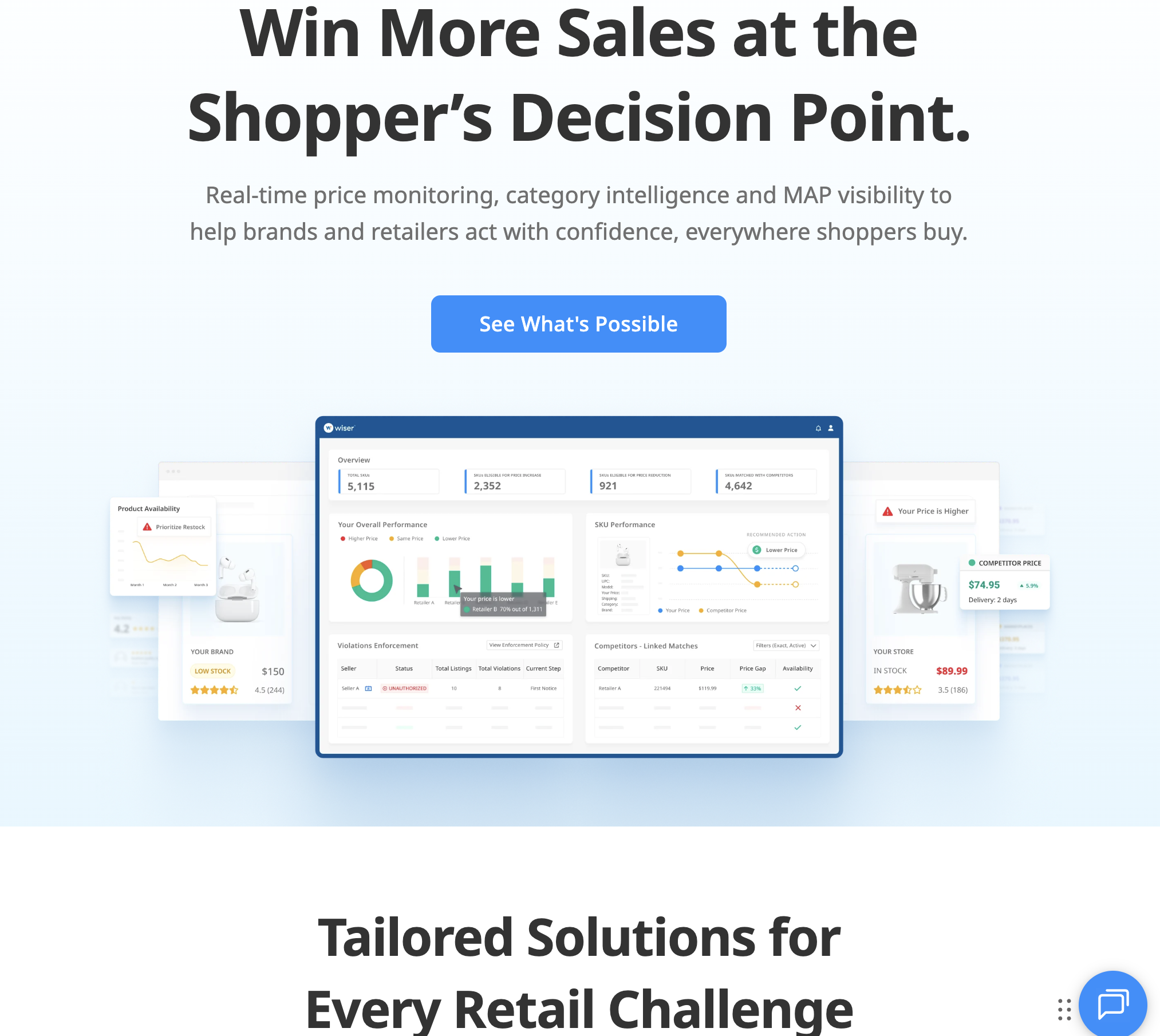
4. Wiser Solutions — Best for Enterprise Omnichannel Commerce Intelligence & In-Store Price Audits
Best For: Global enterprise brands, consumer packaged goods (CPG) manufacturers, and multi-channel retailers requiring unified visibility across both digital e-commerce storefronts and physical brick-and-mortar retail shelves.
Wiser Solutions is an enterprise-grade retail intelligence platform that uniquely bridges the gap between digital e-commerce price monitoring and physical brick-and-mortar shelf audits. By combining automated digital shelf crawlers with a crowdsourced network of physical in-store auditors, Wiser delivers a holistic picture of brand pricing compliance.
In-Depth Feature Analysis:
Omnichannel Price & Promotion Tracking: Continuously monitors competitor pricing across major global marketplaces (Amazon, Walmart, Target) alongside direct brand storefronts and localized dealer networks.
Crowdsourced Physical In-Store Audits: Leverages the "Mobee" crowdsourced shopper app to physically audit retail shelf prices, promotional endcaps, and out-of-stock compliance inside thousands of physical retail locations nationwide.
Automated MAP Compliance & Violation Evidence: Automatically logs unauthorized seller activity and price discounting violations, generating verifiable compliance dossiers for legal and commercial enforcement.
Assortment & Share of Voice Intelligence: Analyzes competitor catalog depth, promotional strategies, sponsored product rankings, and digital shelf positioning across competitive categories.
Operational Limitations:
Enterprise-Only Sales Model: Wiser does not offer self-serve onboarding or transparent monthly plans; prospective clients must undergo extensive enterprise sales calls and pilot agreements.
Substantial Financial Commitment: Annual contract minimums (frequently exceeding $15,000–$30,000/year) make Wiser cost-prohibitive for small and mid-market online merchants.
Pricing Structure:
Enterprise Pricing (Custom Quote): Tailored annually based on the total number of tracked SKUs, crawl frequencies, in-store audit geographic requirements, and enterprise analytics modules.
5. Minderest — Best for Retail Intelligence & Cross-Border Catalog Assortment Optimization
Best For: Mid-to-large enterprise retailers, European and North American multi-category distributors, and brand manufacturers requiring high-precision product matching and cross-border catalog assortment tracking.
Minderest is a leading retail intelligence and price monitoring platform widely utilized across European and North American retail enterprises. With a strong reputation for data accuracy exceeding 99%, Minderest excels at automated product matching across vast multi-category catalogs.
In-Depth Feature Analysis:
High-Precision AI Product Matching: Proprietary machine learning algorithms match identical and similar products across competitive catalogs using visual image recognition, EAN/UPC barcodes, brand titles, and technical specifications.
Dynamic Pricing & Price Elasticity Rules: Simulates the revenue and gross margin impact of price changes before deploying updates to e-commerce stores via automated API connectors.
Cross-Border & Multi-Currency Intelligence: Tracks competitor pricing across diverse international storefronts, accounting for localized VAT taxes, shipping tariffs, and currency fluctuations.
Distribution Channel & Distributor Monitoring: Enables manufacturers to monitor whether wholesale distributors and third-party retailers are complying with contractual pricing policies.
Operational Limitations:
Steep Learning Curve: The enterprise-focused interface contains extensive reporting tools, filtering rules, and data export parameters that require dedicated staff training.
Pricing Barriers for Emerging Brands: Lacks entry-level self-serve tiers, focusing primarily on established retail operations with substantial SKU counts.
Pricing Structure:
Custom Enterprise Pricing: Monthly SaaS subscriptions tailored to catalog size, number of tracked competitor domains, and crawl frequencies (typically starting around $500+/month).
6. Intelligence Node — Best for AI Digital Shelf Visibility & Real-Time Price Optimization
Best For: Fortune 500 retail enterprises, large-scale consumer electronics brands, and apparel conglomerates requiring real-time competitive pricing feeds across billions of retail data points.
Intelligence Node is a high-volume retail analytics and digital shelf intelligence platform that crawls vast amounts of global e-commerce data. Backed by proprietary machine learning models, Intelligence Node tracks over 3.5 billion products across 1,400+ enterprise categories.
Comprehensive Digital Shelf Auditing: Evaluates competitive product positioning, search query rankings, out-of-stock rates, review sentiment, and image compliance across global retailer websites.
Automated MAP & Counterfeit Seller Tracking: Identifies gray-market sellers, counterfeit listings, and unauthorized discounters on global marketplaces (Amazon, eBay, Alibaba).
Seamless Enterprise API Integration: Integrates directly with SAP, Oracle, and proprietary retail ERP systems to feed real-time pricing data into enterprise merchandising algorithms.
Operational Limitations:
High Implementation Complexity: Setting up custom category taxonomies and enterprise data connectors requires dedicated implementation engineering and consulting timelines.
Cost-Prohibitive for SMBs: Engineered strictly for high-tier retail enterprises with massive data requirements and dedicated merchandising teams.
Pricing Structure:
Custom Enterprise Contracts: Structured around enterprise data feed volume, API throughput limits, and digital shelf category scope.
7. Competera — Best for Algorithmic & Deep Learning Price Elasticity Modeling
Best For: Modern e-commerce retailers, multi-category department stores, and enterprise retail chains that want to move beyond simple "match the lowest competitor" rules toward deep-learning price elasticity optimization.
Competera is an advanced algorithmic pricing and retail intelligence platform. Rather than simply alerting merchants to competitor discounts, Competera uses deep econometric modeling to calculate price elasticity—helping businesses maximize gross margin rather than engaging in a destructive race to the bottom.
In-Depth Feature Analysis:
Deep-Learning Price Elasticity Engines: Analyzes competitive price movements alongside internal inventory levels, sales velocity, seasonality, and promotional cadences to calculate optimal price points for every SKU.
Margin Preservation Architecture: Prevents blind discounting by identifying which products require competitive price matching (traffic drivers) and which items can sustain higher margins without sacrificing conversion rates.
Promotional Effectiveness Analytics: Evaluates the real revenue and margin lift of competitor promotional events (e.g., "Buy One Get One", flash discounts), advising merchants on when to counter.
Automated Scenario Modeling: Allows merchandising executives to simulate the financial outcomes of different pricing strategies (e.g., revenue maximization vs. market share capture) before pushing updates live.
Operational Limitations:
Requires Substantial Historical Data: Competera’s econometric algorithms require significant historical sales transaction volume to train predictive models, making it unsuitable for newly launched stores.
Specialized Strategic Scope: Focuses primarily on predictive pricing algorithms rather than functioning as a lightweight scraper for one-off competitor audits.
Pricing Structure:
Custom Enterprise Licensing: Annual enterprise software agreements based on corporate revenue scale, SKU complexity, and AI modeling requirements.
8. Informed.co — Best for Automated Amazon & Walmart Marketplace Repricer
Best For: High-volume marketplace sellers, third-party Amazon FBA merchants, and Walmart Marketplace brands focused on winning the Buy Box and maximizing marketplace sales velocity.
Informed.co (formerly Appeagle) is a specialized algorithmic repricing software platform designed specifically for marketplace sellers. By connecting directly to seller APIs on Amazon, Walmart, and eBay, Informed.co recalculates and adjusts listing prices within seconds of competitive movements.
In-Depth Feature Analysis:
Algorithmic Buy Box Repricing: Proprietary repricing algorithms dynamically optimize listing prices to capture and maintain the Amazon and Walmart Buy Box while protecting minimum profit margins.
Velocity & Profit-Driven Strategies: Reprice based on inventory turnover goals (e.g., raise prices as stock dwindles to avoid stockouts, or drop prices to liquidate aging inventory before long-term storage fees kick in).
Multi-Marketplace Synchronization: Simultaneously reprices listings across Amazon (US, UK, EU, Japan), Walmart Marketplace, and eBay from a centralized management portal.
Margin & ROI Safeguards: Enforces strict minimum and maximum price thresholds, ensuring that aggressive algorithmic price wars never erode profitability below your cost-of-goods-sold floor.
Operational Limitations:
Confined Strictly to Marketplaces: Lacks capabilities to track or scrape independent competitor direct-to-consumer (DTC) storefronts, custom B2B supplier portals, or niche webshops.
GMV-Tiered Pricing: Subscription costs scale directly with your monthly gross merchandise value (GMV), becoming progressively more expensive as your revenue grows.
Pricing Structure:
Starter ($99/mo): For merchants generating up to $10k in monthly revenue; automated algorithmic repricing.
Growth ($149/mo): For merchants generating up to $50k monthly revenue.
Scale ($299/mo): For merchants generating up to $250k monthly revenue.
Enterprise: Custom pricing for merchants exceeding $250k monthly revenue.
Stop doing repetitive tasks. Let Sai handle them for you.
Sai is your AI computer use agent — it operates your apps, automates your workflows, and gets work done while you focus on what matters.