
Oops! Something went wrong while submitting the form.
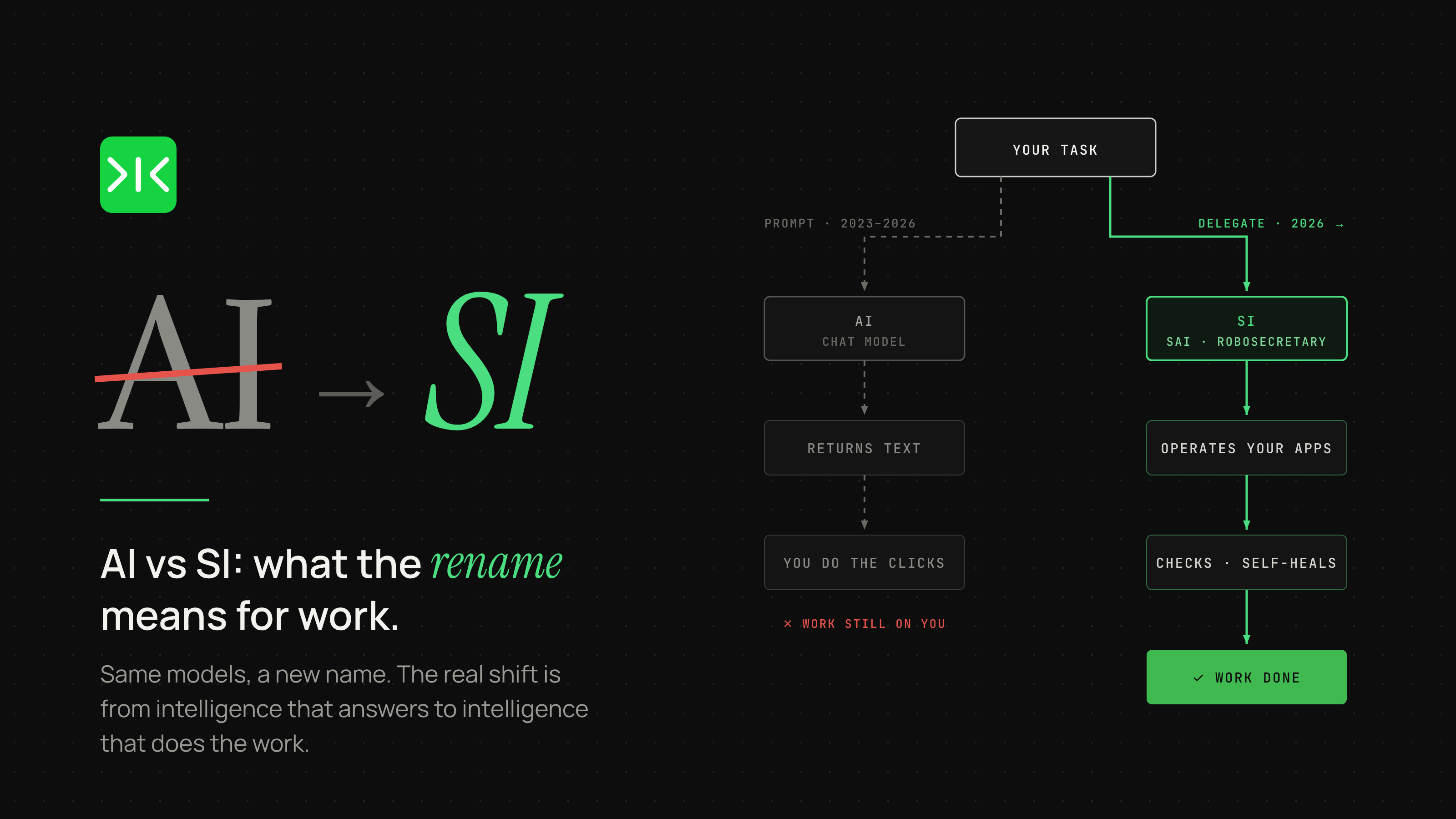
SI stands for Super Intelligence. On September 29, 2026, a White House executive order directed federal agencies to replace "AI" with "SI" in official communications. Legally, SI covers the same technology as AI. The practical difference for work is elsewhere: in the move from AI that answers to agents that act.
Key facts
The order is a vocabulary change for the executive branch. The White House argues the name "conveys the true capabilities of the technologies being developed today" (fact sheet).
It does not rewrite AI law. As IAPP notes, organizations will now manage two vocabularies: "SI" in federal materials, and "AI" in statutes, state laws, contracts and vendor questionnaires.
For businesses, Freshfields expects federal solicitations and forms to adopt the new term. A future statutory definition could shape incentives, export controls and compliance.
If SI and AI cover the same technology, the useful question is what changed in how that technology works. The answer: it moved out of the chat box and onto the computer. In this article, "SI-era" means agents that operate software to finish tasks, not models that only generate text.
1. From prompt engineering to task delegation.
Chat-era AI made the prompt the bottleneck. With an agent, you state the goal: "Pull competitors' annual pricing for three product lines and update our pricing sheet." The agent plans the steps, navigates the sites, handles pop-ups and saves the result.
2. GUI agency beyond the API walled garden.
API automation stops where the API stops. A GUI agent uses the screen, so it can reach vendor portals and decades-old desktop software. At Microsoft Build 2026, Sai ran an overnight claims-processing workflow inside a legacy app, with no APIs, on Windows 365 for Agents.
3. Muscle memory instead of reasoning from scratch.
A pure LLM agent pays full reasoning cost on every run. Simular's neuro-symbolic approach uses the model to discover a workflow, then replays it as code. Simular reports 90%+ token reduction and up to ~200x lower cost on repeated tasks. When the screen changes, the agent falls back to the model and repairs the routine.
4. Managed workspaces and human approval.
An agent should not roam your personal desktop. Sai for Enterprise runs on Entra-joined, Intune-managed Cloud PCs with a full audit trail. It is SOC 2 Type II and HIPAA compliant, supports zero data retention and bring-your-own-key encryption. Guardrails pause the agent before any irreversible action.
5. Reliability measured on long tasks.
Small error rates compound: 90% per-step accuracy over 10 steps gives about 35% end-to-end success. That is why long-horizon benchmarks matter. OSWorld 2.0, from the XLANG Lab, has 108 real-world tasks. Each takes a human a median of about 1.6 hours and averages 318 tool calls (paper). Sai scored a 73.0% partial score at $15.70 per task, ahead of Claude Opus 5 Max Thinking (70.6%, $23.70) and GPT-5.6 Sol Max (62.6%, $26.62). On binary full-task success, Sai scored 28.25%, versus 23.14% for GPT-5.6 Sol in Simular's comparison, a reminder that long tasks remain hard for every agent.
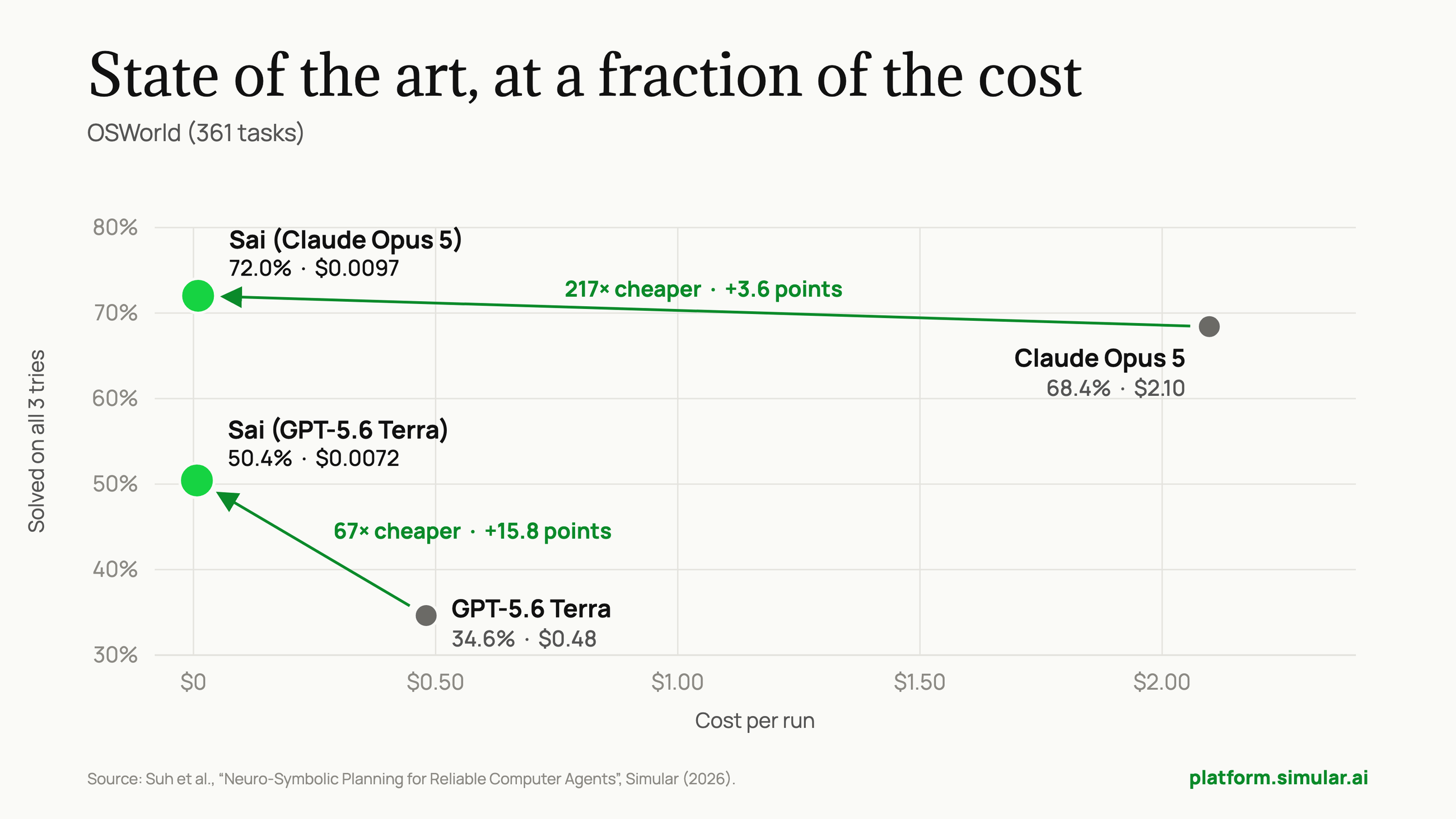
There is a gap between speculative superintelligence and software that reliably finishes tasks on a computer. Closing it takes three things: a dedicated computer to work on, eyes and hands on the interface, and execution reliable enough to trust.
Sai is built for that gap. It is a robosecretary: a computer-use agent that runs a fleet of autonomous computers and hands back finished work. The name was there before the order, but the fit is hard to miss: S + AI, read as SI. Our version of the tagline: Super intelligence, put to work.
Sai builds on Simular's open-source Agent S research. It is model-agnostic: bring your own key, an open-weight model, or an on-prem model. Small teams start with Sai for SMB. Larger organizations deploy Sai for Enterprise, with role-specific playbooks for finance, sales and marketing.